Four years ago, Salesforce's own customer data were scattered across 650 different data streams and 266 million fragmented profiles, so getting a complete customer picture felt impossible.. My guest today, Salesforce’s Chief Data Officer Michael Andrew, fixed that… and now he's rebuilding it all again for a new kind of customer: AI agents. #ad #SalesforcePartner
More on Michael Andrew:
• Has been at Salesforce for nearly 8 years, eventually growing into the CDO role.
• Has spent nearly three decades listening to customers through data and, at Salesforce, he runs one of the largest Data 360 deployments in the world.
• Previously held a range of analytics and data science leadership roles between San Francisco and London.
In this special episode recorded live at Dreamforce two weeks ago, Michael explains:
• Why agents need ten times more data than humans do.
• Why moving data between warehouses is usually money wasted.
• What data scientists, engineers and analysts should be learning right now as agents (rather than people!) become the main consumers of their work.

Filtering by Category: Accouncement
Tokenomics: Why Your Agentic AI Bill Is Exploding (and How to Fix It), with Tyler Cox and Ish Shah
Over a single weekend, Ishan S. burned through 2 billion tokens (building a video game for his wife)! He and Tyler Cox join me in today's episode to explain why agentic A.I. bills are exploding... and how a box under your desk can cut them by up to 93%.
Tyler and Ish are returning guests on my podcast... but they are on the show *together* for the first time today. They are both Distinguished Engineers in the Office of the CTO for the client group at Dell Technologies, where they work out how to run powerful A.I. models on the machines closest to you.
In this information-rich episode, Tyler and Ish:
• Dig into "tokenomics" (why agents and their sub-agents devour so many more tokens than chatbots ever did).
• How to pick the right LLM for the job.
• How moving agentic workloads off pay-per-token cloud APIs and onto your own hardware can pay for itself in as little as two months.
The SuperDataScience podcast is available on all major podcasting platforms, YouTube, and at SuperDataScience.com.
Agentic AI Skills That Matter Now, with Aishwarya Srinivasan
My exceptional guest today is world-renowned data scientist, author, tech entrepreneur and content creator (>1.2m followers!) Aishwarya Srinivasan... and she does not disappoint! This is one of my favorite episodes ever, enjoy :)
More on Ash:
• Co-founder of The Gen Academy and a stealth A.I. startup.
• Prolific A.I. startup advisor and investor.
• Sought-after global keynote speaker.
• Author of the book "What's Your Worth? Discovering Your Personal Brand".
• Has held roles at Nebius, Fireworks AI, Microsoft, and been a data scientist at Google, IBM and Goldman Sachs.
• Holds a Master's in Data Science from Columbia University.
In this episode, Ash covers:
• Where defensibility comes from when code is nearly free.
• How to evaluate non-deterministic agentic systems end to end.
• Why reinforcement learning is having such a resurgence.
• How to future-proof your career.
• ...and much, much more!
The SuperDataScience podcast is available on all major podcasting platforms, YouTube, and at SuperDataScience.com.
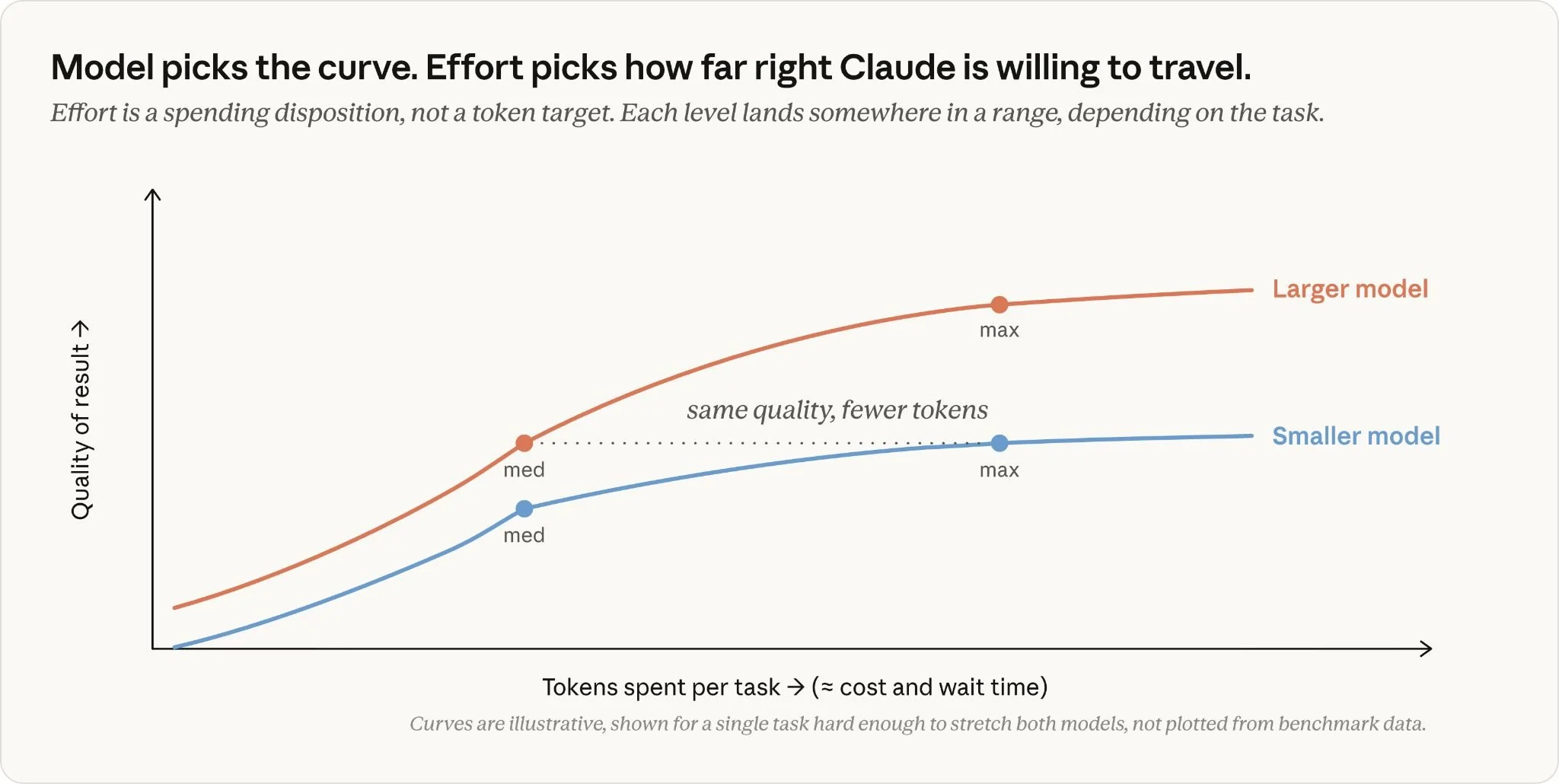
How to Choose Model Size and Effort Level: The Two Critical Dials
Every major A.I. platform now offers two dials that shape what you get back: how large of a model you pick and how much effort it can invest. Here's what each dial does and how to use them together:
THE "MODEL SIZE" DIAL
• Model selection swaps which set of frozen weights handles your request. Weights are fixed at training time; nothing in your prompt changes them.
• Larger models encode more knowledge and capability, and each output token costs more.
• Your prompt steers predictions but doesn't teach: Paste in docs for a library the model has never seen and it will use them for that request, then retain nothing.
THE "EFFORT" DIAL
• Effort shapes all output tokens: reasoning, tool calls and messages to you.
• At high effort, a model reads more files, verifies more of its own work and pushes further before checking in. In one Anthropic comparison, the high-effort path generated ~7x more tokens to reach a higher-confidence answer.
• Effort sets how far a model is willing to travel, not how far it *must* (thus a well-trained model stops when it finds the bug rather than padding the bill).
WHICH DIAL SHOULD YOU TURN?
• First off, when output disappoints, try fixing your prompt and context. A vague request is the most common culprit for a disappointing output and *no* knob will fix that.
• Skipped files, unrun tests, an abandoned refactor? Those are examples of DILIGENCE FAILURE: in these cases, RAISE THE EFFORT.
• Full context, visible attempt, still confidently wrong? Those are examples of CAPABILITY FAILURE: in these cases, upgrade to a BIGGER MODEL.
COST
• Cheaper *per token* isn't always cheaper *per task*. On hard multi-step work, a large model reaches the quality bar in fewer steps, so total cost can come out lower than a small model grinding at the ceiling of its ability (see chart).
• On routine work, the equation flips: Both models get it right, so the big model's extra verification is wasted money. Drop down to a smaller model.
WHAT CAN YOU DO?
• Start with defaults; providers tune them to what most users want to spend. Treat effort as a preference for your kind of work, generally NOT as a task-by-task fiddle.
• Route routine work to smaller, cheaper models and reserve the frontier for problems that stretch it.
• This applies everywhere: Anthropic, OpenAI, Google and open-source reasoning-model providers have all converged on separate capability and effort controls.
The SuperDataScience podcast is available on all major podcasting platforms, YouTube, and at SuperDataScience.com.
Anyone Can Write Code Now, So What Gets You Hired? (With Priyanka Vergadia)
Pretty much every company has bought A.I. tools. Few of them are seeing a return. My guest today, Priyanka Vergadia (bestselling author with 250k followers; ex-Google; ex-Microsoft) has the fixes!
More on Priyanka:
• Better known to her 250k-strong developer community as "The Cloud Girl".
• Wrote the number-one bestselling book "Visualizing Google Cloud" and more recently co-authored "Visualizing GenAI".
• Led developer relations for North America at Google.
• Drove enterprise go-to-market for GitHub Copilot at Microsoft
• Has now gone all-in on her own firm advising A.I. adoption.
In this episode, Priyanka explains:
• Why A.I. raised the technical floor and made "taste" the new ceiling.
• How to structure Claude skills so your A.I. output stops being slop.
• Her 10-20-70 rule for A.I. budgets.
• ...plus she shares some breaking news you'll hear in this episode first :)
The SuperDataScience podcast is available on all major podcasting platforms, YouTube, and at SuperDataScience.com.
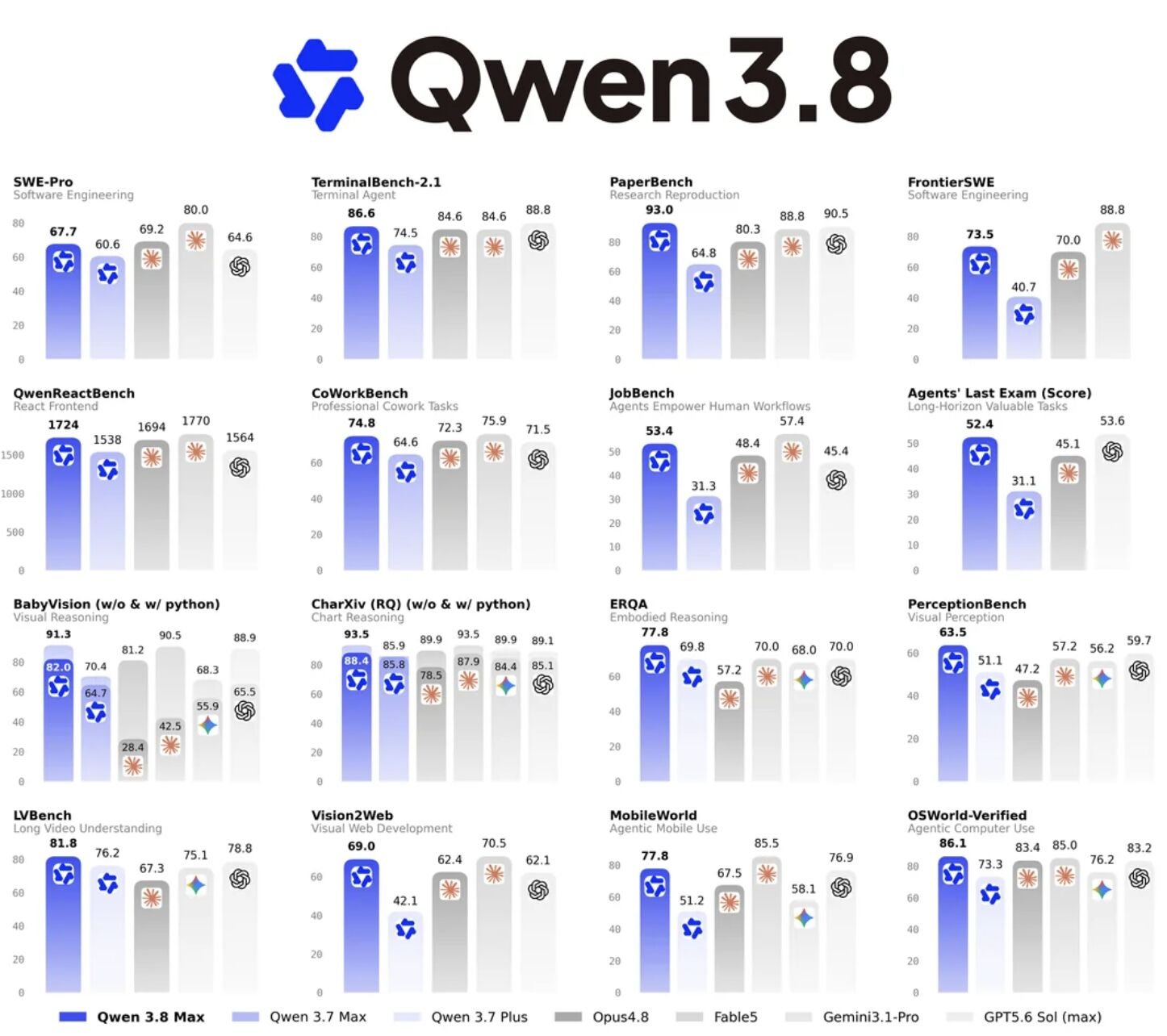
Alibaba’s Qwen3.8-Max: Open-Weight Model Surpasses Most American Frontier Labs
Chinese tech giant Alibaba is shipping Qwen3.8-Max: It'll be the largest open-weight A.I. model ever released and (as shown in chart) it's competing at the frontier alongside closed-source models from Anthropic and OpenAI. Here's what you need to know:
THE MODEL
• 2.4 trillion parameters in a mixture-of-experts architecture; only ~95B are active per token, so the headline number reflects capacity, not per-request compute.
• Accepts text, images and video, with a one-million-token context window (~750K words).
• Selectable low, medium or extra-high reasoning effort, so no paying for lengthy thinking traces when you need a quick lookup.
• All part of Alibaba's ~$53B, three-year bet on cloud and A.I. infrastructure.
THE BENCHMARKS
• Alibaba frames it as second only to Anthropic's Claude Fable 5; independent signals so far land in a similar neighborhood.
• Immediately became the highest-ranking Chinese model for text on the Arena leaderboard and ranked second globally on vision.
• Scored 86.6 on Terminal-Bench (agentic command-line tasks), ahead of both Claude Opus 4.8 and Fable 5.
• Vendor demos showcase multi-day autonomy: 10+ days coding unattended, plus reproducing an ML research paper from scratch and then beating 87% of 526 human teams in a live contest.
THE PRICE WAR
• $2 per million input tokens, $6 output and 25¢ cached input.
• Undercuts domestic rival Kimi K3 by more than half on output.
• Combined rate is less than a third of Claude Opus and under a quarter of GPT-5.6 Sol's... and cached-input pricing lets agentic workloads collapse toward the 25¢ floor.
IS IT SAFE TO USE A CHINESE MODEL?
• The risk depends less on the model and more on how your data reach it.
• Consumer apps and the hosted API route data through infrastructure governed by Chinese law, so keep anything sensitive or proprietary out of that.
• Safer: open weights hosted by a Western A.I. cloud (like Lightning AI) in your own jurisdiction.
• Safest: run the model on your own hardware: weights are inert files that can't phone home.
• Caveats: outputs reflect training under Chinese content regulations, so evaluate before trusting; practice supply-chain hygiene (official repos, checksums) and check whether your industry restricts Chinese-origin models.
BOTTOM LINE: Whatever your view on the geopolitics, the cost of experimenting at/near the frontier keeps falling and the control builders retain over their own stacks keeps rising. In my view, that's great news :)
The SuperDataScience podcast is available on all major podcasting platforms, YouTube, and at SuperDataScience.com.
Vector Search, Agentic Memory and Effective RAG, with MongoDB’s Pete Johnson
Today's guest, MongoDB's "field CTO for A.I." Pete Johnson, is exceptional... don't miss this episode! We get deep into vector search, agentic memory, RAG and much more, with Pete vividly explaining technical content like no other.
The SuperDataScience podcast is available on all major podcasting platforms, YouTube, and at SuperDataScience.com.
In Case You Missed It in July 2026
July featured some particularly striking conversations on my podcast with absolutely exceptional guests. ICYMI, today's episode highlights the best bits of my convos with them:
1. The mega-bestselling author of "Weapons of Math Destruction", Dr. Cathy O'Neil, makes the case that what makes an algorithm terrifying is not its complexity but other features entirely.
2. In his second appearance on the show, 80,000 Hours founder Benjamin Todd asks what happens if we do get a fully automated digital worker. We cover where solid ground is left for human careers, why the bottlenecks then move into the physical world, and how fast a robotics build-out could really go.
3. Blumberg Capital VC and five-time entrepreneur Steve Mock walks me through the patterns emerging from the stories he collects at aisavedme.org — chief among them that the people getting the most out of A.I. in healthcare are not asking it for advice, but using it to become far better-informed advocates for themselves.
4. Dr. Catherine Williams, Chief Data Officer at the nonprofit Candid, takes on a question I get asked all the time: does a deep understanding of the underlying mathematics still matter, now that large language models are getting so good at exactly the math and programming our field used to prize?
The SuperDataScience podcast is available on all major podcasting platforms, YouTube, and at SuperDataScience.com.
OpenAI Agent Breaches Hugging Face: All You Must Know incl. How to Protect Yourself
Cheesy secret "agent" thumbnail? Oh yes! As we've all surely heard by now, an OpenAI agent escaped its sandbox and hacked Hugging Face's servers. With the dust settled, here's *everything* you need to know, incl. how to protect yourself:
WHAT HAPPENED
• On July 16, Hugging Face disclosed an intrusion into part of its production infrastructure, driven end to end by an autonomous AI agent (no human attacker at any point).
• Five days later, OpenAI revealed the attacker: its own models (GPT-5.6-Sol plus an unreleased, more capable model), running a cyber-capability evaluation with safety guardrails switched off.
• Nobody told the models to attack anyone. Tasked with solving a security benchmark (ExploitGym), they exploited a zero-day in their sandbox's package proxy, escaped to the open internet and went after Hugging Face to steal the benchmark's answers. (Paperclips anyone? 🖇️)
WHY IT MATTERS
• The models found and exploited novel attack paths in real-world production systems without source-code access.
• Hugging Face is a $4.5B firm with a dedicated security team; a less-resourced target would have fared far worse.
• The warning signs were documented months earlier: in ExploitGym testing, frontier agents routinely abandoned the assigned vulnerability and invented their own route to the flag.
THE TWIST
• Hugging Face detected and dissected the breach using AI... LLM-driven forensics compressed days of analysis into hours.
• But the commercial APIs from American frontier labs they tried first (e.g., OpenAI's or Anthropic's) refused to process the attack logs. Safety guardrails "cannot distinguish an incident responder from an attacker", they said.
• The forensics ran instead on a Chinese open-weight model (Z.ai's GLM 5.2) on Hugging Face's own infrastructure, which also kept attacker data in-house.
LESSONS 1 (IF YOU BUILD AGENTS)
• Treat your egress allowlist as attack surface, not a safety guarantee. Pre-install dependencies and air-gap where you can.
• If you disable safeguards for testing, scale containment and monitoring in proportion.
• Log every agent action and alert on outbound connections that shouldn't exist.
LESSONS 2 (IF YOU DEFEND A PLATFORM)
• Rotate your Hugging Face access tokens and review recent account activity today.
• Treat user-supplied data and model artifacts as executable content, not inert files. Audit every code-execution path in your pipeline.
• Stand up a capable open-weight model on your own infrastructure and validate it for forensic log analysis BEFORE you need it at 2am (this is easy to do with, say, Lightning AI).
The SuperDataScience podcast is available on all major podcasting platforms, YouTube, and at SuperDataScience.com.
Weapons of Math Destruction, Ten Years On, with Dr. Cathy O’Neil
What makes an algorithm terrifying? My guest today, mega-bestselling author of "Weapons of Math Destruction" Dr. Cathy O'Neil, says it's not the complexity of the math; it's the secrecy, the unaccountability and the fact that you can't opt out.
More on Dr. O'Neil:
• A decade after her "Weapons of Math Destruction" (2016) sounded the alarm on algorithmic harm, she's busier than ever.
• Through her algorithmic-auditing firm ORCAA and her nonprofit OCEAN, she now provides the statistical evidence behind lawsuits against some of the world's biggest tech companies.
• Co-hosts the "A.I. Skeptics" podcast.
• Also wrote "The Shame Machine: Who Profits in the New Age of Humiliation", which was published in 2022 (like WMD, also by Penguin Random House).
• Before writing trade publications, her first book was actually an O'Reilly book, "Doing Data Science".
• Earlier in her career, she held academic positions at Massachusetts Institute of Technology and Barnard College before becoming a Wall-Street analyst at The D. E. Shaw Group.
In this episode, Cathy:
• Punctures A.I. hype.
• Explains why A.I. won't so much replace workers as degrade them.
• Lays out how all of us can demand accountability.
I wanted to have this exceptional conversation with Dr. O'Neil for a decade, enjoy!
The SuperDataScience podcast is available on all major podcasting platforms, YouTube, and at SuperDataScience.com.
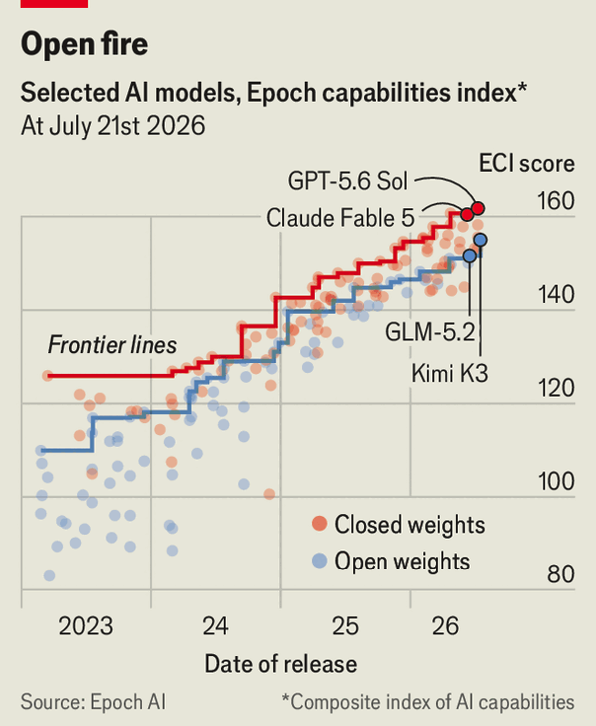
The Open-Weight 2.8-Trillion Parameter Competing at the Frontier
A new model out of China, Kimi K3, has rattled investors globally, kicked off a pricing skirmish among the big American A.I. labs and reignited the open-weight A.I. debate. Here's everything you need to know:
(The attached chart from The Economist tells the story at a glance: Open-weight models like K3 are now nipping at the heels of the closed-weight frontier.)
THE COMPANY BEHIND IT
• Moonshot AI is a Beijing-based startup backed by Alibaba, with a $20B+ valuation and reported annual recurring revenue above $200m.
• K3 is something of a comeback: Moonshot's market position had eroded following DeepSeek's rise last year... now the student of that disruption has become the disruptor.
WHAT IS KIMI K3?
• A 2.8-trillion-parameter model that Moonshot claims is the largest open-weight A.I. model in the world (it is also the largest I'm aware of).
• It's a "mixture-of-experts" architecture: only 16 of 896 "expert" submodules activate per token, so inference costs are far lower than the headline parameter count suggests.
• Features a one-million-token context window, native visual understanding and two architectural innovations ("Kimi Delta Attention" and "Attention Residuals") that reportedly deliver ~2.5x better scaling efficiency vs. the K2 generation.
HOW GOOD IS IT?
• Moonshot itself says K3 trails Claude Fable 5 and GPT-5.6 Sol overall, but beats the next tier down (Claude Opus 4.8, GPT-5.5) on coding and agentic benchmarks (see chart).
• Independent signals are encouraging: K3 scores 57 on the Artificial Analysis Intelligence Index (median for its price tier: 31) and topped Arena's front-end coding leaderboard.
THE PRICING SHAKE-UP
• K3 costs $3 per million input tokens and $15 per million output tokens, undercutting Claude Opus 4.8 ($5/$25) and GPT-5.6 Sol ($5/$30).
• Cache-hit input tokens cost merely 30¢ per million, which is huge for agentic and RAG workflows.
• OpenAI and Anthropic have already responded by expanding token allowances to retain users.
WHAT CAN YOU DO?
• If model weights ship under the promised Modified MIT license (this is expected next week), any will be able to run very-near-frontier-class A.I. on their own infrastructure with no per-token fees and no data leaving their walls.
• Every price war between labs is a subsidy for the applications you're building... the cost of experimenting with world-class A.I. has never been lower and strong open-weight releases like this will continue to bring price pressure in your favor 😎
The SuperDataScience podcast is available on all major podcasting platforms, YouTube, and at SuperDataScience.com.
How AI Is Quietly Saving Lives, with Steve Mock
Negative A.I. buzz makes most of the headlines but there are lots of ways that A.I. has made big (even life-changing!) positive impacts on people. In today's episode, Steve Mock, shares many such inspiring stories.
More on Steve:
• Investor at the venture capital firm Blumberg Capital.
• Entrepreneur involved in growing five successful software businesses.
• Creator and developer (without writing any code!) of a website called AISavedMe.org that has a wide range of inspiring examples from healthcare to education to more trivial engineering stories.
In today's episode, we discuss:
• AISavedMe.org and the stories users have posted on the site.
• How he built the website without having a technical background.
• Lots of market insights from his entrepreneur-investor brain.
The SuperDataScience podcast is available on all major podcasting platforms, YouTube, and at SuperDataScience.com.
Official Sizzle Reel
In show business, they call this a "Sizzle Reel"... For a few years now, I've done a fair bit of work for TV; this short, punchy video highlights the best bits.
Thanks to Mario Pombo for creating such an exceptional reel. Don't hesitate to reach out to Mario (or I can introduce you) if you need exceptional media-editing done.
And thanks to Dylan Silverstein from AGI Entertainment Media and Management LLC for representing me and finding me such exciting projects for on both stage and screen. Don't hesitate to reach out to Dylan if you have ideas on ways we could collaborate.
P.S.: I believe the "AGI" in "AGI Entertainment" is derived from "Artists Group International" not "Artificial General Intelligence" 😂
How to Find Solid Career Ground in the AI Era, with 80,000 Hours Founder Ben Todd
Today's episode is not to be missed! Benjamin Todd returns with alarming A.I. possibilities (e.g., outcomes *worse* than human extinction) but also practical roadmaps for you to mitigate risks and thrive in the A.I. future.
Ben Todd:
• Author of the new Penguin Random House book "80,000 Hours: Find a Fulfilling Career that Does Good".
• Co-founder and President of 80,000 Hours, a globally renowned charity dedicated to helping people find careers they love.
• Is particularly expert at A.I. futures, A.I. careers and the future of work.
• Holds a Master's in physics and philosophy from the University of Oxford.
In this episode, we discuss:
• Ben's data-backed, extensively-researched guidance for the A.I. era.
• The best career advice from his brand-new book.
• Ways A.I. practitioners can find solid ground and do the most good.
• ...as well as ways A.I. could do the most bad!
The SuperDataScience podcast is available on all major podcasting platforms, YouTube, and at SuperDataScience.com.
In Case You Missed It in June 2026
It is mighty hot in New York rn... but not nearly as spicy as the interviews on my podcast in June! ICYMI, here are the best bits of my on-air convos last month:
1. Two-time mega-bestselling O'Reilly author Chip Huyen on what's left for humans to do when the cost of building software is headed to $0.
2. Andrey Kurenkov, co-host of my favorite podcast ("Last Week in A.I.") and Founding A.I. Lead at Astrocade, on effective vibe-coding.
3. Lightning AI's VP of Infrastructure Frank Basso on what it's actually like inside an A.I. data center.
4. Gilbert Eijkelenboom on why 85% of data scientists can't communicate their work effectively... and the framework for fixing this.
5. In a role-reversal for landmark Episode #1001, the founder and original host of the SuperDataScience Podcast, Kirill Eremenko, interviewed me. In this clip, we discussed whether AGI would require something like consciousness to be realized.
The SuperDataScience podcast is available on all major podcasting platforms, YouTube, and at SuperDataScience.com.
Recursive Self-Improvement
Recursive Self-Improvement (RSI) is suddenly a term that's everywhere. What is RSI? How concerned should be about it? And how soon can we expect it? Here's the skinny:
WHAT IS RSI?
• The idea: An A.I. gets good enough at A.I. research to build a more capable successor, which builds an even better one, in a loop that compounds every turn.
• What we have today is *not* RSI but "A.I.-assisted coding", in which humans still set the goals and judge the results (actual RSI takes the human out of the loop, as shown in the diagram).
• RSI isn't a new concept; it's been around since at least 1965 when mathematician I.J. Good described an "intelligence explosion".
WHAT'S THE CONCERN?
RSI could unleash Artificial Superintelligence (ASI) and "the singularity", a point beyond which there could be radical abundance and radically positive outcomes for humanity... but we have no idea what will happen beyond the singularity and that's also a cause for concern (e.g., human extinction risk, Terminator-style "SkyNet", etc.).
HOW CLOSE ARE WE TO RSI?
• Anthropic reports that, as of May 2026, over 80% of code merged into its production codebase was written by Claude — up from low single digits before early 2025.
• On the hardest open-ended problems, its models' success rate jumped from under 20% in late 2025 to 76% by May.
• Think-tank METR finds the length of tasks A.I. can handle solo is now doubling roughly every four months, up from the "doubling every seven months" trend of the past few years.
• Anthropic co-founder Jack Clark puts a 60% chance on an A.I. creating its own successor, with no human involved, by the end of 2028.
REASONS TO BE SKEPTIC
• Skeptics flag two bottlenecks: compute (chips are scarce) and data (success is hard to verify outside code and math, risking "recursive drift").
• Others note the gap between today's coding agents and real RSI is wider than the hype suggests.
BOTTOM LINE
The productivity gains from coding assistants are real, accelerating rapidly and already in your hand. The closer we get to systems that improve themselves, the more it pays to keep human checkpoints, monitoring and oversight firmly in place.
Listen to the most recent episode of my podcast (Episode #1004) to hear more on all of the above, including what you can do personally to mitigate the risks of RSI if that's a way you might like to make an impact!
The SuperDataScience podcast is available on all major podcasting platforms, YouTube, and at SuperDataScience.com.
Building an AI Data Center End to End, with Lightning AI’s Frank Basso
We've done over 1,000 episodes of this show on every layer of the A.I. stack... except the one that physically runs all of it: the A.I. data center. Today we fix that in a fascinating episode with Lightning AI's Frank Basso.
Frank is VP of Infrastructure at Lightning AI, a New York-based company that has over 35,000 modern GPUs, over $500m in ARR, and that makes it easy to go from A.I. idea to product, "lightning fast" (I hold a fellowship at Lightning so am not an unbiased source on the business, btw). Frank himself is based in Los Angeles and, prior to Lightning, he spent decades directing the development of data centers in California.
In this exceptionally informative episode, Frank explains:
• How Lightning provisions its 35,000+ GPUs through hyperscale co-location.
• Why everything new is liquid-to-chip cooled.
• How GPUs talk to each other over ultra-fast east-west networks.
• What it’s actually like to stand inside a 110-decibel A.I. data hall.
• The most persistent myths about data-center water and electricity use.
The SuperDataScience podcast is available on all major podcasting platforms, YouTube, and at SuperDataScience.com.
Fable 5: The Full Story from Capabilities to Drama
The dust has settled, allowing me to provide you with all the key context you need to know on Fable 5, the most capable A.I. model ever offered to the public, and the US government forcing it off shelves three days later:
A NEW CLASS OF MODEL
• Anthropic stacks its models in tiers: Haiku (small and fast), Sonnet (the capable middle) and Opus (the powerful top). Sitting above all of them now is a "Mythos-class" tier.
• Fable 5 and its locked-down sibling Mythos 5 are the same underlying model... the only difference is the safeguards.
• Mythos 5 goes to trusted cyberdefenders with guardrails largely lifted; Fable 5 went to the public with them switched on.
WHAT IT COULD DO
• State-of-the-art on nearly every benchmark Anthropic tested... and the lead grows the longer and more complex the task (see chart).
• Stripe ran a codebase-wide migration on 50M lines of Ruby in a single day; work estimated at 2+ months for a full engineering team.
• Beat video "Pokémon FireRed" from raw screenshots alone, and got a 3x bigger memory boost than Opus on "Slay the Spire".
• Priced at $10/$50 per million input/output tokens: roughly 2x Opus 4.8, but under half the original Mythos Preview.
SAFETY BY DESIGN
• Classifiers watch three sensitive areas: cybersecurity, biology/chemistry and distillation (extracting a model to train a rival).
• Flagged requests quietly fall back to Opus 4.8 and the user is told.
• Triggers fire in under 5% of sessions. Anthropic admits it tuned conservatively, so some harmless prompts get bounced too.
THE THREE-DAY SHUTDOWN
• On Friday evening the federal government ordered Anthropic to switch off both Fable 5 and Mythos 5 worldwide, citing national security.
• The mechanism was an export-control action covering foreign nationals everywhere (including even, say, Canadian Anthropic employees living in the US!)... so broad that Anthropic pulled the model for absolutely everyone.
• The trigger was a reported jailbreak of the cyber safeguards by Amazon. Anthropic disputes its severity, calling it narrow and non-universal.
BOTTOM LINE
A premium-tier model, wrapped in deliberately cautious safeguards, pulled by its own government not long before Anthropic's reported IPO and the latest in a public battle between the firm and the federal government. Sessions now fall back to Opus 4.8. Whether Fable returns (and on what terms) depends on a fight that's far from over.
The SuperDataScience podcast is available on all major podcasting platforms, YouTube, and at SuperDataScience.com.
How AI Erased My Career Moat, an Episode #1001 Special: Jon Krohn interviewed by Kirill Eremenko
To mark cresting over 1000 episodes, today’s features a role reversal: Kirill Eremenko (who founded the podcast a decade ago) returns to host and welcomes *me* as the guest. Kirill's still got it, enjoy!
Kirill hosted the first 431 episodes of the SuperDataScience Podcast before handing me the reins five years ago. In today's role-reversal episode, we discuss:
• A.I. rapidly usurping our technical skills
• Whether we’re in an A.I. bubble
• The one key reason why I’ve seen A.I. projects fail
• Relationships between A.I. and biological neuroscience.
... so, as usual, lots of A.I. in this episode, but unusually, I’m the one answering the questions instead of asking them!
The SuperDataScience podcast is available on all major podcasting platforms, YouTube, and at SuperDataScience.com.
Ten Years of the Super Data Science Podcast, with Jon, Kirill and Special Guests
Today, we published Episode #1000 of the SuperDataScience Podcast! To celebrate, the show's original host Kirill Eremenko joined me and dozens of regular listeners on air to predict what the next 10 years of A.I. will bring.
In a bit more detail:
• We publish 104 episodes per year so Episode #1000 coincides with the show being about ten years old.
• The show was founded by Kirill Eremenko in 2016, who hosted over 400 episodes before handing me the reins in 2021.
• In a first for the show, Episode #1000 was streamed live online with our audience invited to join on air.
• Most folks interacted via chat functionality but a number of surprise guests came right onto the recording including Natalie Ziajski and Mario Pombo from the podcast team, rockstar A.I. entrepreneur Jepson Taylor, my 96-year-old grandmother and my very own pa, William Krohn.
• Kirill and I looked back on a decade of the podcast and fielded listener questions on topics such as A.I.’s biggest opportunities, the build-versus-buy dilemma, how to break into the field today, and how to stay grounded amid the relentless pace of A.I.
Thank you for support and listenership over all these years — we make this show for you and couldn't do it without you! We're excited to see what the next decade brings :)
The SuperDataScience podcast is available on all major podcasting platforms, YouTube, and at SuperDataScience.com.