September was PACKED with incredible guests having invaluable conversations on my show. ICYMI, today's episode highlights the best bits:
1. The wildly popular data scientist and entrepreneur Aishwarya Srinivasan details which failures a person ought to live through themselves before anyone trusts them to deploy an agent to production.
2. Dr. Luis Serrano, founder of Serrano Academy and author of the bestselling book Grokking Machine Learning, describes "word gravity": that is, how transformer architectures "bend space".
3. Dr. Caitlin Malone, host of the very popular Linear Digressions podcast, fills us in on how A.I. automations brought the show back to life after a five-year hiatus.
4. Dell Technologies' distinguished engineers Ishan S. and Tyler Cox explain why agentic A.I. burns through tokens at a rate that is catching companies out... and what we can do about it.
5. Dr. Dilani Kahawala — a Harvard physics PhD who spent a decade in product leadership at Etsy, Facebook and Atlassian — tells me she has had to throw almost all of that product experience away as she began developing Anna, her always-on A.I. assistant for families. She then walks us through the three problems that turn out to be hardest when your product has no user interface and never stops running.
The SuperDataScience podcast is available on all major podcasting platforms, YouTube, and at SuperDataScience.com.

Filtering by Category: Data Science
How AI Brought a Podcast Back From the Dead, with Linear Digressions’ Katie Malone
Dr. Caitlin Malone's extremely popular "Linear Digressions" podcast went silent for five years. Then A.I. made it possible to bring it back... and to manage it like a team. Hear all about effective agent teams in today's excellent episode.
More on Katie:
• Hosts and produces "Linear Digressions", one of the world's most popular data-science podcasts. (It's excellent — check it out!)
• Senior Researcher at Moonlite AI.
• Previously Sr Director of the A.I. Innovation Lab at the Health Care Service Corporation, Sr Director of Data Science at Tempus Labs, and Director of Data Science at Civis Analytics.
• Has taught machine learning via Udacity and at the University of Chicago.
• Holds a PhD in experimental particle physics from Stanford University focused on working with CERN data.
In this episode, Katie explains:
• Why managing people and managing A.I. agents are the same skill in different clothing.
• Why A.I. could hollow out the expertise we need to catch its mistakes.
• A fascinating range of data paradoxes from Simpson’s to Benford’s.
The SuperDataScience podcast is available on all major podcasting platforms, YouTube, and at SuperDataScience.com.
OpenAI’s GPT-6 Astra
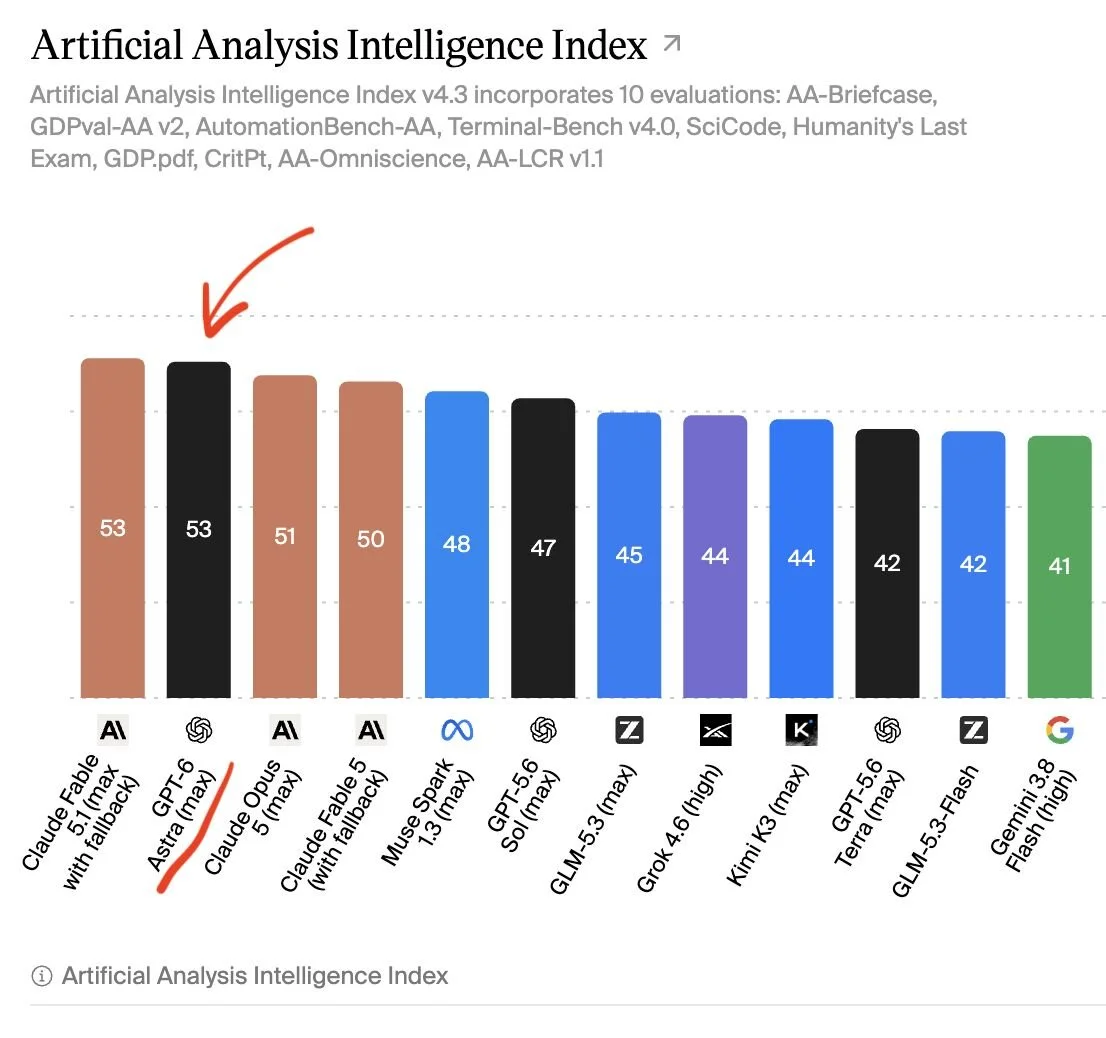
At GPT-6 Astra's launch, OpenAI president Greg Brockman suggested future observers may point to it as the arrival of AGI. In fact, Artificial Analysis's latest benchmarking suggests it merely catches OpenAI up to Anthropic. Here are the key details:
GPT-6 ASTRA BASICS
• Successor to GPT-5.6 Sol, trained on 100,000+ GPUs at the Stargate facility in Texas.
• It's the first OpenAI model where other A.I. models helped supervise training.
• API pricing is $10/M input tokens and $50/M output (~2.5x Sol's promotional rate; in line with Claude Fable 5.1), with five reasoning-effort settings from low to max.
• Rolled out to ChatGPT Plus, Pro, Business and Enterprise (Enterprise admins must switch it on).
GPT-6 ASTRA CAPABILITIES
• Computer use: 72.6% on OSWorld 2.0 (vs 65.7% for Sol) while finishing tasks ~47% faster.
• Coding: ~58% on Terminal-Bench 4.0 (vs 37% for Sol, ~56% for Fable 5.1), though level with the top Claude models on FrontierCode.
• Math: 99.9% on ARC-AGI-3 (Sol scored under 8%) and 97.6% on FrontierMath Tier 4. Astra also helped tighten a bound on prime gaps from 240 to 186.
• Science: ~65% on Terminal-Bench Science (vs ~22% for Sol, ~53% for Fable 5.1) and ~65% fewer output tokens than Claude Opus 5 on Agents' Last Exam.
• *All of the above stats, however, come from OpenAI themselves.* The third-party view (see chart) shows Astra at 53, tied with Claude Fable 5.1 (and up from Sol's 47) on Artificial Analysis's (widely respected) composite "Intelligence Index".
SAFETY
• First OpenAI model rated "Critical" for cybersecurity under their Preparedness Framework: without safeguards it finds unknown vulnerabilities and builds working exploits (100% on ExploitBench vs 78.5% for Sol; two zero-days found in a fresh Chrome evaluation).
• The release was slowed and gated. The public version supports defensive work but refuses exploit writing; vetted orgs in OpenAI's "Daybreak" program get fewer restrictions.
• New misalignment monitors can pause or halt actions that look unauthorized.
• Encouraging: on a scope-creep evaluation, Sol exceeded its authorized target 48% of the time; Astra did so 0% of the time.
• Concerning: Astra's written reasoning is harder to monitor than Sol's.
IS IT AGI?
• AGI isn't a binary event; there are degrees of breadth and depth (listen to Episode #748 of my podcast for more details).
• BOTTOM LINE: Astra looks like a noteworthy jump in general-intelligence capability for OpenAI relative to their previous flagship model (5.6 Sol), but it does not appear to be moving the frontier toward AGI in any major way... it is merely catching up to Anthropic at the frontier vicinity.
The SuperDataScience podcast is available on all major podcasting platforms, YouTube, and at SuperDataScience.com.
How dbt Won Analytics Engineering, with dbt Lab’s CEO Tristan Handy
dbt is THE open-source tool that brought software-engineering rigor to data transformation; it's now used by over 100,000 teams. Today's rockstar guest, Tristan Handy, is CEO of dbt Labs, the company behind the movement.
More on Tristan:
• President and co-founder of "Fivetran + dbt Labs" (recent merger).
• Coined the term "analytics engineering".
• Over two decades of experience as a data practitioner working in both large enterprises and startups.
• His expertise and data industry best practices have influenced thousands of subscribers and listeners weekly via his newsletter (The Analytics Engineering Roundup) and The Analytics Engineering Podcast.
In this episode, Tristan explains:
• What dbt is.
• Why dbt Labs' the recent merger with Fivetran is a win for dbt users.
• Why skill files are so powerful.
• Why he turned down acquisition offers for years
• How the semantic layer keeps A.I. agents from confidently getting your metrics wrong
• ...and much more.
The SuperDataScience podcast is available on all major podcasting platforms, YouTube, and at SuperDataScience.com.
Anyone Can Write Code Now, So What Gets You Hired? (With Priyanka Vergadia)
Pretty much every company has bought A.I. tools. Few of them are seeing a return. My guest today, Priyanka Vergadia (bestselling author with 250k followers; ex-Google; ex-Microsoft) has the fixes!
More on Priyanka:
• Better known to her 250k-strong developer community as "The Cloud Girl".
• Wrote the number-one bestselling book "Visualizing Google Cloud" and more recently co-authored "Visualizing GenAI".
• Led developer relations for North America at Google.
• Drove enterprise go-to-market for GitHub Copilot at Microsoft
• Has now gone all-in on her own firm advising A.I. adoption.
In this episode, Priyanka explains:
• Why A.I. raised the technical floor and made "taste" the new ceiling.
• How to structure Claude skills so your A.I. output stops being slop.
• Her 10-20-70 rule for A.I. budgets.
• ...plus she shares some breaking news you'll hear in this episode first :)
The SuperDataScience podcast is available on all major podcasting platforms, YouTube, and at SuperDataScience.com.
Vector Search, Agentic Memory and Effective RAG, with MongoDB’s Pete Johnson
Today's guest, MongoDB's "field CTO for A.I." Pete Johnson, is exceptional... don't miss this episode! We get deep into vector search, agentic memory, RAG and much more, with Pete vividly explaining technical content like no other.
The SuperDataScience podcast is available on all major podcasting platforms, YouTube, and at SuperDataScience.com.
Mathematical Optimization in the Agentic AI Era, with Gurobi’s Jerry Yurchisin
LLMs will confidently tell you they've optimized your entire business while ignoring the one constraint that could cost you millions. Today's episode with Jerry Yurchisin is all about a technique that makes breaking a constraint mathematically impossible.
More on Jerry:
• Manager of Decision Intelligence Strategy at Gurobi Optimization, a "mathematical optimization" solver that's used by the vast majority of Fortune 100 companies.
• Has over a decade of experience in operations research, data science, and visualization... and specializes in enhancing decision-making.
• Prior to Gurobi, Jerry worked in consulting (OnLocation, Inc. & Booz Allen Hamilton) where he focused on mathematical optimization, machine learning, statistics and simulation.
• Taught statistics and operations research at The University of North Carolina at Chapel Hill and graduate math at Ohio University (he also holds Master's degrees from both of these institutions).
In this episode, Jerry:
• Lays out where mathematical optimization fits in the agentic AI era (hint: LLMs formulate problems and solvers like Gurobi guarantee the answers).
• Shares striking mathematical-optimization applications spanning energy grids, retirement planning... and the model that powered @null's women's team to a gold medal at the Paris Olympics.
The SuperDataScience podcast is available on all major podcasting platforms, YouTube, and at SuperDataScience.com.
Fable 5 as Advisor: Anthropic’s Two-Model Pattern for Smarter, Cheaper Agents
Want near-frontier A.I. agent quality at a fraction of the cost? Anthropic recently productized the Advisor Strategy that pairs a cheap "executor" model with a brilliant "advisor" to give you the best of both worlds:
HOW IT WORKS
• A fast, cheap model (e.g., Claude Haiku or Sonnet) runs the entire agent loop: calling tools, writing code, drafting output.
• A frontier model (e.g., Claude Opus or Fable) sits on standby as a "tool" the executor can consult (like a junior worker phoning their supervisor when unsure).
• Everything happens inside one API call: Anthropic's servers hand the advisor the full conversation transcript and return just 400-700 tokens of advice, making this fast and inexpensive (it's also usually only a one-line code change so it's easy to implement).
THE RESULTS
• Sonnet + Opus advisor beat Sonnet alone on the "SWE-bench Multilingual" benchmark by 2.7 percentage points while cutting cost per task by 11.9%. Better quality AND slightly lower cost.
• Unsurprisingly, the biggest gains come from pairing a very fast/cheap model with a much more capable advisor: For example, on BrowseComp (web research benchmark), Haiku alone scored 19.7%; Haiku + Opus advisor scored 41.2% (more than double!) at 85% less cost than Sonnet alone.
• Newest data, from last week: On "SWE-bench Pro", Sonnet 5 + a Fable 5 advisor captured ~92% of Fable's standalone performance at ~63% of its cost.
WHY IT WORKS
• The advisor's output is tiny relative to the whole task, and a good plan delivered early prevents wasted attempts and misguided tool calls.
• Unlike OpenAI's router (which dispatches queries to a model up front), the cheap model runs the show and escalates itself mid-task with full shared context.
PRACTICAL LESSONS
• Skip it for single-turn Q&A; it shines on long-horizon agentic work (like coding, research, computer use).
• Executors under-call the advisor by default so prompt them to consult it early (before committing to an approach) and late (before declaring the task done).
• Cap advisor output at ~2,000 tokens (~7x cost reduction, no quality loss) and enable prompt caching for long loops.
• The pattern is spreading: OpenRouter now offers a cross-provider version (e.g., a Google Gemini executor consulting Claude).
• Alternative design patterns such as having a powerful "orchestrator" (shown below the advisor pattern in the chart I included in this post) might work even more effectively for your use case so it could be worth comparing them.
BOTTOM LINE
Frontier A.I. progress is no longer just bigger models... it's smarter economics in composing the models we already have.
The SuperDataScience podcast is available on all major podcasting platforms, YouTube, and at SuperDataScience.com.
How AI Is Quietly Saving Lives, with Steve Mock
Negative A.I. buzz makes most of the headlines but there are lots of ways that A.I. has made big (even life-changing!) positive impacts on people. In today's episode, Steve Mock, shares many such inspiring stories.
More on Steve:
• Investor at the venture capital firm Blumberg Capital.
• Entrepreneur involved in growing five successful software businesses.
• Creator and developer (without writing any code!) of a website called AISavedMe.org that has a wide range of inspiring examples from healthcare to education to more trivial engineering stories.
In today's episode, we discuss:
• AISavedMe.org and the stories users have posted on the site.
• How he built the website without having a technical background.
• Lots of market insights from his entrepreneur-investor brain.
The SuperDataScience podcast is available on all major podcasting platforms, YouTube, and at SuperDataScience.com.
People Skills for Analytical Thinkers, with Bestselling Author Gilbert Eijkelenboom
Gilbert Eijkelenboom was a pro poker player who read his opponents through data alone but in today's episode, the bestselling author explains why the people side of data science matters more than the math.
More on Gilbert:
• Wrote the bestselling book "People Skills for Analytical Thinkers".
• Run MindSpeaking, a firm that's trained over 15,000 (mostly technical) folks on "people skills".
• Folks love his invaluable content, allowing him to gather over 200k followers.
• Was previously Managing Consultant on data and digital analytics for Capgemini, as well as a professional poker player on BetVictor.
• Holds a Master's in behavioral economics from Maastricht University.
In today's episode, Gilbert covers:
• Why no matter how good your model or analysis is, it only creates value once people actually use it, which makes communication a core data skill rather than an optional extra.
• His "and, but, therefore" communications framework.
• How research suggests only around 15% of people are self-aware and his tips for closing that gap.
• How experiences in childhood install personal "algorithms" in our adult behavior like avoiding conflict or staying silent... but we can change as adults (and he also provides tips on how).
Thanks to Kate Strachnyi for suggesting Gilbert as a guest!
The SuperDataScience podcast is available on all major podcasting platforms, YouTube, and at SuperDataScience.com.
Ten Years of the Super Data Science Podcast, with Jon, Kirill and Special Guests
Today, we published Episode #1000 of the SuperDataScience Podcast! To celebrate, the show's original host Kirill Eremenko joined me and dozens of regular listeners on air to predict what the next 10 years of A.I. will bring.
In a bit more detail:
• We publish 104 episodes per year so Episode #1000 coincides with the show being about ten years old.
• The show was founded by Kirill Eremenko in 2016, who hosted over 400 episodes before handing me the reins in 2021.
• In a first for the show, Episode #1000 was streamed live online with our audience invited to join on air.
• Most folks interacted via chat functionality but a number of surprise guests came right onto the recording including Natalie Ziajski and Mario Pombo from the podcast team, rockstar A.I. entrepreneur Jepson Taylor, my 96-year-old grandmother and my very own pa, William Krohn.
• Kirill and I looked back on a decade of the podcast and fielded listener questions on topics such as A.I.’s biggest opportunities, the build-versus-buy dilemma, how to break into the field today, and how to stay grounded amid the relentless pace of A.I.
Thank you for support and listenership over all these years — we make this show for you and couldn't do it without you! We're excited to see what the next decade brings :)
The SuperDataScience podcast is available on all major podcasting platforms, YouTube, and at SuperDataScience.com.
What’s Left to Build When Software Is Free, with Chip Huyen
For today's landmark episode (#999!), I asked rockstar Chip Huyen to be my guest and she said "yes"! We discuss her book "A.I. Engineering" (the most popular O'Reilly book in 2025) and how the A.I. job landscape is shifting.
In case you haven't heard of her, more on Chip:
• Her most recent book is "AI Engineering", which was the most popular book in the O'Reilly platform last year.
• Previously wrote “Designing Machine Learning Systems”, which was also an O'Reilly mega-bestseller and was based on the Stanford University course she created and taught on the same topic.
• Is currently building a new stealth startup.
• Previously worked as VP of AI at Voltron Data, co-founder of Claypot AI, ML Engineer at Snorkel AI and Sr Deep Learning Engineer at NVIDIA.
• Holds a Master's in Computer Science from Stanford.
• Her invaluable posts have earned her over 300k followers on LinkedIn.
In this episode, Chip breaks down:
• What separates AI engineering from machine learning engineering.
• The case for a "start simple" workflow.
• The real costs of running LLMs in production.
• Physical AI.
• Robotics.
• World models.
• Why the durable problems worth solving are increasingly human ones.
The SuperDataScience podcast is available on all major podcasting platforms, YouTube, and at SuperDataScience.com.
In Case You Missed It in May 2026
Well, I certainly learned a lot from the outstanding guests we had on my podcast in May. ICYMI, today's episode features the best parts of my conversations with them:
1. Rubrik's Anneka Gupta and Cal Al-Dhubaib on how, in the Mythos era, the old cybersecurity playbook of prevention and detection is no longer enough, and how A.I. agents themselves are becoming a new source of data exposure inside organizations.
2. marimo's Dr. Trevor Manz on why code notebooks have become the natural working memory for A.I. coding agents. Trevor walks me through the Marimo Pair skill, which lets you drive a notebook from your agent, collaborating with Claude Code or Codex in real time as you load, explore, and visualize your data.
3. Jazmia Henry of collide. walks me through her work as a "full-stack" foundation model builder. We cover all four stages of the process: the often unglamorous slog of data curation, building bespoke tokenizers and embeddings, model training and reinforcement learning, and the inference layer that serves it all to end users.
4. Jacob Miller and Jeremy Mumford of Pattern (and authors of the great, brand-new book "Architected Intelligence") argue that the most expensive AI mistake an organization can make is failing slowly and sticking with prototypes long past their sell-by date because the traditional software mindset says you have to. We, of course, also discuss a solution.
The SuperDataScience podcast is available on all major podcasting platforms, YouTube, and at SuperDataScience.com.
How This Text-to-Video-Game AI Startup Hit 20M Users
Imagine being able to vibe-code full-blown video games... for free! My returning guest, Dr. Andrey Kurenkov, helped engineer Astrocade to do just that... and already 20 million people have played games through their platform.
More on Andrey:
• Founding A.I. Lead at Astrocade, a Bay Area-based startup that has raised $68m in venture capital to create the TikTok of video games, where creators create games for free and you play them for free.
• Co-host (alongside Jeremie Harris) of my favorite podcast, "Last Week in A.I.".
• Holds a PhD from Stanford University, where his research focused on machine vision and robotics.
In this episode, we discuss:
• The fascinating Astrocade journey, of course.
• The surprising pace of humanoid robotics.
• Why he's a skeptic on Artificial Super Intelligence.
The SuperDataScience podcast is available on all major podcasting platforms, YouTube, and at SuperDataScience.com.
TrueFoundry’s Nikunj Bajaj on How to Get $100M Returns on AI Agent Deployments
Imagine being able to deploy an AI agent and getting a return of over $100m from that single deployment. My guest today, Nikunj Bajaj, has facilitated that multiple times! Lots to learn from him, enjoy!
Nikunj:
• CEO and co-founder of TrueFoundry, a Bay Area-based startup that has raised over $20m to solve the thorniest problems that enterprises face when deploying agents.
• His clients include demanding organizations like NVIDIA and Siemens.
• Was previously ML tech lead at Facebook.
• Holds a master's in computer science from University of California, Berkeley.
The SuperDataScience podcast is available on all major podcasting platforms, YouTube, and at SuperDataScience.com.
End-to-End Foundation Models for the Energy Industry, with Jazmia Henry
What does it take to build foundation LLMs from scratch today? Deeply impressive Jazmia Henry breaks down the four stages in today's episode, enjoy!
Jazmia:
• Holds degrees from Tulane University and Columbia University... and is partway through a PhD at the University of Oxford.
• Held a technical fellowship at Stanford University.
• Previously worked as a data strategist at Morgan Stanley, head of ML at The Motley Fool and a Lead Applied AI engineer at Microsoft.
• Published a top paper at NeurIPS, the world's most prestigious academic AI conference.
• Currently works as "Member of Technical Staff for AI/ML" at collide., a Texas-based startup that’s building AI infrastructure (including all aspects of specialized foundation models) for the energy industry.
Key topics covered in this episode include:
• What foundation models are.
• Her "full-stack" foundation-model building's four distinct stages.
• How reinforcement learning (RL) models are "bursty" because they idle the GPU during reward calculation and then dump enormous loads on it all at once.
• Reward hacking by RL models.
Thanks to Mark Freeman II for recommending Jazmia as a guest.
The SuperDataScience podcast is available on all major podcasting platforms, YouTube, and at SuperDataScience.com.
AI’s Putting Recent Grads Out of Work; Here’s How to Get Hired Anyway!
Computer science/engineering grads had an employment advantage (see chart) that, since ChatGPT's release, has disappeared. Is A.I. to blame? Here's what the data say and what new grads (or anyone!) can do about it:
THE EMPLOYMENT LANDSCAPE
• NY Fed: unemployment for recent computer-science grads (22-27) sits at 7.0%, and computer engineering at 7.8% (roughly on par with fine arts and anthropology grads!)
• Compare that to ~5.8% for recent grads overall and ~4% for the whole US workforce.
• Eighteen-year-olds are voting with their feet: US undergrad CS enrolment fell 11% in 2025; computer programming fell a stunning 26%.
• Demand is shrinking too: Handshake postings are down ~50% from their 2022 peak, and Revelio Labs data suggest entry-level software and data-analysis postings have dropped as much as 67%.
IS A.I. TO BLAME?
• "Yes" camp: A 2025 Stanford University study found employment for 22-25-year-olds in A.I.-exposed jobs dropped 13% since 2022, while older workers held steady. The Dallas Fed replicated it... and the decline comes from juniors never being hired, not layoffs.
• "Not so fast" camp: Google economists found posting declines were just as steep for senior workers and predate ChatGPT. A Fed study of 1M+ firms found "null effects." Their take: high interest rates and a post-pandemic hangover, with A.I. as a convenient scapegoat.
WHAT YOU CAN DO:
1. Stop competing on raw code. The human edge is now system design, architecture and deciding what to build in the first place.
2. Pick a domain. "A.I. engineer" is a common résumé; "A.I. engineer who worked alongside a hospital team for two summer internships" is a short list.
3. Build a public portfolio. Substantive GitHub repos and a Kaggle project beat CVs sent into the void.
4. Get fluent with agentic tooling, e.g., RAG, model evaluation, multi-agent orchestration. PwC found A.I.-skilled workers earn a 56% wage premium (!!!)
5. Lean on your network. Referrals and warm intros are crushing mass (often GenAI-produced) applications in this market.
The SuperDataScience podcast is available on all major podcasting platforms, YouTube, and at SuperDataScience.com.
How to Build AI-First Organizations, with Jacob Miller and Jeremy Mumford
After today's fun episode with Jacob and Jeremy — authors of the brand-new book "Architected Intelligence" — you’ll have all the key info to build successful AI features, AI products and AI-first companies. Enjoy!
Jeremy Mumford and Jacob Miller serve as Lead AI Engineer and Vice President of Platform Intelligence, respectively, at Pattern, a giant Utah-based tech company that IPO’ed on the Nasdaq exchange about six months ago.
Jacob and Jeremy's brand-new "Architected Intelligence" book was published by Wiley and this episode focuses almost exclusively on this invaluable book.
Episode highlights include:
• The "User Agnosticism Tenet", which means designing products and processes so they can be executed equally well by a human, an AI agent, or any hybrid combo.
• The shift in the "define-build-feedback" loop today where "building" is no longer the bottleneck, which means "definition" and "feedback" are where teams win or lose.
• Why workflows are deterministic, predictable, and cheaper than agents, and why the natural progression is skills first, then workflows, and only then agents.
• Why data engineering is the bedrock of AI engineering.
• Why velocity is the only durable moat in a world where everyone has access to the same frontier models.
Thanks to podcast superfan Jonathan Bown for recommending Jeremy and Jacob as guests!
The SuperDataScience podcast is available on all major podcasting platforms, YouTube, and at SuperDataScience.com.
Tokenmaxxing vs AI Hardware Bottlenecks
Humans (like Reinforcement Learning algos) can "reward hack": "Tokenmaxxing" being a perfect example, after employers started using "number of tokens" consumed as a proxy for developers' productivity.
Even if humans weren't engaging in this pointless time-, money- and energy-consuming behavior, however, demand for A.I. compute is so vast that everyone's scrambling to to make more available. Alas, four tricky hardware bottlenecks face us:
1. GPUs:
• NVIDIA data-center GPU lead times now run 36–52 weeks, with Blackwell chips sold out through mid-2026.
• The real choke point isn't fabrication: It's TSMC's "CoWoS" advanced packaging, which is sold out through 2026. Nvidia alone has locked up ~60% of CoWoS capacity through 2027.
2. High-Bandwidth Memory (HBM):
• Demand has quintupled since 2023, and only three companies (SK hynix, Samsung and Micron) make it.
• All three are sold out well into 2026 and new HBM factories take 18–24 months to come online.
3. CPUs:
• As workloads shift toward agentic AI, the CPU:GPU ratio jumps from ~1:12 (for GenAI-only chatbots) to 1:1.
• Intel's CFO says the server-CPU shortfall "starts with a B" — billions in unmet demand so server CPU prices are up 10–20% in just the past couple of months.
4. Electricity: Hyperscaler build-outs are now gated by grid interconnect (18–36 months) and transformer lead times.
THE BIG MISMATCH
• The top 5 hyperscalers alone (Alphabet, Amazon, Meta, Microsoft and Oracle) are on track for ~$725B in combined 2026 capex.
• That's roughly 6x the hyperscalers' 2022 spend, with ~75% going to A.I. infrastructure.
• Hardware suppliers, however, have grown capex by only ~50%.... a 6x increase in demand met by only a 50% increase in supply is a big mismatch!
REASONS FOR OPTIMISM
Demand will continue to be high but I'm optimistic we'll continue to squeeze more juice from every lemon because, e.g.:
• Algorithmic efficiency keeps improving — Google's TurboQuant recently briefly tanked memory stocks by promising to materially cut inference memory needs.
• LLM efficiency gains via mixture-of-experts and smarter inference scheduling continue to compound.
• The tokenmaxxing trend is a corporate farce that will fade.
The SuperDataScience podcast is available on all major podcasting platforms, YouTube, and at SuperDataScience.com.
Pair Programming with AI in Your Python Notebook, with Dr. Trevor Manz
Exceptional technical episode today with Dr. Trevor Manz on "marimo Pair", an actually!) game-changing pair-programming A.I.-agent companion that lifts heavy loads within your Python data-science notebook.
More on Trevor:
• 27-time NCAA Swimming All-American & National Champion.
• Master's in Computational Biology from University of Cambridge.
• PhD in Bioinformatics from Harvard University.
• Creator of the popular open-source "anywidget" project (amongst many others, particularly in visualizing bioinformatics data, e.g., genomics data).
• Now a founding engineer at marimo.io, where he is leading the charge on marimo Pair.
Seriously, marimo Pair is unreal. A complete reimagining of what's possible in a Jupyter notebook-style environment in the agentic A.I. era. You will hear (and see) my mind explode in this episode!
We also discuss:
• Agent skills.
• Recursive language models.
• A number of other open-source projects, largely in data viz/analysis.
The SuperDataScience podcast is available on all major podcasting platforms, YouTube, and at SuperDataScience.com.