In today's exceptional episode, prominent A.I. researcher, entrepreneur and bestselling author Richard Socher details how RSI ("Recursive Self-Improvement") could arrive in as little as a year... and it will herald a new era of scientific breakthroughs.
More on Dr. Socher:
• CEO and co-founder of Recursive, a startup that came out of stealth this year and has already raised over half a billion dollars to build recursively self-improving superintelligence that automates scientific discovery.
• Also co-founder and CEO of the A.I. search engine You.com and a founder of the A.I.-focused venture capital firm AIX Ventures.
• Previously Chief Scientist at Salesforce.
• His brand-new book, "The Eureka Machine", is already a national bestseller.
In this episode, Richard explains:
• How A.I. could deliver a century's worth of scientific breakthroughs in a decade.
• Why fears of an overnight A.I. takeoff ignore physical constraints.
• Which software and jobs will last no matter how capable A.I. becomes.
• ...and much more! This is one of my favorite episodes of the show, don't miss it!
The SuperDataScience podcast is available on all major podcasting platforms, YouTube, and at SuperDataScience.com.

Is AI Holding Kids Back from Learning?
Does A.I. stop kids from learning? New data from thousands of students suggest it depends on how A.I. is used. Below are the details... and the implications for how all of us should be using A.I.!
A.I. USE CAN BE BAD FOR LEARNING
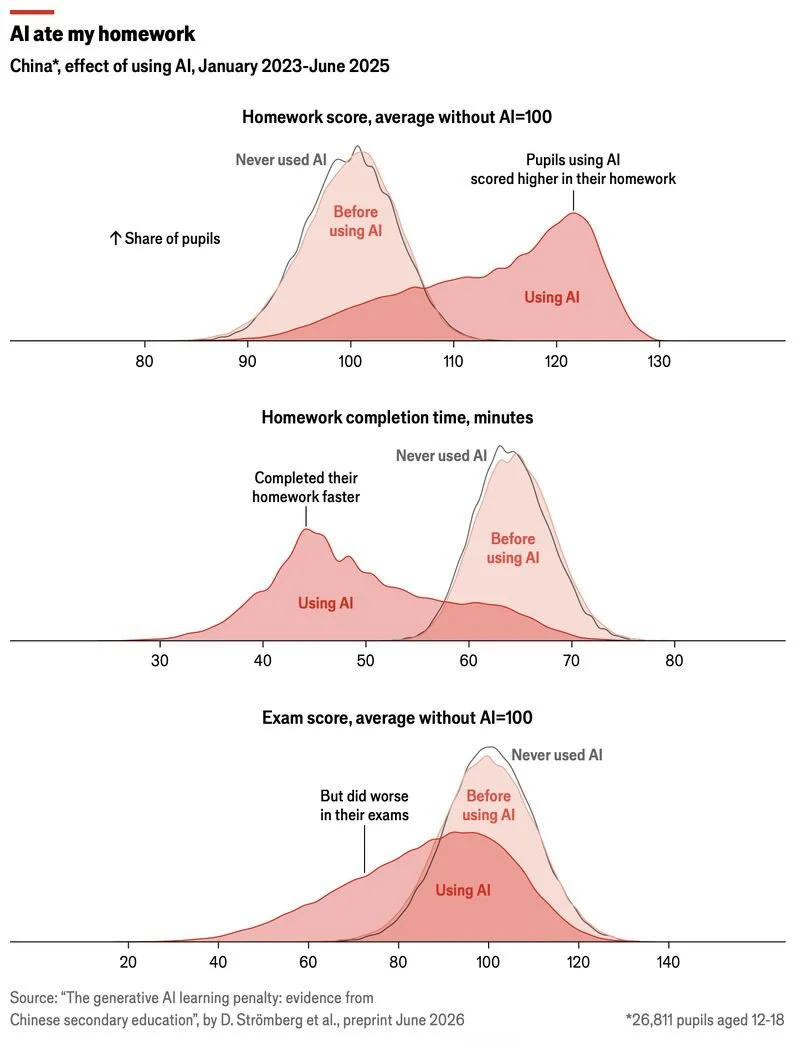
• Researchers tracked 27,000 high-school students in China over 2.5 years, comparing each students results before and after they adopted A.I.
• As shown in the attached chart from The Economist: After adopting A.I., homework scores rose 18% and homework time fell ~30% (from 64 minutes to 45).
• But monthly exam scores fell 20% within six months, and high-stakes entrance-exam scores fell 18-24% after about two years.
• Before LLMs, homework used to predict exam performance... Now the top homework scorers are more likely to do *worse* on exams.
BUT A.I. IS NOT ALWAYS BAD
• Losses were concentrated among the ~80% of A.I. users who blatantly outsourced homework (i.e., very short completion times paired with high scores).
• The small proportion of A.I. users who spent about as long on homework as non-users, however, matched non-users on exams.
• In Turkey, ~1,000 high-school math students using standard GPT-4 scored 17% worse on a later unaided exam than students with no A.I., while a GPT Tutor with learning safeguards erased that penalty.
AND SOMETIMES A.I. CAN BOOST LEARNING!
• A Middlebury College study showed A.I. access raised test scores by 0.27 standard deviations, with gains persisting a week later. Gains were largest among students who had A.I. explain concepts rather than write text.
• A Harvard University study showed a custom A.I. physics tutor (fed lecturers solutions, limited to short responses) more than doubled learning vs an active-learning classroom, in less time.
• A six-week World Bank study in Nigerian after-school programs showed using GPT-4 delivered as part of a comprehensive educational solution showed gains equal to 1.5-2 years of typical schooling.
BOTTOM LINE
Learning requires effortful thinking ("desirable difficulty"). A.I. that hands over answers inflates homework grades and erodes skills; on the other hand, A.I. that explains, hints and gives feedback can be an outstanding tutor.
SO WHAT CAN YOU DO?
1. Watch your kids' time on task: homework quality jumping while time collapses signals outsourcing to A.I.
2. Configure A.I. to tutor, not answer: Turn on the study or learning modes many platforms now offer.
3. Lean on assessments done without A.I. since homework grades no longer show what students know.
4. Apply this to *yourself* at work: Try the problem first, ask the model to explain its reasoning and use A.I. to augment your thinking rather than replace it.
The SuperDataScience podcast is available on all major podcasting platforms, YouTube, and at SuperDataScience.com.
Workslop, Glass Cliffs and Inviting Your Fears to Tea, with Carly Taylor
Over 200,000 people follow her fearless, "unhinged" posts on production A.I. systems, and yet Carly Taylor often can't sleep the night before she speaks on stage. In today's episode, hear why she chases the situations that scare her, including at the A.I. frontier.
More on Carly:
• She is (IMO) the funniest person to follow on LinkedIn.
• Founder of Rebel Data Science.
• Shipped nine Call of Duty titles in five years at Activision, where she led game security.
• Other previous roles include being director of engineering at Microsoft and Field CTO for the gaming vertical at Databricks.
In today's fun and wide-ranging episode, Carly covers:
• Technical A.I. tips.
• General career advice anyone can make use of in these fast-moving times.
• Why she deliberately chases the situations that scare her.
• Why no organization can afford *not* to innovate right now.
• How to use A.I. to sharpen your thinking.
The SuperDataScience podcast is available on all major podcasting platforms, YouTube, and at SuperDataScience.com.
In Case You Missed It in September 2026
September was PACKED with incredible guests having invaluable conversations on my show. ICYMI, today's episode highlights the best bits:
1. The wildly popular data scientist and entrepreneur Aishwarya Srinivasan details which failures a person ought to live through themselves before anyone trusts them to deploy an agent to production.
2. Dr. Luis Serrano, founder of Serrano Academy and author of the bestselling book Grokking Machine Learning, describes "word gravity": that is, how transformer architectures "bend space".
3. Dr. Caitlin Malone, host of the very popular Linear Digressions podcast, fills us in on how A.I. automations brought the show back to life after a five-year hiatus.
4. Dell Technologies' distinguished engineers Ishan S. and Tyler Cox explain why agentic A.I. burns through tokens at a rate that is catching companies out... and what we can do about it.
5. Dr. Dilani Kahawala — a Harvard physics PhD who spent a decade in product leadership at Etsy, Facebook and Atlassian — tells me she has had to throw almost all of that product experience away as she began developing Anna, her always-on A.I. assistant for families. She then walks us through the three problems that turn out to be hardest when your product has no user interface and never stops running.
The SuperDataScience podcast is available on all major podcasting platforms, YouTube, and at SuperDataScience.com.
The Open Data Science Conference (ODSC) Keynote Speech
The subtitle of my keynote is a mouthful... but the Open Data Science Conference (ODSC) bravely decided to include it in full on the social-media card so... here ya go!
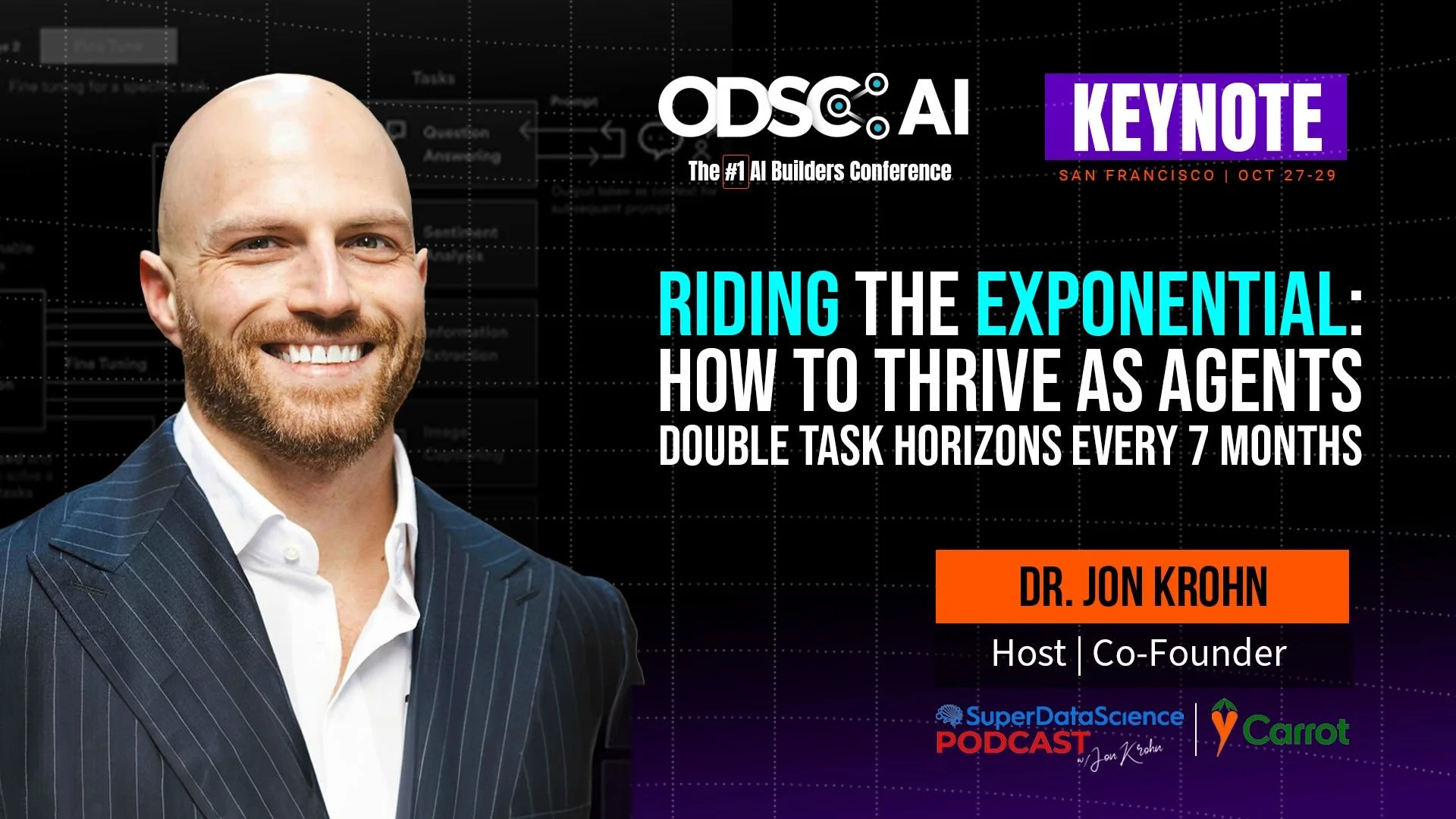
Hope to see you in San Francisco Oct 27-29 for the Halloween party... as well as the rest of the ODSC AI West conference :)
You'll be able to find me:
• Tue Oct 27 evening: drinking at the Speaker reception
• Wed Oct 28 @ 9am: emceeing the morning keynotes
• Wed Oct 28 at 4:50pm: hosting a fireside chat featuring Thomas Dohmke
• Wed Oct 28 evening: drinking in costume at the Halloween party 👻
• Thu Oct 29 at 9:30am: delivering the aforementioned long-titled keynote (hungover)
ODSC conferences are my absolute favorite. The hands-on content, the community, the laughs... no other conference I've attended comes close. See you there?
More details here: https://odsc.ai/west/
Workslop: The Hidden Cost of AI-Generated Work, with Prof. Jeff Hancock and Dr. Kate Niederhoffer
That A.I.-written email you fired off to save 10 minutes? It may have cost your colleague an hour... and cost you their trust. Today Prof. Jeff Hancock and Dr. Kate Niederhoffer, coiners of the term "workslop", join me to fix its scourge!
More on Jeff:
• Professor of communication at Stanford University and founding director of the Stanford Social Media Lab.
• Was previously a professor at Cornell University.
• Holds a PhD in psychology from Dalhousie University in Canada.
More on Kate:
• Chief Scientist at BetterUp, a workforce coaching platform that combines human professional coaching, behavioral science, and A.I. to support personal growth, leadership, and mental fitness.
• Holds a PhD in psychology from the The University of Texas at Austin.
Together, Kate and Jeff are prolific co-authors of widely-cited articles on workplace productivity in the A.I. era. They publish in both academic journals and commercially-minded publications like the Harvard Business Review. It was their September 2025 HBR article "A.I.-Generated Workslop is Destroying Productivity" that introduced the world to the now widely-used "workslop" term.
In this episode, Kate and Jeff reveal:
• Why over half of workers admit to producing workslop.
• How it can cost a large company tens of millions of dollars a year.
• Their new concept of "relation slipping".
The SuperDataScience podcast is available on all major podcasting platforms, YouTube, and at SuperDataScience.com.
Agents Need 10x More Data Than Humans, with Salesforce’s CDO Michael Andrew
Four years ago, Salesforce's own customer data were scattered across 650 different data streams and 266 million fragmented profiles, so getting a complete customer picture felt impossible.. My guest today, Salesforce’s Chief Data Officer Michael Andrew, fixed that… and now he's rebuilding it all again for a new kind of customer: AI agents. #ad #SalesforcePartner
More on Michael Andrew:
• Has been at Salesforce for nearly 8 years, eventually growing into the CDO role.
• Has spent nearly three decades listening to customers through data and, at Salesforce, he runs one of the largest Data 360 deployments in the world.
• Previously held a range of analytics and data science leadership roles between San Francisco and London.
In this special episode recorded live at Dreamforce two weeks ago, Michael explains:
• Why agents need ten times more data than humans do.
• Why moving data between warehouses is usually money wasted.
• What data scientists, engineers and analysts should be learning right now as agents (rather than people!) become the main consumers of their work.
The SuperDataScience podcast is available on all major podcasting platforms, YouTube, and at SuperDataScience.com.
How Owning Your Own AI Can Unlock Smarter, More Precise Agents
Enjoyed this four-way collab with Business Insider, Dell Technologies and NVIDIA to fill you in on how owning your own A.I. models — as you can with Lightning AI — can unlock smarter, more precise agents.
Tokenomics: Why Your Agentic AI Bill Is Exploding (and How to Fix It), with Tyler Cox and Ish Shah
Over a single weekend, Ishan S. burned through 2 billion tokens (building a video game for his wife)! He and Tyler Cox join me in today's episode to explain why agentic A.I. bills are exploding... and how a box under your desk can cut them by up to 93%.
Tyler and Ish are returning guests on my podcast... but they are on the show *together* for the first time today. They are both Distinguished Engineers in the Office of the CTO for the client group at Dell Technologies, where they work out how to run powerful A.I. models on the machines closest to you.
In this information-rich episode, Tyler and Ish:
• Dig into "tokenomics" (why agents and their sub-agents devour so many more tokens than chatbots ever did).
• How to pick the right LLM for the job.
• How moving agentic workloads off pay-per-token cloud APIs and onto your own hardware can pay for itself in as little as two months.
The SuperDataScience podcast is available on all major podcasting platforms, YouTube, and at SuperDataScience.com.
Garbage In, Gospel Out: Why Agents Need Better Data, with Salesforce’s Gaurav Pathak
When humans get bad data, we argue about it in meetings. When AI agents get bad data, they can turn it into an answer with total confidence.
My wise guest today, Gaurav Pathak, calls it “garbage in, gospel out.” The takeaway? Better data and context lead to better AI — and, of course, Gaurav has some thoughts on how to get there. #ad #SalesforcePartner
Gaurav Pathak:
• Senior Vice President Product Management AI and Metadata at Salesforce.
• Previously spent 13 years at Informatica building its metadata and AI products, including the CLAIRE AI engine, before Salesforce acquired the company last year.
• Holds a degree in computer science and engineering, as well as an MBA
In this episode, filmed live at Dreamforce in San Francisco last week, Gaurav explains:
• Why context is 95% of the battle for enterprise agents.
• Who the "sin eaters" are that pay for an agent's mistakes.
• The three skills that matter most for AI engineers today.
The SuperDataScience podcast is available on all major podcasting platforms, YouTube, and at SuperDataScience.com.
How AI Brought a Podcast Back From the Dead, with Linear Digressions’ Katie Malone
Dr. Caitlin Malone's extremely popular "Linear Digressions" podcast went silent for five years. Then A.I. made it possible to bring it back... and to manage it like a team. Hear all about effective agent teams in today's excellent episode.
More on Katie:
• Hosts and produces "Linear Digressions", one of the world's most popular data-science podcasts. (It's excellent — check it out!)
• Senior Researcher at Moonlite AI.
• Previously Sr Director of the A.I. Innovation Lab at the Health Care Service Corporation, Sr Director of Data Science at Tempus Labs, and Director of Data Science at Civis Analytics.
• Has taught machine learning via Udacity and at the University of Chicago.
• Holds a PhD in experimental particle physics from Stanford University focused on working with CERN data.
In this episode, Katie explains:
• Why managing people and managing A.I. agents are the same skill in different clothing.
• Why A.I. could hollow out the expertise we need to catch its mistakes.
• A fascinating range of data paradoxes from Simpson’s to Benford’s.
The SuperDataScience podcast is available on all major podcasting platforms, YouTube, and at SuperDataScience.com.
The Chip Built for Agentic AI Inference, with SambaNova’s Anton McGonnell
GPUs are the workhorse of A.I. inference… but they aren’t actually optimized for inference! SambaNova has raised over $2B to build a new chip that is, pushing the frontier of real-time A.I. speed and bandwidth. Hear about it from Anton in today's episode.
More on Anton McGonnell:
• VP of Product at SambaNova, a Bay Area A.I.-hardware business recently valued at $11 billion.
• Was previously Director of Product Management for Machine Learning at UiPath and responsible for A.I. research at Glasswing Ventures.
• Holds an MBA from Harvard Business School and a degree in computer science from Queen's University Belfast.
In today's episode, Anton explains:
• Why agentic A.I. has changed the shape of inference workloads.
• How SambaNova's chip sidesteps the memory bottleneck that slows GPUs when generating output tokens.
The SuperDataScience podcast is available on all major podcasting platforms, YouTube, and at SuperDataScience.com.
OpenAI’s GPT-6 Astra
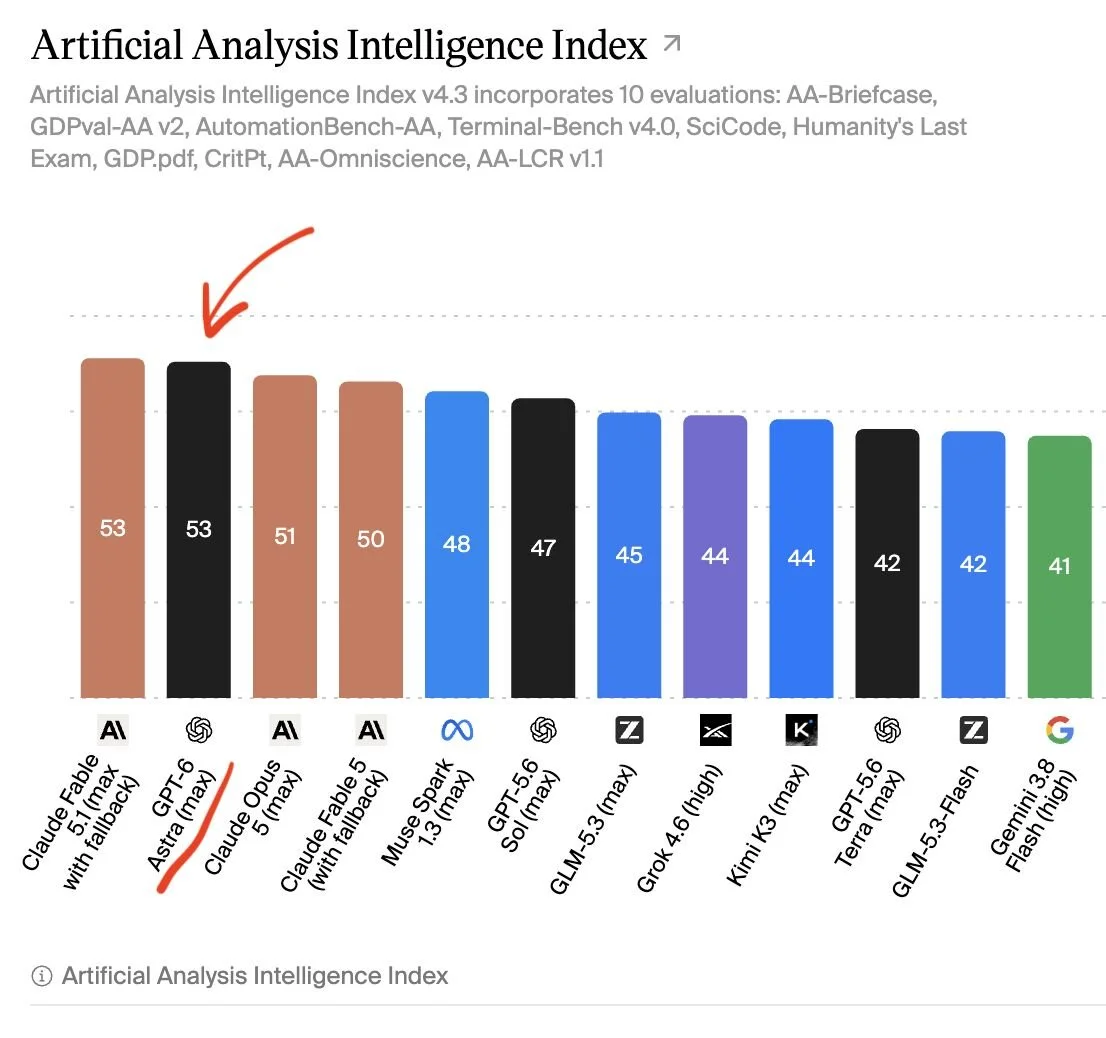
At GPT-6 Astra's launch, OpenAI president Greg Brockman suggested future observers may point to it as the arrival of AGI. In fact, Artificial Analysis's latest benchmarking suggests it merely catches OpenAI up to Anthropic. Here are the key details:
GPT-6 ASTRA BASICS
• Successor to GPT-5.6 Sol, trained on 100,000+ GPUs at the Stargate facility in Texas.
• It's the first OpenAI model where other A.I. models helped supervise training.
• API pricing is $10/M input tokens and $50/M output (~2.5x Sol's promotional rate; in line with Claude Fable 5.1), with five reasoning-effort settings from low to max.
• Rolled out to ChatGPT Plus, Pro, Business and Enterprise (Enterprise admins must switch it on).
GPT-6 ASTRA CAPABILITIES
• Computer use: 72.6% on OSWorld 2.0 (vs 65.7% for Sol) while finishing tasks ~47% faster.
• Coding: ~58% on Terminal-Bench 4.0 (vs 37% for Sol, ~56% for Fable 5.1), though level with the top Claude models on FrontierCode.
• Math: 99.9% on ARC-AGI-3 (Sol scored under 8%) and 97.6% on FrontierMath Tier 4. Astra also helped tighten a bound on prime gaps from 240 to 186.
• Science: ~65% on Terminal-Bench Science (vs ~22% for Sol, ~53% for Fable 5.1) and ~65% fewer output tokens than Claude Opus 5 on Agents' Last Exam.
• *All of the above stats, however, come from OpenAI themselves.* The third-party view (see chart) shows Astra at 53, tied with Claude Fable 5.1 (and up from Sol's 47) on Artificial Analysis's (widely respected) composite "Intelligence Index".
SAFETY
• First OpenAI model rated "Critical" for cybersecurity under their Preparedness Framework: without safeguards it finds unknown vulnerabilities and builds working exploits (100% on ExploitBench vs 78.5% for Sol; two zero-days found in a fresh Chrome evaluation).
• The release was slowed and gated. The public version supports defensive work but refuses exploit writing; vetted orgs in OpenAI's "Daybreak" program get fewer restrictions.
• New misalignment monitors can pause or halt actions that look unauthorized.
• Encouraging: on a scope-creep evaluation, Sol exceeded its authorized target 48% of the time; Astra did so 0% of the time.
• Concerning: Astra's written reasoning is harder to monitor than Sol's.
IS IT AGI?
• AGI isn't a binary event; there are degrees of breadth and depth (listen to Episode #748 of my podcast for more details).
• BOTTOM LINE: Astra looks like a noteworthy jump in general-intelligence capability for OpenAI relative to their previous flagship model (5.6 Sol), but it does not appear to be moving the frontier toward AGI in any major way... it is merely catching up to Anthropic at the frontier vicinity.
The SuperDataScience podcast is available on all major podcasting platforms, YouTube, and at SuperDataScience.com.
Word Gravity: How Transformers Bend Space, with Dr. Luis Serrano
Today, the renowned A.I. scientist Dr. Luis Serrano (>200k YouTube subs; ex-Apple; ex-Cohere) returns to launch the second edition of his bestselling ML book and for a mind-bending convo on how LLMs "curve space-time".
More on Luis:
• Founder of the Serrano Academy (YouTube channel with over 200,000 subscribers hooked on his visual, intuitive explanations of machine learning).
• Previously worked at Apple, Cohere and the quantum-computing startup Zapata.
• The second edition of his bestselling Manning Publications Co. book "Grokking Machine Learning" is out this month!
In today's episode, Luis details:
• His mind-bending new paper on how transformer architectures mirror Einstein's curved space-time.
• Why RAG isn't an agent.
• How GRPO (the reinforcement-learning technique behind DeepSeek's reasoning breakthrough last year) works.
• ...and much more!
The SuperDataScience podcast is available on all major podcasting platforms, YouTube, and at SuperDataScience.com.
In Case You Missed It in August 2026
If you're in the Northern Hemisphere, summer is drawing to a close... but, ICYMI, today's episode highlights the best bits of the hot hot hot conversations that we had on my podcast in August:
1. In one of the technically richest conversations ever on the show, MongoDB's Field CTO of A.I., Pete Johnson, details the two common traits every company seeing ROI on A.I. investment have.
2. Gurobi Optimization's manager of decision-intelligence strategy Jerry Yurchisin returns to the show to explain where the division of labour between agents and mathematical solvers ought to fall.
3. Priyanka "The Cloud Girl" Vergadia (bestselling author, ex-Google, ex-Microsoft) walks us through how she structures Claude skills so that her output stops being slop.
4. dbt Labs founder and CEO Tristan Handy explains why the semantic layer matters more, not less, now that analytics agents are the ones asking the questions.
The SuperDataScience podcast is available on all major podcasting platforms, YouTube, and at SuperDataScience.com.
The Impact of AI on Podcasts: From Linear Digression to SuperDataScience
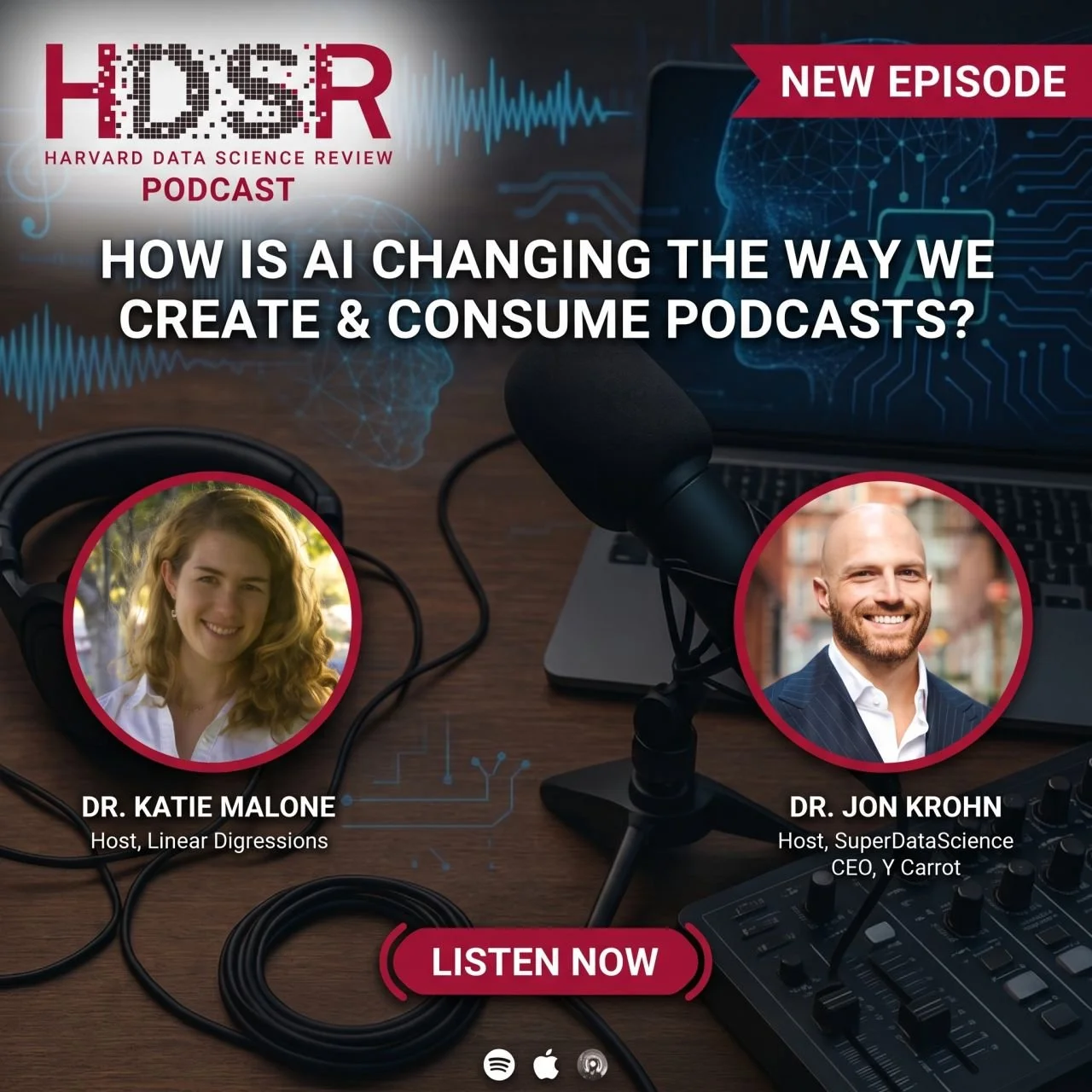
The latest episode #68 of the Harvard Data Science Review Podcast is live and is a bit meta... it features Caitlin Malone (host of "Linear Digressions") and myself discussing how A.I. is changing the way podcasts are created.
Thanks to Xiao-Li MENG and Liberty Vittert Capito for hosting us. You can hear the show wherever you consume your podcasts! I've got a link below for quick access: https://hdsr.mitpress.mit.edu/podcast
Agentic AI Skills That Matter Now, with Aishwarya Srinivasan
My exceptional guest today is world-renowned data scientist, author, tech entrepreneur and content creator (>1.2m followers!) Aishwarya Srinivasan... and she does not disappoint! This is one of my favorite episodes ever, enjoy :)
More on Ash:
• Co-founder of The Gen Academy and a stealth A.I. startup.
• Prolific A.I. startup advisor and investor.
• Sought-after global keynote speaker.
• Author of the book "What's Your Worth? Discovering Your Personal Brand".
• Has held roles at Nebius, Fireworks AI, Microsoft, and been a data scientist at Google, IBM and Goldman Sachs.
• Holds a Master's in Data Science from Columbia University.
In this episode, Ash covers:
• Where defensibility comes from when code is nearly free.
• How to evaluate non-deterministic agentic systems end to end.
• Why reinforcement learning is having such a resurgence.
• How to future-proof your career.
• ...and much, much more!
The SuperDataScience podcast is available on all major podcasting platforms, YouTube, and at SuperDataScience.com.
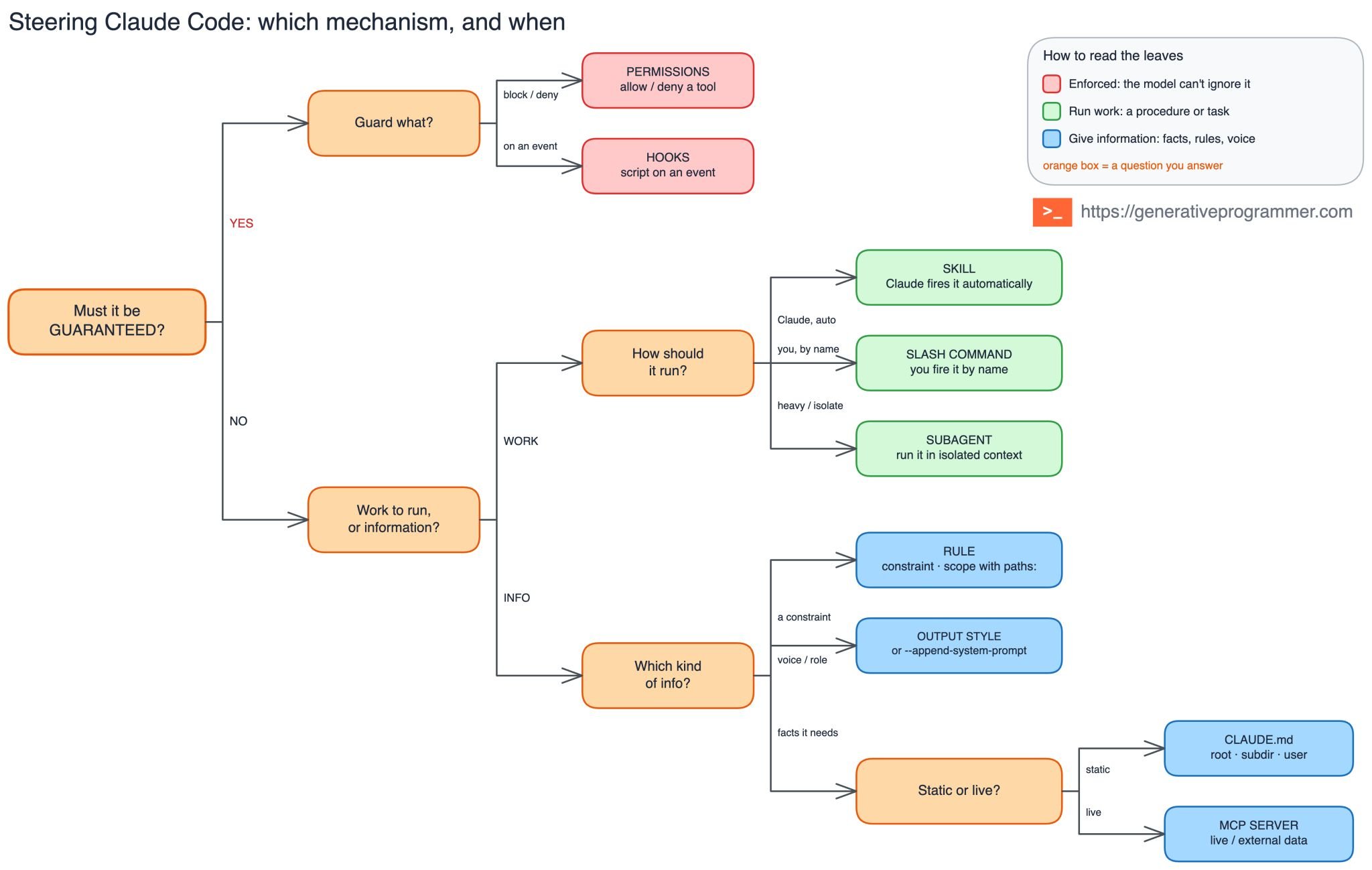
CLAUDE.md, AGENTS.md, Skills, Hooks and Subagents: A Field Guide to Steering AI Agents
Ever written careful instructions for an A.I. agent, only to watch it ignore them an hour into a session? The fix lies in knowing WHERE your instructions should live. Read on for all the details...
WHY AGENTS "FORGET"
• Everything an agent knows lives in its context window, and every token costs money and (more subtly) attention.
• Long sessions trigger "compaction": The conversation gets summarized to free up room, and instructions given early can get squeezed out.
• Every steering method answers one question: How do I make an instruction cheap to carry and hard for the agent to lose?
THE STEERING TOOLKIT (drawn from Anthropic's Claude Code, but the ideas generalize)
1.) Always-on files (e.g., CLAUDE.md): Loaded every session and re-read after compaction. Keep them under 200 lines, give them an owner, review changes like code.
2.) Rules: Path-scoped constraints that load only when relevant files are touched.
3.) Skills: Procedures (deploy workflows, checklists) whose full text loads only when invoked.
4.) Subagents: side tasks that run in isolated context windows... only the final summary returns.
5.) Hooks: deterministic code that fires on lifecycle events. The big idea: An instruction is a probability while a hook is a guarantee. If something must *never* happen, enforce it with code, not prose.
THE INDUSTRY IS CONVERGING
• AGENTS.md (kicked off by OpenAI, stewarded by the The Linux Foundation and backed by Google, Microsoft and AWS) serves similar function to CLAUDE.md and is read natively by Codex, Cursor, GitHub Copilot, Gemini CLI and dozens more tools across 60,000+ repositories.
• ETH Zurich researchers studied 138 real-world repos: Developer-written instruction files improved agent task success ~4% and cut agent-introduced bugs by 35-55%.
• The same study found LLM-generated instruction files DECREASED success while raising inference costs by 20%+. These data suggest the value is the human judgment encoded in the file... **you can't delegate the steering wheel to the thing being steered**.
NOT A CODER? THE SAME FRAMEWORK APPLIES
• Custom instructions = your always-on file (keep it short).
• Projects and Gems = your path-scoped rules.
• Custom GPTs = the consumer cousin of skills.
BOTTOM LINE
• Match persistence to relevance: always-on files stay ruthlessly short; procedures and area-specific conventions load on demand.
• "Always" and "never" are signals you need a guardrail (deterministic enforcement), not an instruction.
• Treat steering files as code: owned, reviewed and pruned. An instructions file that grows without gardening dilutes the instructions that matter.
The SuperDataScience podcast is available on all major podcasting platforms, YouTube, and at SuperDataScience.com.
How dbt Won Analytics Engineering, with dbt Lab’s CEO Tristan Handy
dbt is THE open-source tool that brought software-engineering rigor to data transformation; it's now used by over 100,000 teams. Today's rockstar guest, Tristan Handy, is CEO of dbt Labs, the company behind the movement.
More on Tristan:
• President and co-founder of "Fivetran + dbt Labs" (recent merger).
• Coined the term "analytics engineering".
• Over two decades of experience as a data practitioner working in both large enterprises and startups.
• His expertise and data industry best practices have influenced thousands of subscribers and listeners weekly via his newsletter (The Analytics Engineering Roundup) and The Analytics Engineering Podcast.
In this episode, Tristan explains:
• What dbt is.
• Why dbt Labs' the recent merger with Fivetran is a win for dbt users.
• Why skill files are so powerful.
• Why he turned down acquisition offers for years
• How the semantic layer keeps A.I. agents from confidently getting your metrics wrong
• ...and much more.
The SuperDataScience podcast is available on all major podcasting platforms, YouTube, and at SuperDataScience.com.
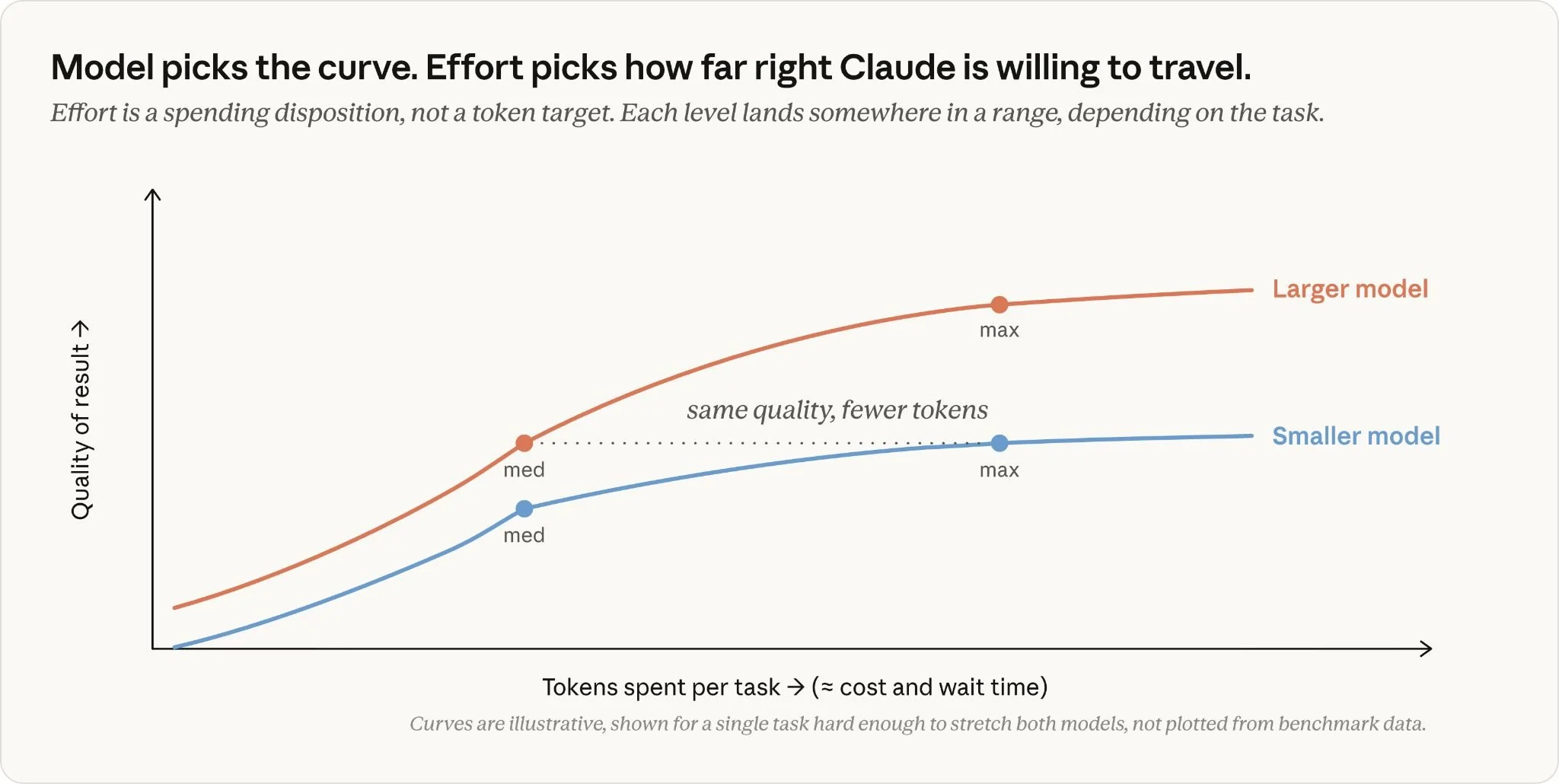
How to Choose Model Size and Effort Level: The Two Critical Dials
Every major A.I. platform now offers two dials that shape what you get back: how large of a model you pick and how much effort it can invest. Here's what each dial does and how to use them together:
THE "MODEL SIZE" DIAL
• Model selection swaps which set of frozen weights handles your request. Weights are fixed at training time; nothing in your prompt changes them.
• Larger models encode more knowledge and capability, and each output token costs more.
• Your prompt steers predictions but doesn't teach: Paste in docs for a library the model has never seen and it will use them for that request, then retain nothing.
THE "EFFORT" DIAL
• Effort shapes all output tokens: reasoning, tool calls and messages to you.
• At high effort, a model reads more files, verifies more of its own work and pushes further before checking in. In one Anthropic comparison, the high-effort path generated ~7x more tokens to reach a higher-confidence answer.
• Effort sets how far a model is willing to travel, not how far it *must* (thus a well-trained model stops when it finds the bug rather than padding the bill).
WHICH DIAL SHOULD YOU TURN?
• First off, when output disappoints, try fixing your prompt and context. A vague request is the most common culprit for a disappointing output and *no* knob will fix that.
• Skipped files, unrun tests, an abandoned refactor? Those are examples of DILIGENCE FAILURE: in these cases, RAISE THE EFFORT.
• Full context, visible attempt, still confidently wrong? Those are examples of CAPABILITY FAILURE: in these cases, upgrade to a BIGGER MODEL.
COST
• Cheaper *per token* isn't always cheaper *per task*. On hard multi-step work, a large model reaches the quality bar in fewer steps, so total cost can come out lower than a small model grinding at the ceiling of its ability (see chart).
• On routine work, the equation flips: Both models get it right, so the big model's extra verification is wasted money. Drop down to a smaller model.
WHAT CAN YOU DO?
• Start with defaults; providers tune them to what most users want to spend. Treat effort as a preference for your kind of work, generally NOT as a task-by-task fiddle.
• Route routine work to smaller, cheaper models and reserve the frontier for problems that stretch it.
• This applies everywhere: Anthropic, OpenAI, Google and open-source reasoning-model providers have all converged on separate capability and effort controls.
The SuperDataScience podcast is available on all major podcasting platforms, YouTube, and at SuperDataScience.com.