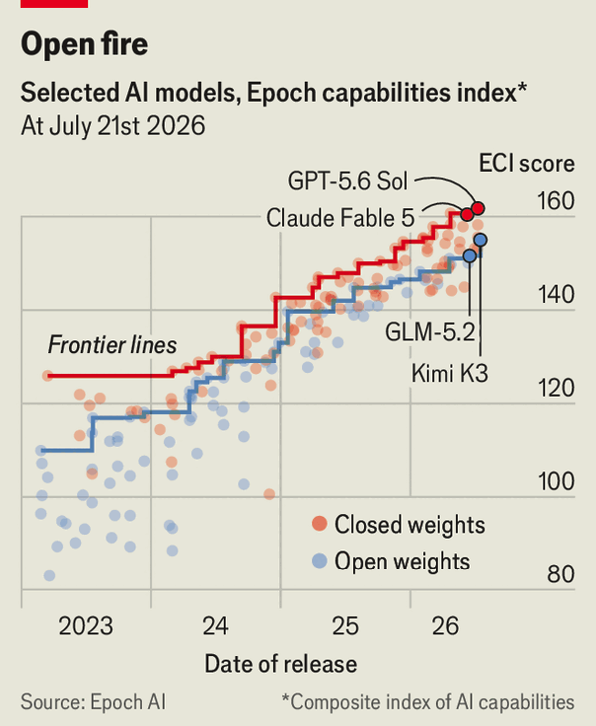
A new model out of China, Kimi K3, has rattled investors globally, kicked off a pricing skirmish among the big American A.I. labs and reignited the open-weight A.I. debate. Here's everything you need to know:
(The attached chart from The Economist tells the story at a glance: Open-weight models like K3 are now nipping at the heels of the closed-weight frontier.)
THE COMPANY BEHIND IT
• Moonshot AI is a Beijing-based startup backed by Alibaba, with a $20B+ valuation and reported annual recurring revenue above $200m.
• K3 is something of a comeback: Moonshot's market position had eroded following DeepSeek's rise last year... now the student of that disruption has become the disruptor.
WHAT IS KIMI K3?
• A 2.8-trillion-parameter model that Moonshot claims is the largest open-weight A.I. model in the world (it is also the largest I'm aware of).
• It's a "mixture-of-experts" architecture: only 16 of 896 "expert" submodules activate per token, so inference costs are far lower than the headline parameter count suggests.
• Features a one-million-token context window, native visual understanding and two architectural innovations ("Kimi Delta Attention" and "Attention Residuals") that reportedly deliver ~2.5x better scaling efficiency vs. the K2 generation.
HOW GOOD IS IT?
• Moonshot itself says K3 trails Claude Fable 5 and GPT-5.6 Sol overall, but beats the next tier down (Claude Opus 4.8, GPT-5.5) on coding and agentic benchmarks (see chart).
• Independent signals are encouraging: K3 scores 57 on the Artificial Analysis Intelligence Index (median for its price tier: 31) and topped Arena's front-end coding leaderboard.
THE PRICING SHAKE-UP
• K3 costs $3 per million input tokens and $15 per million output tokens, undercutting Claude Opus 4.8 ($5/$25) and GPT-5.6 Sol ($5/$30).
• Cache-hit input tokens cost merely 30¢ per million, which is huge for agentic and RAG workflows.
• OpenAI and Anthropic have already responded by expanding token allowances to retain users.
WHAT CAN YOU DO?
• If model weights ship under the promised Modified MIT license (this is expected next week), any will be able to run very-near-frontier-class A.I. on their own infrastructure with no per-token fees and no data leaving their walls.
• Every price war between labs is a subsidy for the applications you're building... the cost of experimenting with world-class A.I. has never been lower and strong open-weight releases like this will continue to bring price pressure in your favor 😎
The SuperDataScience podcast is available on all major podcasting platforms, YouTube, and at SuperDataScience.com.