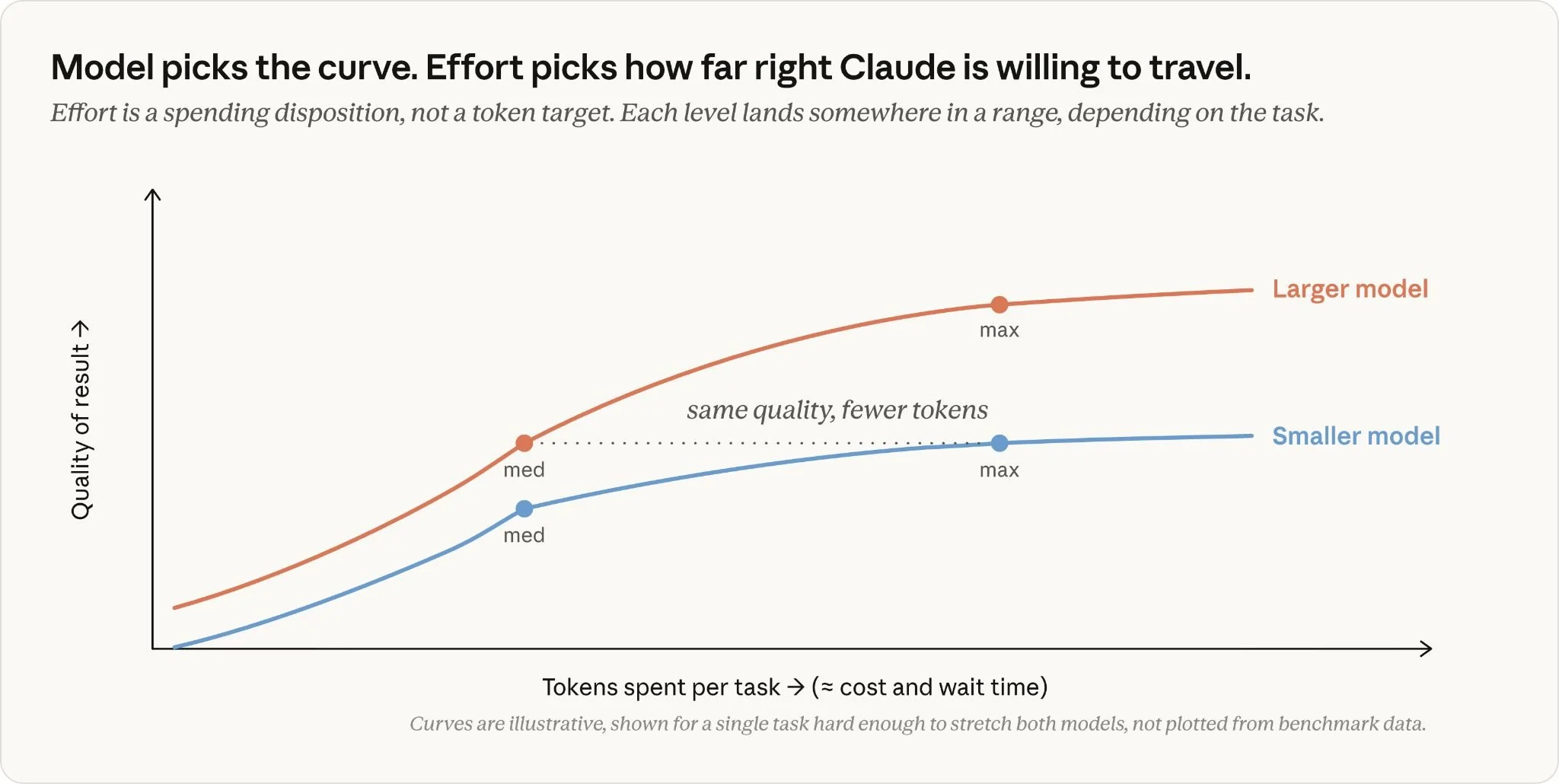
Every major A.I. platform now offers two dials that shape what you get back: how large of a model you pick and how much effort it can invest. Here's what each dial does and how to use them together:
THE "MODEL SIZE" DIAL
• Model selection swaps which set of frozen weights handles your request. Weights are fixed at training time; nothing in your prompt changes them.
• Larger models encode more knowledge and capability, and each output token costs more.
• Your prompt steers predictions but doesn't teach: Paste in docs for a library the model has never seen and it will use them for that request, then retain nothing.
THE "EFFORT" DIAL
• Effort shapes all output tokens: reasoning, tool calls and messages to you.
• At high effort, a model reads more files, verifies more of its own work and pushes further before checking in. In one Anthropic comparison, the high-effort path generated ~7x more tokens to reach a higher-confidence answer.
• Effort sets how far a model is willing to travel, not how far it *must* (thus a well-trained model stops when it finds the bug rather than padding the bill).
WHICH DIAL SHOULD YOU TURN?
• First off, when output disappoints, try fixing your prompt and context. A vague request is the most common culprit for a disappointing output and *no* knob will fix that.
• Skipped files, unrun tests, an abandoned refactor? Those are examples of DILIGENCE FAILURE: in these cases, RAISE THE EFFORT.
• Full context, visible attempt, still confidently wrong? Those are examples of CAPABILITY FAILURE: in these cases, upgrade to a BIGGER MODEL.
COST
• Cheaper *per token* isn't always cheaper *per task*. On hard multi-step work, a large model reaches the quality bar in fewer steps, so total cost can come out lower than a small model grinding at the ceiling of its ability (see chart).
• On routine work, the equation flips: Both models get it right, so the big model's extra verification is wasted money. Drop down to a smaller model.
WHAT CAN YOU DO?
• Start with defaults; providers tune them to what most users want to spend. Treat effort as a preference for your kind of work, generally NOT as a task-by-task fiddle.
• Route routine work to smaller, cheaper models and reserve the frontier for problems that stretch it.
• This applies everywhere: Anthropic, OpenAI, Google and open-source reasoning-model providers have all converged on separate capability and effort controls.
The SuperDataScience podcast is available on all major podcasting platforms, YouTube, and at SuperDataScience.com.