We've done over 1,000 episodes of this show on every layer of the A.I. stack... except the one that physically runs all of it: the A.I. data center. Today we fix that in a fascinating episode with Lightning AI's Frank Basso.
Frank is VP of Infrastructure at Lightning AI, a New York-based company that has over 35,000 modern GPUs, over $500m in ARR, and that makes it easy to go from A.I. idea to product, "lightning fast" (I hold a fellowship at Lightning so am not an unbiased source on the business, btw). Frank himself is based in Los Angeles and, prior to Lightning, he spent decades directing the development of data centers in California.
In this exceptionally informative episode, Frank explains:
• How Lightning provisions its 35,000+ GPUs through hyperscale co-location.
• Why everything new is liquid-to-chip cooled.
• How GPUs talk to each other over ultra-fast east-west networks.
• What it’s actually like to stand inside a 110-decibel A.I. data hall.
• The most persistent myths about data-center water and electricity use.
The SuperDataScience podcast is available on all major podcasting platforms, YouTube, and at SuperDataScience.com.

Filtering by Category: Accouncement
Fable 5: The Full Story from Capabilities to Drama
The dust has settled, allowing me to provide you with all the key context you need to know on Fable 5, the most capable A.I. model ever offered to the public, and the US government forcing it off shelves three days later:
A NEW CLASS OF MODEL
• Anthropic stacks its models in tiers: Haiku (small and fast), Sonnet (the capable middle) and Opus (the powerful top). Sitting above all of them now is a "Mythos-class" tier.
• Fable 5 and its locked-down sibling Mythos 5 are the same underlying model... the only difference is the safeguards.
• Mythos 5 goes to trusted cyberdefenders with guardrails largely lifted; Fable 5 went to the public with them switched on.
WHAT IT COULD DO
• State-of-the-art on nearly every benchmark Anthropic tested... and the lead grows the longer and more complex the task (see chart).
• Stripe ran a codebase-wide migration on 50M lines of Ruby in a single day; work estimated at 2+ months for a full engineering team.
• Beat video "Pokémon FireRed" from raw screenshots alone, and got a 3x bigger memory boost than Opus on "Slay the Spire".
• Priced at $10/$50 per million input/output tokens: roughly 2x Opus 4.8, but under half the original Mythos Preview.
SAFETY BY DESIGN
• Classifiers watch three sensitive areas: cybersecurity, biology/chemistry and distillation (extracting a model to train a rival).
• Flagged requests quietly fall back to Opus 4.8 and the user is told.
• Triggers fire in under 5% of sessions. Anthropic admits it tuned conservatively, so some harmless prompts get bounced too.
THE THREE-DAY SHUTDOWN
• On Friday evening the federal government ordered Anthropic to switch off both Fable 5 and Mythos 5 worldwide, citing national security.
• The mechanism was an export-control action covering foreign nationals everywhere (including even, say, Canadian Anthropic employees living in the US!)... so broad that Anthropic pulled the model for absolutely everyone.
• The trigger was a reported jailbreak of the cyber safeguards by Amazon. Anthropic disputes its severity, calling it narrow and non-universal.
BOTTOM LINE
A premium-tier model, wrapped in deliberately cautious safeguards, pulled by its own government not long before Anthropic's reported IPO and the latest in a public battle between the firm and the federal government. Sessions now fall back to Opus 4.8. Whether Fable returns (and on what terms) depends on a fight that's far from over.
The SuperDataScience podcast is available on all major podcasting platforms, YouTube, and at SuperDataScience.com.
How AI Erased My Career Moat, an Episode #1001 Special: Jon Krohn interviewed by Kirill Eremenko
To mark cresting over 1000 episodes, today’s features a role reversal: Kirill Eremenko (who founded the podcast a decade ago) returns to host and welcomes *me* as the guest. Kirill's still got it, enjoy!
Kirill hosted the first 431 episodes of the SuperDataScience Podcast before handing me the reins five years ago. In today's role-reversal episode, we discuss:
• A.I. rapidly usurping our technical skills
• Whether we’re in an A.I. bubble
• The one key reason why I’ve seen A.I. projects fail
• Relationships between A.I. and biological neuroscience.
... so, as usual, lots of A.I. in this episode, but unusually, I’m the one answering the questions instead of asking them!
The SuperDataScience podcast is available on all major podcasting platforms, YouTube, and at SuperDataScience.com.
Ten Years of the Super Data Science Podcast, with Jon, Kirill and Special Guests
Today, we published Episode #1000 of the SuperDataScience Podcast! To celebrate, the show's original host Kirill Eremenko joined me and dozens of regular listeners on air to predict what the next 10 years of A.I. will bring.
In a bit more detail:
• We publish 104 episodes per year so Episode #1000 coincides with the show being about ten years old.
• The show was founded by Kirill Eremenko in 2016, who hosted over 400 episodes before handing me the reins in 2021.
• In a first for the show, Episode #1000 was streamed live online with our audience invited to join on air.
• Most folks interacted via chat functionality but a number of surprise guests came right onto the recording including Natalie Ziajski and Mario Pombo from the podcast team, rockstar A.I. entrepreneur Jepson Taylor, my 96-year-old grandmother and my very own pa, William Krohn.
• Kirill and I looked back on a decade of the podcast and fielded listener questions on topics such as A.I.’s biggest opportunities, the build-versus-buy dilemma, how to break into the field today, and how to stay grounded amid the relentless pace of A.I.
Thank you for support and listenership over all these years — we make this show for you and couldn't do it without you! We're excited to see what the next decade brings :)
The SuperDataScience podcast is available on all major podcasting platforms, YouTube, and at SuperDataScience.com.
CBS PrimeTime News: OpenAI IPO & Public Ownership of AI
Last night, I was on CBS PrimeTime News to discuss OpenAI's upcoming IPO, as well as Senator Bernie Sanders' plans for an A.I. sovereign wealth fund... an idea I thought could be "awkward".
How This Text-to-Video-Game AI Startup Hit 20M Users
Imagine being able to vibe-code full-blown video games... for free! My returning guest, Dr. Andrey Kurenkov, helped engineer Astrocade to do just that... and already 20 million people have played games through their platform.
More on Andrey:
• Founding A.I. Lead at Astrocade, a Bay Area-based startup that has raised $68m in venture capital to create the TikTok of video games, where creators create games for free and you play them for free.
• Co-host (alongside Jeremie Harris) of my favorite podcast, "Last Week in A.I.".
• Holds a PhD from Stanford University, where his research focused on machine vision and robotics.
In this episode, we discuss:
• The fascinating Astrocade journey, of course.
• The surprising pace of humanoid robotics.
• Why he's a skeptic on Artificial Super Intelligence.
The SuperDataScience podcast is available on all major podcasting platforms, YouTube, and at SuperDataScience.com.
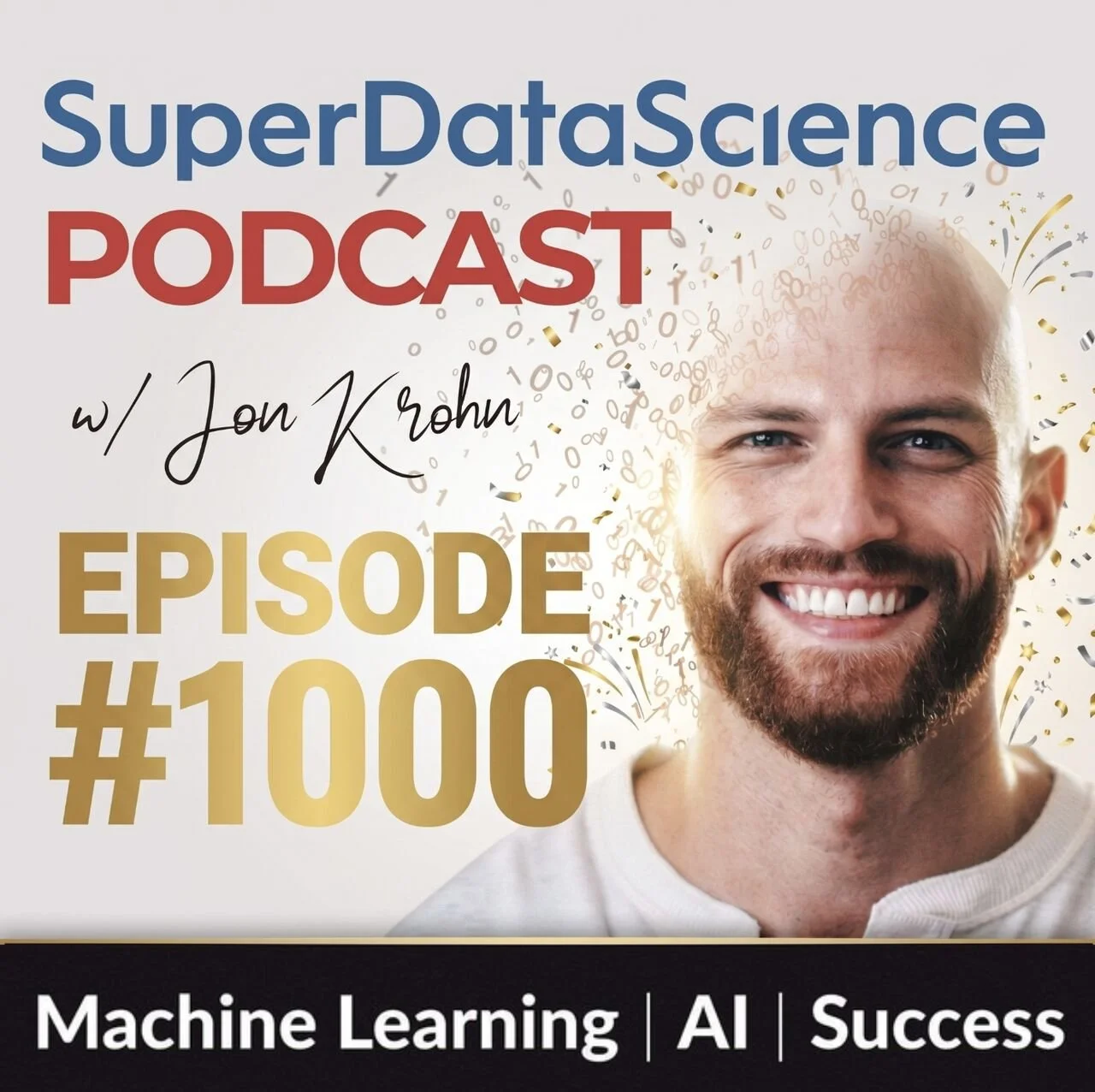
Episode #1000: Join Us Live for the First-Ever Interactive SDS Podcast!
Ten years ago, Kirill Eremenko founded The SuperDataScience Podcast. To celebrate the upcoming Episode #1000, we are inviting you to join us both in a format we've never tried before:
It will be the first-ever interactive episode where you can join in online as we record, and ask your questions... or I suppose just make comments! You'll be able to ask share your thoughts in the chat or come right onto the show via video.
Kirill (founder, original host) and I (current host) will both be there, so you can ask us anything, e.g.:
• Did Kirill think the show would last ten years and 1000 episodes?
• How has data science transformed over the past decade?
• Did Jon have hair on his head ten years ago?
Date: Next Thursday, June 4th
Time: 5pm Eastern Time / 2pm Pacific Time
To get a calendar invite that includes the URL to join us live, check out the Luma link below ⬇️
luma.com/7vl7mdos
The "Super Data Science Podcast with Jon Krohn" is available on all major podcasting platforms and a video version is on YouTube. Whether you join us or not for the interactive recording, Episode #1000 will be published on Friday June 12th!
How to Build AI-First Organizations, with Jacob Miller and Jeremy Mumford
After today's fun episode with Jacob and Jeremy — authors of the brand-new book "Architected Intelligence" — you’ll have all the key info to build successful AI features, AI products and AI-first companies. Enjoy!
Jeremy Mumford and Jacob Miller serve as Lead AI Engineer and Vice President of Platform Intelligence, respectively, at Pattern, a giant Utah-based tech company that IPO’ed on the Nasdaq exchange about six months ago.
Jacob and Jeremy's brand-new "Architected Intelligence" book was published by Wiley and this episode focuses almost exclusively on this invaluable book.
Episode highlights include:
• The "User Agnosticism Tenet", which means designing products and processes so they can be executed equally well by a human, an AI agent, or any hybrid combo.
• The shift in the "define-build-feedback" loop today where "building" is no longer the bottleneck, which means "definition" and "feedback" are where teams win or lose.
• Why workflows are deterministic, predictable, and cheaper than agents, and why the natural progression is skills first, then workflows, and only then agents.
• Why data engineering is the bedrock of AI engineering.
• Why velocity is the only durable moat in a world where everyone has access to the same frontier models.
Thanks to podcast superfan Jonathan Bown for recommending Jeremy and Jacob as guests!
The SuperDataScience podcast is available on all major podcasting platforms, YouTube, and at SuperDataScience.com.
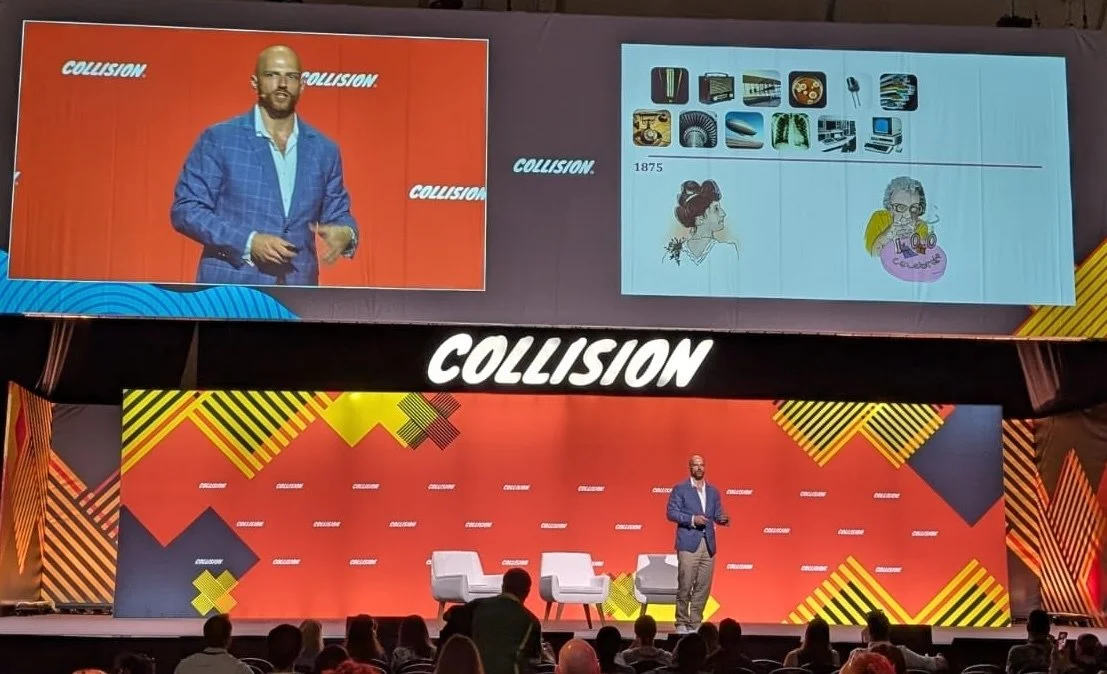
Web Summit Vancouver 2026
"Collision" has grown and re-branded as "Web Summit Vancouver". I'm looking forward to experiencing the new brand for the first time next week! See you there? Here's where you can catch me:
• Tue May 12 at 11am: Mentor Hours on "scaling your startup"
• Wed May 13 at 1:30pm: Delivering my agentic A.I. talk ("Something Big is Happening") on the "A.I. Summit" stage.
• Wed May 13 at 1:50pm: Emceeing the "A.I. Summit" stage all afternoon.
More on Web Summit Vancouver:
• Taking place May 11–14 at the Vancouver Convention Centre.
• It's the second year in a row the conference, under this new brand, has taken place (the previous "Collision"-branded event was held annually in Toronto and the photo in this post is from a talk I gave there in 2024).
• Connects over 35,000 startup founders, investors and industry leaders to discuss A.I., entrepreneurship and tech trends.
Jon Krohn's AI Signature Series: First Two Books are Bestsellers
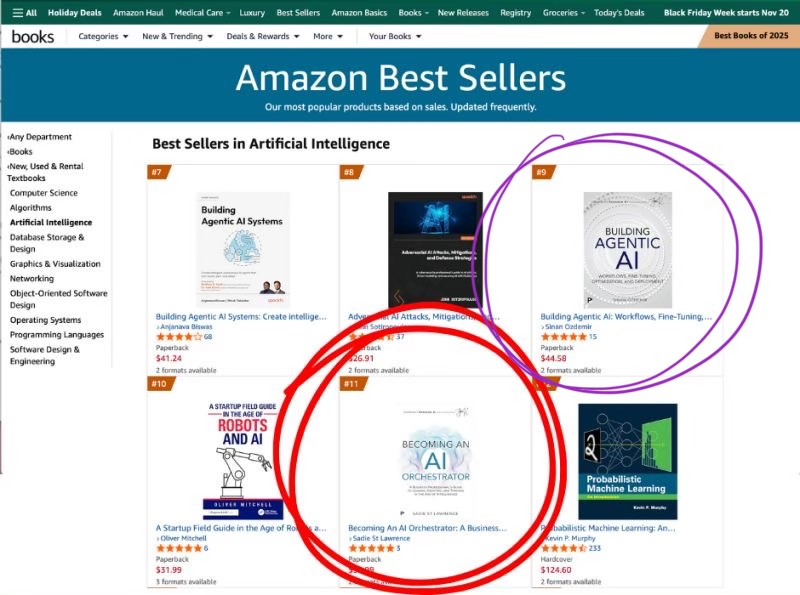
Two books have been published so far in Pearson's "Jon Krohn A.I. Signature Series"... and now both are near the top of Amazon's "Artificial Intelligence" bestsellers list!
Sinan Ozdemir's "Building Agentic A.I." (circled in purple) is in 9th while Sadie St Lawrence's "Becoming an A.I. Orchestrator" (circled in red) is in 11th.
Both books are excellent (as the Amazon reviews quantify) and they are complementary — I (of course!) highly recommend them both.

Book Two in the Pearson AI Signature Series Has Arrived
Announcing today: The second book in my "Pearson AI Signature Series" is "Becoming an AI Orchestrator" by the inimitable Sadie St Lawrence!
Read More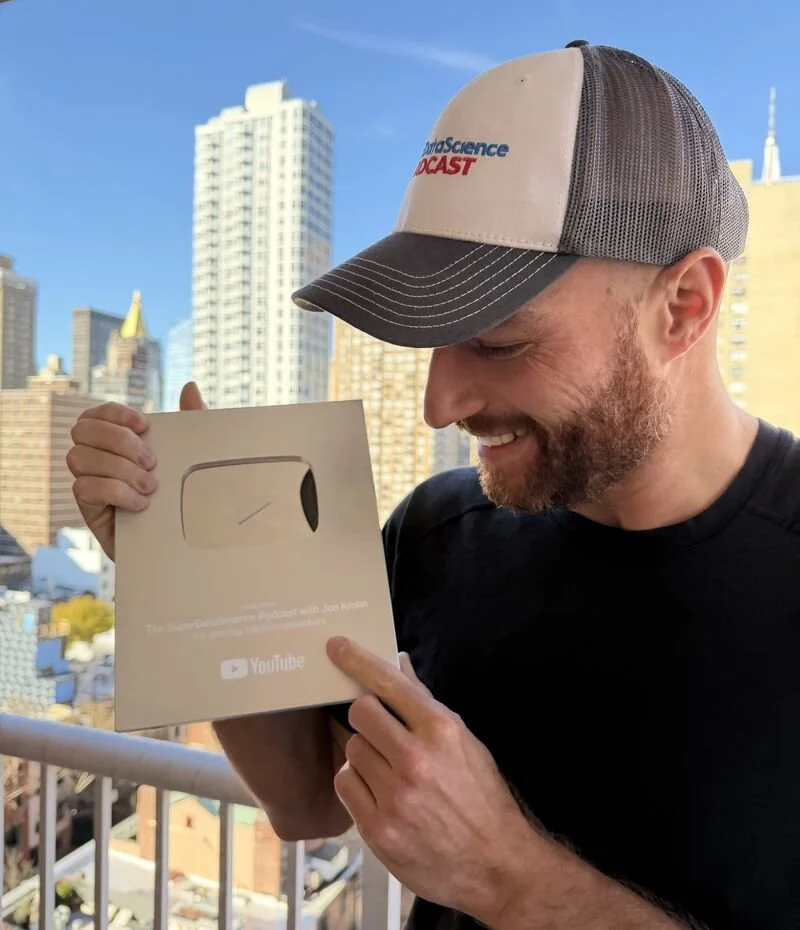
SuperDataScience Podcast Hit 100K YouTube Subscribers
Fun surprise from YouTube in the mail this morning: a plaque commemorating our SuperDataScience Podcast channel for growing to 100,000 subscribers!
Read More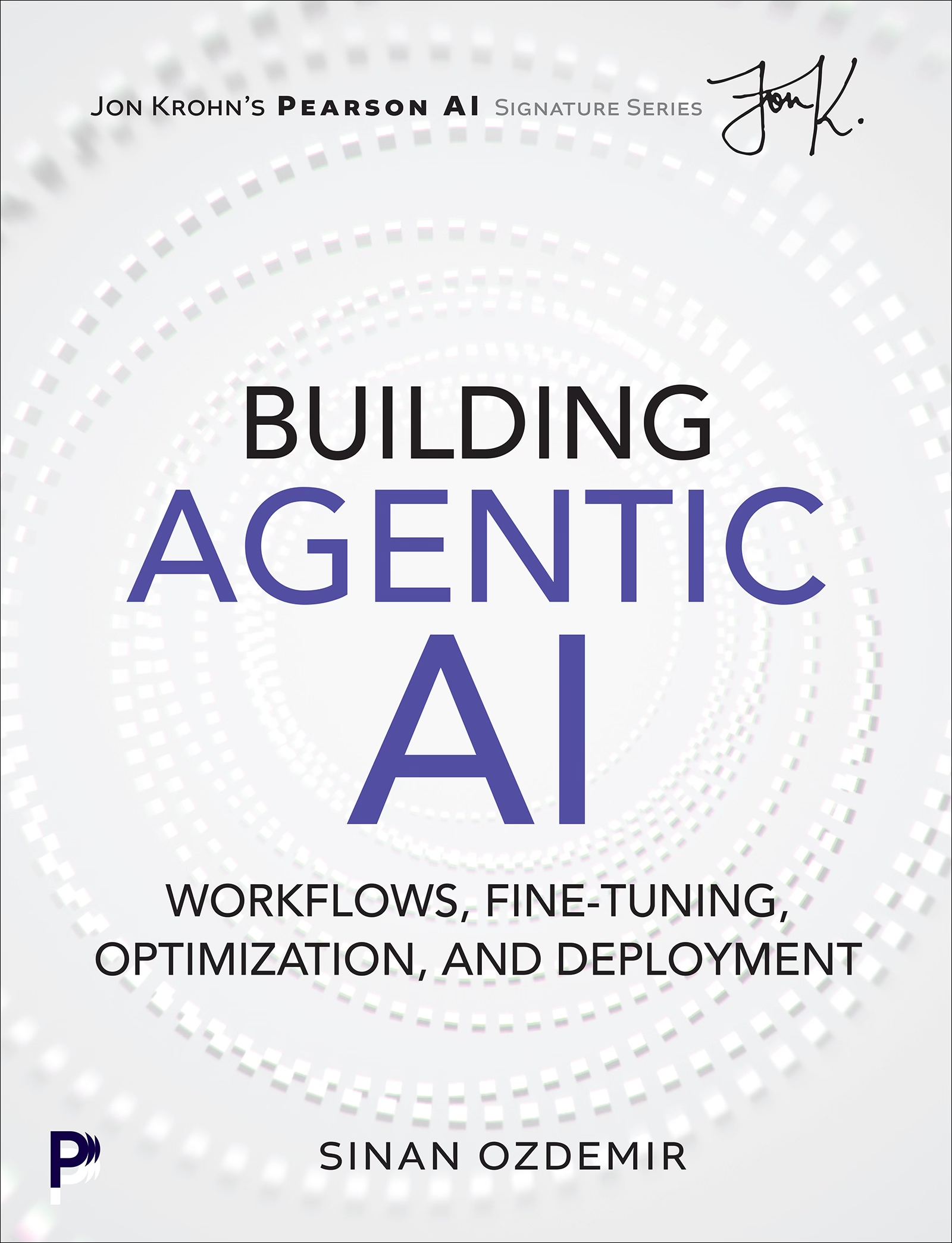
Introducing the First Book in My A.I. Signature Series
I'm delighted to announce that the first book in my "Pearson A.I. Signature Series" is "Building Agentic AI" by the prolific author Sinan Ozdemir... and it will be published on Sunday!
It's available for pre-order now worldwide from wherever you buy your books! You can also read a digital version in the O'Reilly platform today if you have access to it.
The book is packed with hands-on examples in Python and it allows you to master the complete agentic A.I. pipeline, including practical guidance and code on how to:
Design adaptive A.I. agents with memory, tool use, and collaborative reasoning capabilities.
Build robust RAG workflows using embeddings, vector databases and LangGraph state management.
Implement comprehensive evaluation frameworks beyond just "accuracy"
Deploy multimodal A.I. systems that seamlessly integrate text, vision, audio and code generation.
Optimize models for production through fine-tuning, quantization and speculative decoding techniques.
Navigate the bleeding edge of reasoning LLMs and computer-use capabilities.
Balance cost, speed, accuracy and privacy in real-world deployment scenarios.
Create hybrid architectures that combine multiple agents for complex enterprise applications.
Thanks to Debra Williams Cauley, Dayna Isley and many more at Pearson for bringing this series to life. The second book in the series will be available in December and I'll announce that shortly!
Where to Find Me at Web Summit 2025
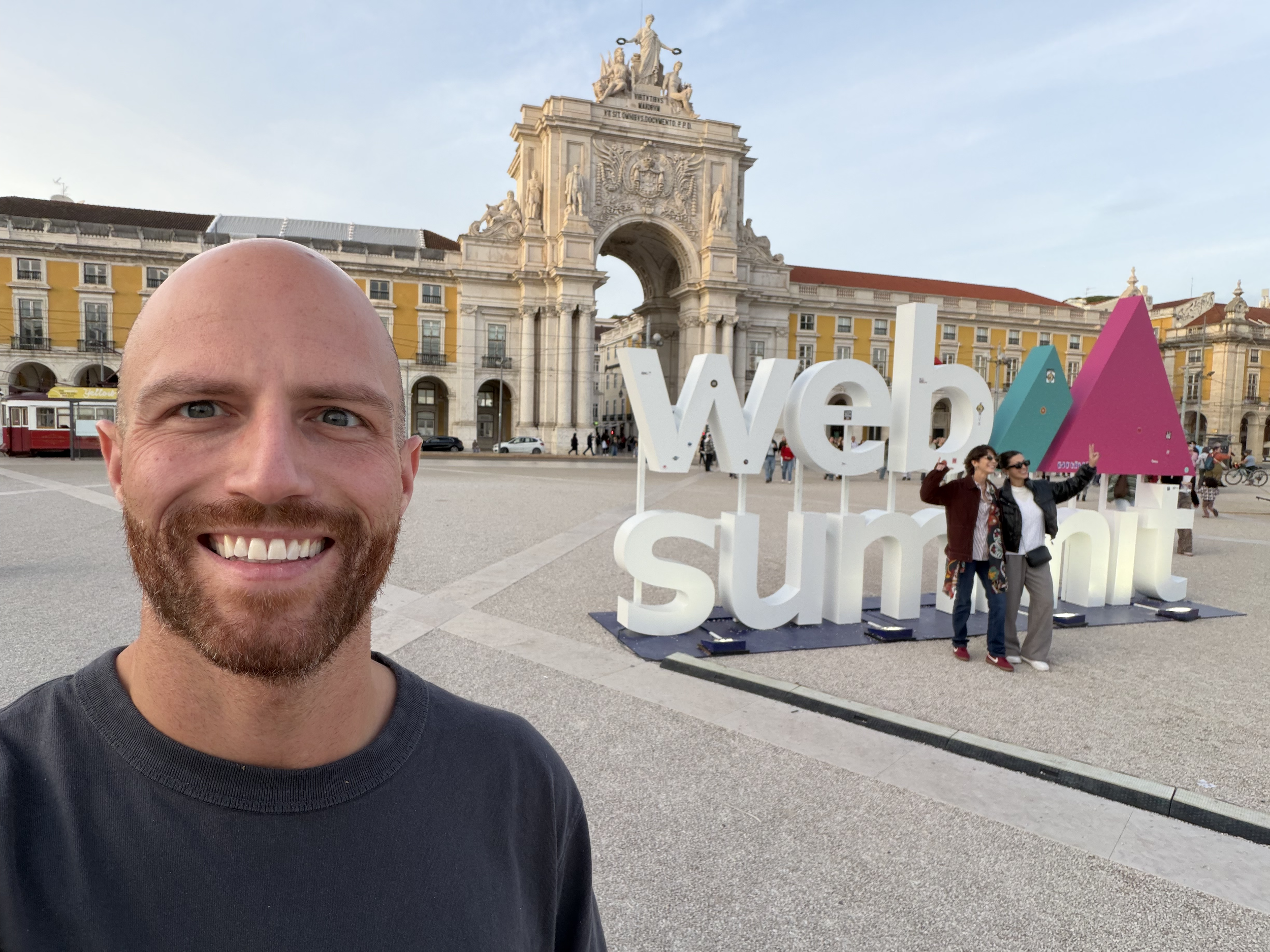
Hello from Lisbon — hope to see you at Web Summit this week! I'll be speaking, emceeing, hosting a meetup and judging a startup competition. Here's where you can catch me:
Tue Nov 11 at 11:30am: I'll be hosting a "Beyond the Stage" Meetup for founders and execs on successful Agentic A.I. projects (at Meetup Location 2).
Tue Nov 11 at 3pm: I'll be a judge in the "Startup Pitch" competition (on Stage 9).
Wed Nov 12 at 1:20pm: "Intro to Agentic A.I." afternoon-opening keynote on the Developer Summit stage.
Wed Nov 12 from 1:40pm to 4pm: Emceeing the Developer Summit stage.
Thu Nov 13 at noon: I'll be providing one-to-one guidance to tech startups on scaling effectively (this is at the official "Mentor Hours" location).
Thanks to Brendan Garrett and Jack Knox for inviting me back! Can't wait :)
My Four-Hour Agentic AI Workshop is Live and 100% Free
In case you missed my post last week, my four-hour Agentic A.I. workshop (with Ed Donner, pictured) is live. 8,000 people have already watched it! Here's what they're saying:
Read More
One Million SuperDataScience Podcast Listens Per Quarter
We've cracked one million listens per quarter for the first time! No doubt buoyed by the mainstream A.I. fascination, but also thanks to our outstanding recent guests, our show had 1.06 million listens in Q1 2023 🍾
The chart shows episode downloads (on podcasting platforms) plus views (on YouTube) for each quarter since I took over as host of The SuperDataScience Podcast in January 2021.
Thank you for listening and providing thoughtful feedback on how we can improve the show. We have fantastic topics lined up for the coming weeks so I'm hopeful we can continue this growth trend in Q2. We're already off to a good start as the past week was — by some margin — the best week for listens in the show's history.
The SuperDataScience podcast is available on all major podcasting platforms, YouTube, and at SuperDataScience.com.


Live podcast recording with Hilary Mason at New York R Conference
Thanks to data science legend Hilary Mason and the engaging audience at the New York R Conference for making Friday's live-filmed episode of the SuperDataScience podcast an exhilarating and illuminating success ⚡️
Look out for Hilary's episode as #589, which will be released on July 5th.

TEDxDrexelU on Deep Learning
I'm giving my first TED-format talk at TEDxDrexelU in Philadelphia on May 21. I'll provide a visual intro to Deep Learning and to the momentous opportunity we have to shape a bewilderingly prosperous world with A.I.
There are only 100 tickets available for sale (for $15!) but my understanding is that my talk will eventually be made available on the TED YouTube channel if you can't make it in-person.
The other compelling speakers are:
• Ebony White, PhD
• Adit Gupta
• Dale Moss
• Nadia Christina Jagessar, MBA
• Dr. Nyree Dardarian
• Raja Schaar, IDSA
Event and ticket details available here.

SuperDataScience Podcast LIVE at MLconf NYC and ScaleUp:AI!
It's finally happening: the first-ever SuperDataScience episodes filmed with a live audience! On March 31 and April 7 in New York, you'll be able to react to guests and ask them questions in real-time. I'm excited 🕺
The first live, in-person episode will be filmed at MLconf NYC on March 31st. The guest will be Alexander Holden Miller, an engineering manager at Facebook A.I. Research who leads bleeding-edge work at mind-blowing intersections of deep reinforcement learning, natural language processing, and creative A.I.
A week later on April 7th, another live, in-person episode will be filmed at ScaleUp:AI. I'll be hosting a panel on open-source machine learning that features Hugging Face CEO Clem Delangue.
I hope to see you at one of these conferences, the first I'll be attending in over two years! Can't wait. There are more live SuperDataScience episodes planned for New York this year and hopefully it won't be long before we're recording episodes live around the world.

ScaleUp: AI Conference
At ScaleUp:AI in New York next month, I'll be moderating a panel on Open-Source Software that features Hugging Face CEO Clem Delangue. Other speakers include Andrew Ng, Allie K. Miller, and William Falcon.
Thanks to the folks at Insight Partners for putting together this high-octane, two-day event, in which you'll hear from the foremost thought leaders and investors on how to unlock your firm's A.I. growth potential.
So excited to be conferencing in-person again and I hope to be able to meet you there! There is a virtual option as well if you can't make it to New York. Whether in-person or virtual, you can use my code "JKAI35" to get 35% off 😀
Conference details/registration here.
Full speaker list here.