
There's mounting evidence that we're in an A.I.-infrastructure investment bubble... but, even if investors lose their shirts, an A.I. bubble bursting would be great news for most of us! How could this be? Read on:
A BUBBLE IS LIKELY HERE
The bull case is that this we're in a boom and the fundamentals will catch up, however various data suggest we're in a bubble.
E.g., OpenAI alone has committed to $600B–$1.4T in infrastructure spending over the coming years — staggering for a company generating ~$13B in annual revenue.
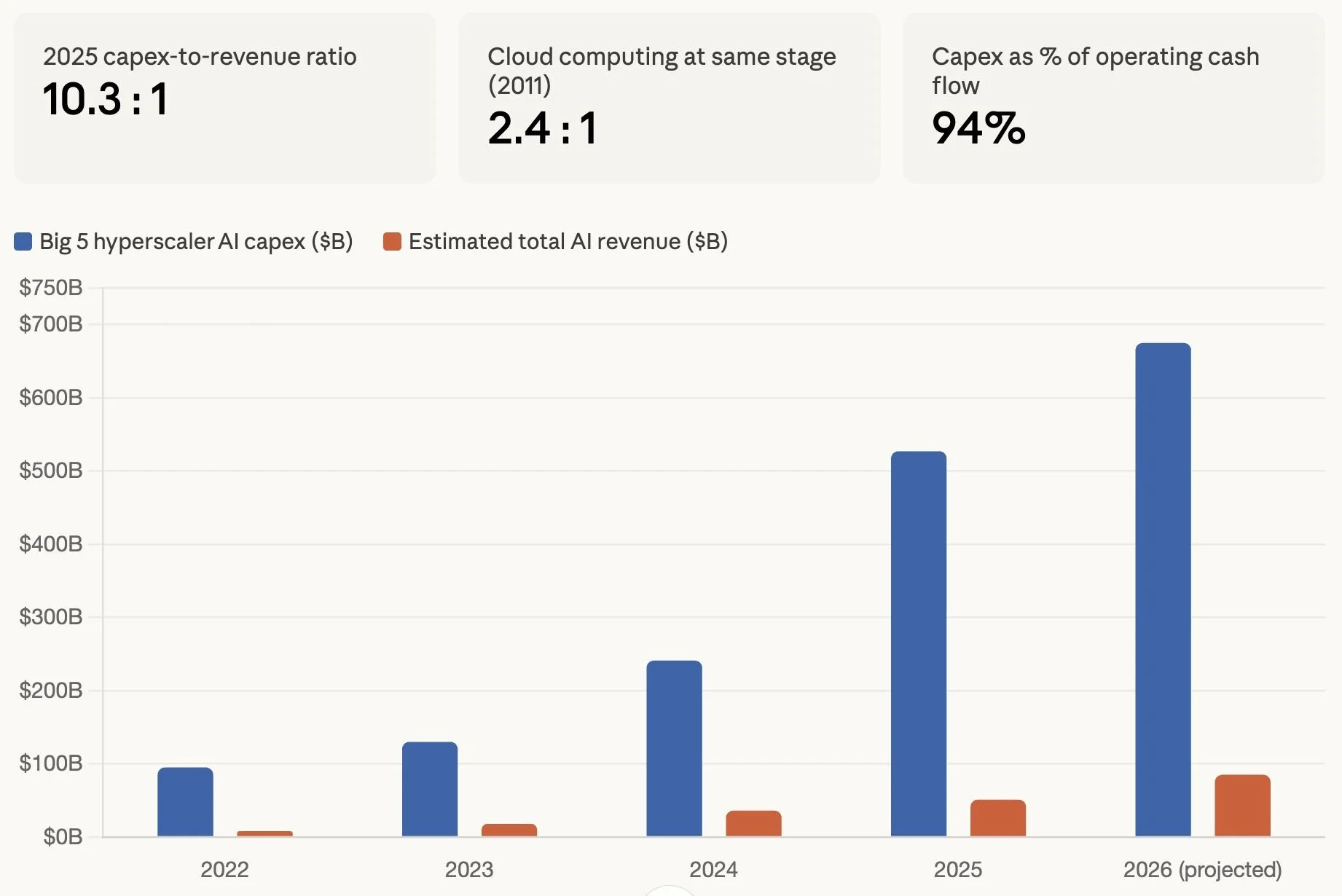
As shown in the chart I made for this post, the five largest hyperscalers had a 10:1 capex-to-revenue ratio in 2025, which dwarfs the 2:1 ratio for cloud-computing investment at the ~same stage.
With capex at 94% of operating cash flow, companies like Google that have famously large cash piles are now issuing bonds.
Circular financing is inflating numbers: NVIDIA pumped $100B into OpenAI so that OpenAI can build data centers full of NVIDIA chips.
WHY BUBBLES AREN'T ALL BAD
Investor Byrne Hobart, CFA argues in his book "Boom" that bubbles have powered many of humanity's greatest breakthroughs — from semiconductors to the Apollo program.
His key insight: participants in a tech race build economic complements to one another. Rising asset prices signal the tech is real, encouraging the investments that make the whole ecosystem work — a self-fulfilling prophecy, but a productive one.
HISTORICAL EVIDENCE
Dot-com era: telecom companies laid 80M+ miles of fiber-optic cable. Most went bankrupt... but bandwidth costs dropped 90%, giving us YouTube, Netflix and cloud computing.
Britain's 1840s railway mania ruined the original investors, yet the network became the backbone of the Industrial Revolution.
Therefore: bubbles leave behind infrastructure the rest of us benefit from for decades.
A WORD ON TIMING
Hobart notes that media called dot-com trading "nutty" back in 1995. Yet at the Nasdaq's post-crash low in 2002, it was still 40% above 1995 levels.
Warning signs of a bubble precede the peak by an unpredictable amount. Acting on them too early can leave you worse off.
WHAT CAN YOU DO?
Diversify your skill set: go deeper into fundamentals (model architecture, optimization, evaluation) rather than relying on wrappers around a single vendor's LLMs.
Build a financial cushion: bubbles create paper wealth and inflated comp packages. Don't let lifestyle inflation consume all of it.
Invest in your network and reputation: When hiring freezes thaw, the people who get picked up first are those other practitioners already know and respect.
The SuperDataScience podcast is available on all major podcasting platforms, YouTube, and at SuperDataScience.com.