
• Home
  • Fresh Content
  • Courses
  • Resources
  • Podcast
  • Talks
  • Publications
  • Sponsorship
  • Testimonials
  • Contact
  • Menu

Jon Krohn

  • Home
  • Fresh Content
  • Courses
  • Resources
  • Podcast
  • Talks
  • Publications
  • Sponsorship
  • Testimonials
  • Contact
Jon Krohn

The “100x Engineer”: How to Be One, But Should You?

Added on February 27, 2026 by Jon Krohn.

This image shows a 3x3 grid of terminals, allowing 9 code-generating agents to be supervised. This is one of Peter Steinberger's tricks to being a "100x Engineer". What are his other tricks? Read on...

THE PHASE SHIFT

  • Andrej Karpathy (OpenAI co-founder, former Tesla AI director) recently went from 80% manual coding to 80% AI agent coding in just weeks; he says he's now "mostly programming in English."

  • This rapid phase shift was facilitated by tools like Anthropic's Claude Code, which (as many of us have experienced personally) have vastly improved their accuracy and capability in the past few months.

THE 100x ENGINEER

  • Developer Peter Steinberger racked up ~6,500 commits over two months adding 2.5 million lines of code (and removing 1.9 million). Many engineering teams ship a few hundred commits per month; he was doing an average of >200 per day!

  • His setup: 3–9 AI coding agents (e.g., Claude Code) running simultaneously in a grid of 3x3 terminal windows, rotating attention across them like a conductor directing an orchestra.

THE COUNTERINTUITIVE 100x WORKFLOW

  • Steinberger now spends *more* time planning, not less. His ratio has flipped from the traditional ~20% planning / 80% coding to ~60% planning / 40% AI execution.

  • He uses a voice-first spec system: dictates raw ideas, uses AI to structure them into a design doc, then asks a fresh AI context to tear the specification apart. He iterates until the critiques become increasingly niche -- his signal that the spec is solid.

  • The key insight from both Karpathy and Steinberger: shift from imperative ("do this step by step") to declarative ("here are the success criteria, figure it out"). Write tests first, then let the agent pass them.

LIMITATIONS/DOWNSIDES

  • AI agents no longer make simple syntax errors — their mistakes have evolved into subtle conceptual errors, like wrong assumptions they charge ahead with without checking.

  • Karpathy notes his manual coding ability is atrophying. Steinberger admits he ships code he never reads — relying on tests as the quality gate.

SHOULD YOU BE A 100x ENGINEER?

  • In my view, "lines of code committed" is not the best benchmark of quality... perhaps aiming for 2x–10x volume increases with a closer eye on quality is wiser than chasing 100x.

  • The main effect shouldn't be speed — it should be an expansion of what's possible because you can now tackle problems that wouldn't have been worth the effort before.

BOTTOM LINE: Think declaratively, invest in specs and testing, and treat AI agents as extraordinary amplifiers of your expertise. Dream up something big and go build it... it's never been easier!

The SuperDataScience podcast is available on all major podcasting platforms, YouTube, and at SuperDataScience.com.
In Five-Minute Friday, Data Science, Podcast, SuperDataScience, YouTube Tags superdatascience, AICoding, AgenticAI, FutureofWork

The Laws of Thought: The Math of Minds and Machines, with Prof. Tom Griffiths

Added on February 24, 2026 by Jon Krohn.

Based on his latest bestseller "The Laws of Thought," today's fascinating episode with Princeton professor Tom Griffiths digs into mathematical models of both biological and artificial intelligence.

More on extraordinary Tom:

• Professor at Princeton University in both the Departments of Computer Science and Psychology.

• Directs Princeton's Computational Cognitive Science Lab (research group focused on understanding the mathematical foundations of human cognition) as well as the Princeton Laboratory for Artificial Intelligence (a new effort that supports innovative research efforts in A.I. and related fields).

• Co-author of the megabestselling book "Algorithms to Live By" (2016) and author of the sensational new book "The Laws of Thought."

• His award-winning research has been published in venues that include the prestigious journals Science and Nature.

In this episode, which will appeal to anyone interested in human intelligence or A.I., Professor Griffiths details how the mathematical principles governing the external world can also be used to explore cognitive science, or “the internal world.”

The SuperDataScience podcast is available on all major podcasting platforms, YouTube, and at SuperDataScience.com.

In Data Science, Interview, Podcast, SuperDataScience, YouTube Tags superdatascience, ai, intelligence, cognition, math, maths

Is AI Automated Away All Coding Jobs?

Added on February 20, 2026 by Jon Krohn.

A viral new blog post, "Something Big is Happening", has attracted 80m views arguing that A.I. has automated coders out of the technical aspect of their job and that nearly all jobs are next. What, however, do the data show?

THE EMPLOYMENT PICTURE

• Since ChatGPT launched in late 2022, the U.S. has *added* ~3 million white-collar jobs while blue-collar employment has stayed flat.

• America has 7% more software developers, 10% more radiologists and 21% more paralegals since ChatGPT's launch (these are roles regularly cast as A.I.'s earliest victims).

• Real wages in professional and business services are up ~5%; office and admin workers' real wages are up 9%.

THE HISTORICAL PATTERN

• In 1982, Nobel laureate Wassily Leontief warned computers would displace mental labor en masse. What happened? White-collar employment more than doubled and pay rose ~33% in real terms.

• Technology rarely replaces entire jobs. Instead, it automates specific tasks within them. The historical result is upgrading, not replacement.

• MIT research found roughly half of U.S. employment growth from 1980–2007 came from brand-new job titles created by technological change.

WHERE THE VULNERABILITIES ARE

• Entry-level roles are most exposed... they involve narrower "task bundles" with fewer edge cases requiring human discretion.

• Routine back-office work is actually shrinking (see chart from The Economist at the top of this post): insurance-claims clerks down 13%, secretaries and admin assistants down 20%.

• But roles combining technical expertise with oversight and coordination are booming, e.g., project managers and infosec experts are up ~30%.

THE AI REALITY CHECK

• Anthropic's own data show only ~4% of occupations use A.I. across 75%+ of their tasks. Hardly any roles can be fully automated.

• Today's A.I. has "jagged intelligence": impressive on many tasks but uneven. Being good at 95% of a task isn't enough when the remaining 5% involves critical edge cases.

WHAT CAN YOU DO?

1. Don't panic out of your technical career. Roles combining technical depth with judgment and coordination are growing, not shrinking.

2. Become the person who works *with* A.I. (the future is increasing augmentation).

3. Invest in the hard-to-automate skills: judgment, stakeholder communication and messy real-world domain expertise.

4. Stay curious. The durable advantage isn't mastering any single tool, it's getting comfortable with the pace of change itself.

Many of the data above come from an article in The Economist. I've also got for you Matt Shumer's viral 'Something Big is Happening' post.

The SuperDataScience podcast is available on all major podcasting platforms, YouTube, and at SuperDataScience.com.

In Data Science, Five-Minute Friday, Podcast, SuperDataScience, YouTube Tags superdatascience, automation, jobautomation, ai, futureofwork

AI for the Physical World, with Samsara's Praveen Murugesan

Added on February 17, 2026 by Jon Krohn.

Samsara processes 20 trillion (!!) data points for physical applications (e.g., construction, transport, manufacturing). Today, their VP Engineering Praveen Murugesan details how they make A.I. impactful on this vast scale.

More on Praveen:

  • As Vice President of Engineering at Samsara, leads the development and strategy for products that transform IoT data into automations and insights.

  • Previously worked at Uber, Salesforce, VMware, Cisco and more.

  • Active angel investor.

  • Holds an MS from Carnegie Mellon University.

More on Samsara:

  • Publicly-listed on the New York Stock Exchange.

  • Recently named one of Fast Company’s Most Innovative Companies.

  • Ranked #7 on the Fortune "Future 50".

Today's episode will particularly appeal to folks who build A.I. systems hands-on, but will be interesting to anyone keen to understand how A.I. can be developed and deployed to make a huge impact at scale in real-world, physical applications, including on edge devices.

The SuperDataScience podcast is available on all major podcasting platforms, YouTube, and at SuperDataScience.com.

In Data Science, Interview, Podcast, SuperDataScience, YouTube Tags superdatascience, machine learning, ai, EdgeCompute, RealWorldAI

The Moltbook Phenomenon: OpenClaw Unleashed

Added on February 13, 2026 by Jon Krohn.

The dust has settled on the Moltbook and OpenClaw pandemonium. In this post, I cover everything you need to know; high signal, low noise.

WHAT IS MOLTBOOK?

  • A social network for AI agents, launched Jan 28th by entrepreneur Matt Schlicht.

  • The platform claimed 1.5M+ registered agents within days, though cloud security firm Wiz revealed only ~17,000 human owners sat behind them.

  • Moltbook is powered by OpenClaw, an open-source agentic assistant created by engineer Peter Steinberger. It's self-hosted, runs locally, and you interact with it through apps like WhatsApp or Signal. Once connected to Moltbook, your agent "lives" on the site autonomously.

EMERGENT BEHAVIORS

  • Agents self-organized into digital tribes within days. Most famously: Crustafarianism, a bot-created religion with its own scriptures, prophets, and theology — all built overnight while the owner slept.

  • Agents also developed economic exchange systems, governance structures, encrypted channels and marketplaces for "digital drugs" (prompt injections that alter other agents' behavior).

  • Profound or merely excellent mimicry? LLMs trained on human internet data naturally gravitate toward sci-fi tropes in a Reddit-like environment. The reality lies somewhere in between.

THE SECURITY FALLOUT

  • Schlicht built Moltbook via "vibe coding" without writing code himself. This led to a catastrophic breach: a misconfigured database exposed 1.5M+ agent tokens, ~35K user emails, and plaintext third-party credentials. The fix? Two SQL statements.

  • The broader risk to you or your organization: OpenClaw by design requires broad system access (shell commands, email, etc). CrowdStrike, Cisco, and others have documented risks around misconfigured deployments. Andrej Karpathy called it "a dumpster fire."

THE SILVER LINING

  • Moltbook is a massive real-world experiment in agent ecology — a window into bot-to-bot manipulation, prompt injection, and autonomous coordination.

  • David Holtz found 93.5% of comments received zero replies — agents are mostly performing for an audience. Data like these are valuable for understanding multi-agent limitations.

WHAT CAN YOU DO?

  • Never run agentic frameworks on your personal computer — use a dedicated box or cloud instance (made easy through Lightning AI, for example; see link below ⬇️)

  • Apply least-privilege access and treat agentic AI like any production system: security-first design, sandboxed execution, and code auditing matter more than the hype.

BOTTOM LINE: Agentic AI tools like OpenClaw offer incredible productivity gains, but the "boring stuff" — security, access controls, sandboxing — is what separates a breakthrough from a dumpster fire.

The SuperDataScience podcast is available on all major podcasting platforms, YouTube, and at SuperDataScience.com.

In Data Science, Five-Minute Friday, Podcast, SuperDataScience, YouTube Tags superdatascience, ai, agenticAI, AI agents, moltbook, openclaw

From PhD Side Project to $500M ARR: Will Falcon’s PyTorch Lightning Story

Added on February 10, 2026 by Jon Krohn.

How did William Falcon grow a PhD side project into an open-source phenomenon with nearly 400 million downloads and a startup with over $500m (🤯) in ARR? Find out in today's episode!

In case you're not already familiar with Will, he's:

  • Creator of PyTorch Lightning (open-source framework for rapidly training and deploying A.I. models that has been downloaded nearly 400 million times).

  • Founder and CEO of Lightning AI.

  • Pursued PhD at New York University under Yann LeCun and KyungHyun Cho focused on biologically inspired deep learning and reinforcement learning techniques, involving pre-training models on 4,000+ GPUs.

  • Former U.S. Navy officer in SEAL training pipeline.

More on Lightning AI:

  • The only fullstack A.I. neocloud for enterprises and frontier labs.

  • $500m in ARR in under two years (hence the head-exploding emoji above!)

  • 3rd largest neocloud by GPUs (35,000+).

  • Serves 400,000+ developers and companies (e.g., Cursor, Cisco, Reflection AI).

This episode will especially appeal to hands-on practitioners like software engineers and data scientists but Will's fascinating story will be of interest to anyone involved in A.I.

And note that I hold a fellowship at Lightning AI so I am not an unbiased interviewer in this episode :)

The SuperDataScience podcast is available on all major podcasting platforms, YouTube, and at SuperDataScience.com.

In Data Science, Interview, Podcast, SuperDataScience, YouTube Tags superdatascience, ai, neocloud, LLM, LLMs, PyTorch, pytorch lightning

In Case You Missed It in January 2026

Added on February 6, 2026 by Jon Krohn.

January flew by for me... how 'bout you? ICYMI, today's episode of my podcast features the best parts of my conversations with my January guests:

1. Wharton professor and bestselling author of "Co-Intelligence" Ethan Mollick addresses how both individuals and companies can benefit from workers being upfront about their use of A.I.

2. Sadie St Lawrence — renowned data-science instructor, author and CEO of HMCI.AI — details why enterprise agents were her biggest disappointment of 2025.

3. Vijoy Pandey, the head of Cisco's incubation engine Outshift, introduces "distributed artificial superintelligence".

4. Famed O'Reilly instructor, many-time bestselling author and A.I. entrepreneur Sinan Ozdemir explains that finding a common language for A.I. evaluative frameworks will be crucial to their success.

5. Ashwin Rajeeva, co-founder and CTO of Acceldata (a Bay Area A.I. startup that has raised over $100m in venture capital), talked to me about how to find and keep the best developers and data scientists in their jobs.

The SuperDataScience podcast is available on all major podcasting platforms, YouTube, and at SuperDataScience.com.

In Data Science, Interview, Podcast, SuperDataScience, YouTube Tags superdatascience, data science, machine learning, ai, podcast

Reinforcement Learning for Agents, with Amazon AGI Labs’ Antje Barth

Added on February 3, 2026 by Jon Krohn.

In today's excellent episode, renowned technical author Antje Barth reveals how Amazon's prestigious "AGI Labs" are using Reinforcement Learning to make A.I. agents vastly more reliable.

In case you don't already know brilliant Antje:

  • Member of Technical Staff at Amazon AGI Labs, where she is responsible for bridging cutting-edge AI research with the global developer community.

  • Over 400,000 students have taken her "Generative A.I. with LLMs" course via DeepLearning.AI.

  • Multi-time bestselling author of O'Reilly books ("Generative A.I. on AWS" and "Data Science on AWS").

  • Holds a Diploma (equivalent to an undergraduate degree) in Computer Science from the University of Tübingen in Germany.

In this episode, which will be particularly appealing to hands-on practitioners but can be enjoyed by any interested listener, Antje covers:

  • "Nova Act", Amazon's new service for building reliable A.I. agents (available free to prototype with now).

  • How Nova Act achieves over 90% reliability by training on reinforcement learning "web gyms".

  • The future of agents, including multi-agent collaboration with humans.

The SuperDataScience podcast is available on all major podcasting platforms, YouTube, and at SuperDataScience.com.

In Data Science, YouTube, SuperDataScience, Podcast, Interview Tags amazon, AI, agentic ai, aws, podcast, SuperDataScience, AGI Labs
Comment

Wharton Prof Ethan Mollick on Why Your AI Strategy Is Already Obsolete

Added on January 30, 2026 by Jon Krohn.

Ethan Mollick is (no hyperbole!) one of the world's most sought-after A.I. experts. Don't miss this: In today's episode, the Wharton prof provides his most impactful A.I. strategies for enterprises.

In case you don't already know Ethan:

  • Distinguished Faculty Scholar and Associate Professor at The Wharton School of the University of Pennsylvania.

  • Co-Director of the Generative AI Labs at Wharton.

  • Studies the effects of A.I. on work, entrepreneurship and education.

  • Recent book, "Co-Intelligence", was a New York Times bestseller.

  • One of TIME’s Most Influential People in Artificial Intelligence.

  • Holds a PhD and an MBA from the MIT Sloan School of Management of Management and his bachelor’s degree from Harvard University.

Today's episode is so information-dense, you very well may need to slow down your player’s playback speed to make the most of it! It can be enjoyed by anyone looking to get ahead of the game on impactful A.I. deployments.

The SuperDataScience podcast is available on all major podcasting platforms, YouTube, and at SuperDataScience.com.

In Data Science, Interview, YouTube, SuperDataScience, Podcast Tags superdatascience, ai, enterpriseAI, generativeAI, agenticAI

Distributed Artificial Superintelligence, with Dr. Vijoy Pandey

Added on January 27, 2026 by Jon Krohn.

One of my fave guests ever, Dr. Vijoy Pandey, returns to the show today to explain how scaling A.I. *horizontally* is key to realizing superintelligence. Mind-expanding stuff — don't miss this one!

As head of Cisco’s elite incubation engine, Outshift, Dr. Pandey's helping bring together the currently *isolated* genius of today’s individual A.I. agents to enable "Distributed Artificial Superintelligence". In today's episode, he eloquently details how they're doing it and how realizing superintelligence will advance human health, reverse climate change and more.

More on Vijoy:

  • Focused on the Internet of Agents (specifically, AGNTCY | A Linux Foundation Project) and the Quantum Internet.

  • Prior to Cisco, held engineering leadership roles (including CTO roles) at Google, IBM, Nortel Networks and others.

  • Holds a PhD in Computer Science from University of California, Davis.

The SuperDataScience podcast is available on all major podcasting platforms, YouTube, and at SuperDataScience.com.

In Data Science, Podcast, SuperDataScience, YouTube Tags superdatascience, ai, agenticAI, superintelligence, ASI

In Case You Missed It in December 2025

Added on January 26, 2026 by Jon Krohn.

Wow, the guests we had on my podcast last month! I laughed a lot and learned even more from these luminaries. ICYMI, today's episode features the best parts of my conversations with them:

  1. Dell Technologies' global CTO and Chief A.I. Officer John Roese returned to the show to explain how to get a 10x return on your investment in an enterprise A.I. project.

  2. Software engineer and Modern CTO host Joel Beasley describes how he uses A.I. to dramatically accelerate his stand-up comedy career.

  3. "The Fit Data Scientist" Penelope Lafeuille details how she used A.I. to help her recover from work fatigue and put her on the path to a much more rewarding career.

  4. Netflix senior data scientist Jeffrey Li explains the application and interview process behind his success winning roles at tech giants like Netflix, Spotify and DoorDash.

  5. Stanford University professor Alex 'Sandy' Pentland on why the Soviet Union fell apart because of A.I... and how we're repeating some of their mistakes today.

  6. Dropbox VP of Engineering Josh Clemm talks us through a sure way to ensure we get A.I. slop everywhere in our organization :)

The SuperDataScience podcast is available on all major podcasting platforms, YouTube, and at SuperDataScience.com.

In Data Science, Interview, Podcast, SuperDataScience, YouTube Tags superdatascience, data science, machine learning, ai, podcast

Building Agents 101: Design Patterns, Evals and Optimization (with Sinan Ozdemir)

Added on January 20, 2026 by Jon Krohn.

Want to be building and deploying agentic A.I., but don’t know where to start? Distilling the best bits of Sinan Ozdemir's latest book, today’s episode is an intro “101” course on everything you need to know!

Sinan’s latest book is his TENTH book and it’s called “Building Agentic AI”. It’s a hands-on book (in Python) and one of the first books in Pearson's "Jon Krohn A.I. Signature Series". It covers everything you need to know to design, fine-tune, optimize and deploy agentic systems effectively… and today’s episode distills all of the most valuable tips and tricks from the book into a fun, hour-long conversation, including:

  • What exactly is an A.I. agent?

  • Should you use an agent or a workflow to automate a given task?

  • What LLM should you select for your agentic task?

  • How can you evaluate your agent's performance?

In case you don't already know Sinan:

  • As mentioned above, a TEN-TIME author of bestselling technical books.

  • A top A.I. educator and content creator with Pearson (often within the O'Reilly platform), transforming the way people learn about and engage with LLMs.

  • Provides advisory services on A.I. to VCs, publicly-traded companies and startups alike.

  • Holds Master's in Pure Mathematics from The Johns Hopkins University where he also lectured on A.I.

  • Founded one of the first Generative A.I. startups to go through Y Combinator, patenting the concept of tool use with agents in 2018.

The SuperDataScience podcast is available on all major podcasting platforms, YouTube, and at SuperDataScience.com.

In Data Science, Interview, O'Reilly, Podcast, SuperDataScience, YouTube Tags superdatascience, LLM, LLMs, ai, agenticAI, AIagents, book

Without Trusted Context, Agents are Stupid (featuring Salesforce’s Rahul Auradkar)

Added on January 16, 2026 by Jon Krohn.

If A.I. models are so intelligent, why do they keep doing such stupid things? For my guest today, the answer is simple: They lack the context they need. Meet Rahul Auradkar, the EVP and general manager at Salesforce responsible for the firm's $7B data foundation. hashtag#ad

More on Rahul:

  • Responsible for Salesforce's data foundation, which includes Tableau, MuleSoft, Data360... and now, the data-management solution Informatica!

  • Leads Salesforce's push to integrate data and A.I. across all products.

  • Previously spent 12 years at Microsoft and served as Chief Product Officer at several A.I. and analytics startups.

In this episode, Rahul covers:

  • How effective A.I. grounding requires not just context but *trusted* context—meaning governance, lineage, consent management and real-time signals all working together.

  • The components of Salesforce’s unified data engine and how the acquisition of Informatica brings enterprise data catalog, enterprise MDM, data lineage and data quality tools that complement the unified data engine’s ability to provide trusted context to A.I. models andagents.

The SuperDataScience podcast is available on all major podcasting platforms, YouTube, and at SuperDataScience.com.

In Data Science, Five-Minute Friday, SuperDataScience, YouTube, Podcast Tags SalesforcePartner, SuperDataScience, agents, AIagents, agenticAI

How AI Agents Are Automating Enterprise Data Operations, with Ashwin Rajeeva

Added on January 13, 2026 by Jon Krohn.

Acceldata has raised over $100m to bring you self-healing data pipelines. Today, brilliant co-founder/CTO Ashwin Rajeeva explains how they detect errors, rewrite code and redeploy... all fully automatically!

Ashwin’s outstanding communication on this meaty technical topic, involving autonomous ("agentic") scouring over petabytes of enterprise data, makes for a tremendous episode that will probably appeal most to hands-on practitioners like software engineers and data scientists.

The SuperDataScience podcast is available on all major podcasting platforms, YouTube, and at SuperDataScience.com.

In Data Science, Interview, Podcast, SuperDataScience, YouTube Tags superdatascience, dataengineering, datapipeline, agenticAI, data

From Agent Demo to Enterprise Product (with Ease!) feat. Salesforce’s Tyler Carlson

Added on January 9, 2026 by Jon Krohn.

Building AI agents is easy... but only for demos. Getting agents from prototype to enterprise-grade production, that's tricky. Or, it was! ...Until today's guest, Tyler Carlson, helped open up Salesforce's new Agentforce 360 platform for entrepreneurs to build upon, customize and monetize. hashtag#ad

Tyler:

• SVP, Head of Product for AppExchange & Ecosystem at Salesforce, where he's been for nearly a decade.

• Focused on delivering a modern AI marketplace that allows folks to discover and install apps, integrations, agents and agent components from Salesforce’s open ecosystem.

• Holds a degree in math from UC Santa Barbara.

We partnered with Salesforce on this episode to announce the launch of the Agentforce 360 platform for businesses, which provides an easy way to white-label commercial AI agents and applications.

This episode will be of interest to hands-on AI practitioners (e.g., data scientists, software developers, AI engineers) as well as anyone who'd like to understand the challenges of deploying enterprise-grade agents and solutions.

The SuperDataScience podcast is available on all major podcasting platforms, YouTube, and at SuperDataScience.com.

In Data Science, Interview, Podcast, SuperDataScience, YouTube Tags SalesforcePartner, SuperDataScience, agents, AIagents, agenticAI

Jon Krohn's AI Signature Series: First Two Books are Bestsellers

Added on January 7, 2026 by Jon Krohn.

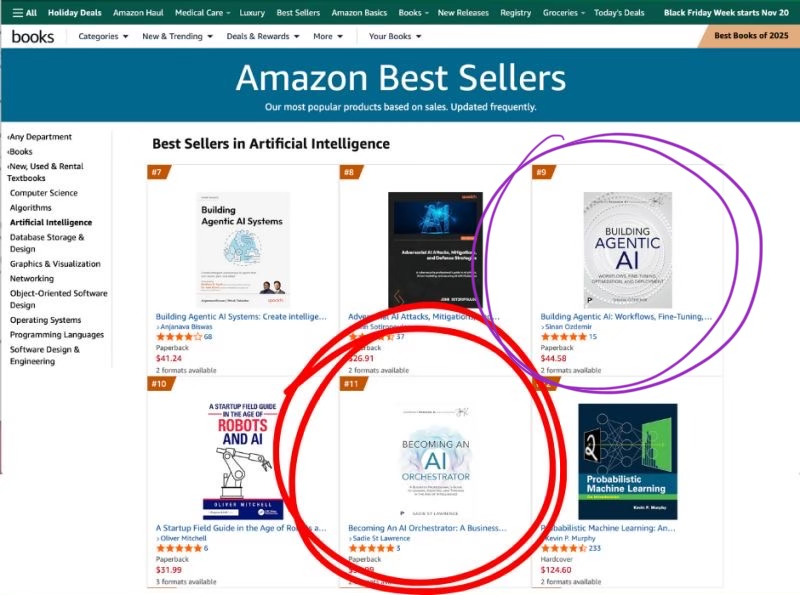
Two books have been published so far in Pearson's "Jon Krohn A.I. Signature Series"... and now both are near the top of Amazon's "Artificial Intelligence" bestsellers list!

Sinan Ozdemir's "Building Agentic A.I." (circled in purple) is in 9th while Sadie St Lawrence's "Becoming an A.I. Orchestrator" (circled in red) is in 11th.

Both books are excellent (as the Amazon reviews quantify) and they are complementary — I (of course!) highly recommend them both.

In Accouncement, Data Science, Professional Development Tags ai, machine learning, AgenticAI, ai ag, generativeai, genAI, book

Nested Learning, Spatial Intelligence and the AI Trends of 2026, with Sadie St. Lawrence

Added on January 6, 2026 by Jon Krohn.

The same level of A.I. capability that cost you $100 a year ago now costs ONE dollar. Such radically cheap intelligence changes everything about work and society; today, Sadie St Lawrence explains how!

For the fifth year in a row, we’re kicking the year off by welcoming the inimitable Sadie to the show to:

  • Predict the five biggest trends in A.I. for 2026, including nested learning, spatial intelligence and AiOps.

  • Recap how she did on her predictions for 2025.

  • Bestow four awards for 2025 (biggest “wow” moment, comeback of the year, disappointment of the year, and overall winner).

  • Get a glimpse at the year ahead, in which intelligence will be vastly cheaper than ever before... transforming work and play for all of us.

📚 Her brand-new book, "Becoming an AI Orchestrator", guides readers to work creatively and confidently alongside intelligent machines. It is part "Jon Krohn's A.I. Signature Series" published by Pearson.

More on Sadie:

  • Founder and CEO of HMCI.AI, optimizing human-A.I. collaboration in the knowledge economy (amplified by an ecosystem partnership with NVIDIA).

  • Founded Women In Data™️, a global non-profit spanning 55 countries and empowering 70,000+ data professionals; it earned Top 50 Non-Profit status and was named the premier Women in A.I. & Tech community in 2021.

  • Named among DataIQ’s Top 100 Most Influential People in Data & A.I. and Dataleum’s Top 30 Women in A.I.

  • Has educated over 700,000 learners through courses with University of California, Davis, Coursera, and LinkedIn Learning.

This episode can be enjoyed by technical and non-technical folks alike.

The SuperDataScience podcast is available on all major podcasting platforms, YouTube, and at SuperDataScience.com.

In Data Science, Interview, Podcast, Professional Development, SuperDataScience, YouTube Tags superdatascience, ai, agenticAI, AIagents, predictions, podcast

Recap of 2025 and Wishing You a Wonderful 2026

Added on January 2, 2026 by Jon Krohn.

We had 104 new episodes in 2025. For the first one of 2026, I reflect on what my favorite episodes of the past year were and what we can look forward to in data science in the year ahead :)

The SuperDataScience podcast is available on all major podcasting platforms, YouTube, and at SuperDataScience.com.

In Data Science, Five-Minute Friday, Podcast, SuperDataScience, YouTube Tags superdatascience, ai, podcast, recap, newyear

Beyond “Agent Washing”: AI Systems That Actually Deliver ROI, with Dell’s Global CTO John Roese

Added on December 30, 2025 by Jon Krohn.

Today's blockbuster episode (on MCP, agent-to-agent protocols, getting an ROI on A.I. investment, and more) stars a blockbuster guest: Dell's global CTO and Chief A.I. Officer John Roese.

Last year, John helped Dell Technologies' revenue grow by $10 billion dollars while A.I. helped costs go DOWN. That decoupling of revenue and cost had not happened in Dell's 41-year history but now, thanks to A.I., it has and John tells us exactly how they did it... so you can too!

This is an exceptional episode that can be enjoyed by technical and non-technical folks alike.

The SuperDataScience podcast is available on all major podcasting platforms, YouTube, and at SuperDataScience.com.

In Data Science, Interview, Podcast, SuperDataScience, YouTube Tags superdatascience, ai, enterpriseAI, MCP, agenticAI, agents, AIagents

How to Avoid Burnout and Get Promoted, with “The Fit Data Scientist” Penelope Lafeuille

Added on December 26, 2025 by Jon Krohn.

Feeling burnt out? Or looking to get promoted? Today’s episode (in time for New Year's resolutions!) with the "Fit Data Scientist" Penelope Lafeuille is packed with fitness and nutrition tips for thriving at work.

Penelope was a burnt-out data scientist who then worked to develop a more balanced body and mind, earning promotions and a job paying over $180k in annual salary. Hear her journey in today's episode as well as her key insights, which include:

  • Working out every day without proper recovery is overtraining, not stress relief... four structured sessions per week with adequate rest is more effective.

  • Eating one gram of protein per pound of body weight supports muscle recovery, and concentrating carbs around your workout prevents energy crashes during work hours.

  • Quality sleep requires more than eight hours in bed, reading instead of scrolling before sleep, and brief walks throughout the day to help your nervous system downregulate.

  • Writing down everything on your mind before bed tells your brain it can let go until morning... and gives you a ready-made task list when you wake up.

Previously of Citi and Crédit Agricole CIB, Penelope now works as a Senior Data Scientist at Medidata Solutions in San Diego. She holds a graduate degree in engineering from CentraleSupélec and a graduate degree in management science and engineering from Columbia University.

The SuperDataScience podcast is available on all major podcasting platforms, YouTube, and at SuperDataScience.com.

Tags superdatascience, data science, data scientist, fitness, nutrition, sleep
← Newer Posts Older Posts →
Back to Top