This week's YouTube video is a quick one on the common options for partial derivative notation.
We publish a new video from my "Calculus for Machine Learning" course to YouTube every Wednesday. Playlist is here.
More detail about my broader "ML Foundations" curriculum and all of the associated open-source code is available in GitHub here.

Accelerating Impact through Community — with Chrys Wu
This week's guest is global tech community builder Chrys Wu who details how you too can leverage communities to accelerate your career. This is the first SuperDataScience episode ever recorded in-person!
In addition to accelerating your career with community, Chrys covers:
• K-pop music and its associated cultural movement
• How the Write/Speak/Code and Hacks/Hackers organizations she co-founded leverage community to make a massive global impact for marginalized genders and journalism, respectively
• Her top resources — social media accounts, blogs, and podcasts — for staying abreast of the latest in data science and machine learning
Chrys is a consultant who specializes in product development and change management. She's also a co-founder of both Write/Speak/Code and Hacks/Hackers, the latter of which has grown to 70 chapters across five continents.
Listen or watch here.
"Math for Machine Learning" course on Udemy complete!
After a year of filming and editing, my "Math for Machine Learning" course on Udemy is complete! To celebrate, we put together this epic video that overviews the 15-hour curriculum in under two minutes.
Over 83,000 students have registered for the course, which provides an introduction to all of the essential Linear Algebra and Calculus that one needs to be an expert Machine Learning practitioner. It's full of hundreds of hands-on code demos in the key Python tensor libraries — NumPy, TensorFlow, and PyTorch — to make learning fun and intuitive.
You can check out the course here.
Does Caffeine Hurt Productivity? (Part 2: Experimental Results)
For this week's Five-Minute Friday, I detail the results of the experiment I ran on myself (chart shown) that suggests my productivity is significantly higher when I don't drink coffee than when I do. Am I alone in this?

You can check out the episode here and a Jupyter notebook of my data and statistical analysis here.
Advanced Partial-Derivative Exercises
My "Machine Learning Foundations" video this week features fun geometrical examples in order to strengthen your command of the partial derivative theory that we covered in the preceding videos.
We publish a new video from my "Calculus for Machine Learning" course to YouTube every Wednesday. Playlist is here.
More detail about my broader "ML Foundations" curriculum and all of the associated open-source code is available in GitHub here.
Transformers for Natural Language Processing
This week's guest is award-winning author Denis Rothman. He details how Transformer models (like GPT-3) have revolutionized Natural Language Processing (NLP) in recent years. He also explains Explainable AI (XAI).
Denis:
• Is the author of three technical books on artificial intelligence
• His most recent book, "Transformers for NLP", led him to win this year's Data Community Content Creator Award for technical book author
• Spent 25 years as co-founder of French A.I. company Planilog
• Has been patenting A.I. algos such as those for chatbots since 1982
In this episode, Denis fills us in on:
• What Natural Language Processing is
• What Transformer architectures are (e.g., BERT, GPT-3)
• Tools we can use to explain *why* A.I. algorithms provide a particular output
We covered audience questions from Serg, Chiara, and Jean-charles during filming. For those we didn't get to ask, Denis is kindly answering via a LinkedIn post today!
The episode's available on all major podcasting platforms, YouTube, and at SuperDataScience.com.
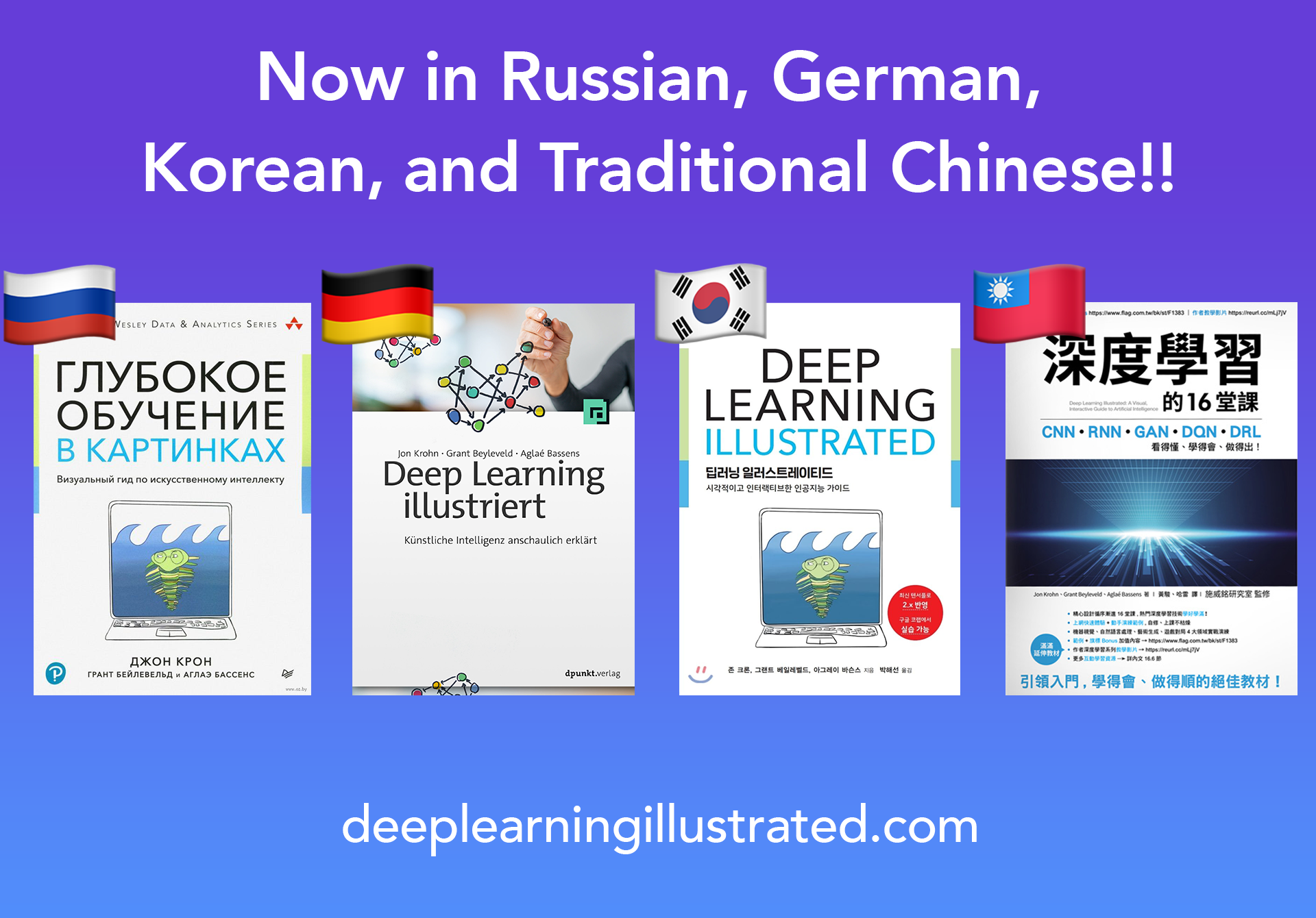
Translations of Deep Learning Illustrated – Now available in Traditional Chinese
My book, Deep Learning Illustrated, recently became available in Traditional Chinese alongside the existing Russian, German, and Korean translations. The new edition instantly became a #1-bestseller in Taiwan.
Thanks to Neville Huang for diligently translating to Traditional Chinese from the original English. Neville also tipped me off to the #1-bestseller status — I've put the screenshot he shared with me on LinkedIn.
Does Caffeine Hurt Productivity? (Part 1)
For Five-Minute Friday this week, I lay out my hypothesis that caffeine decreases people's capacity to focus deeply on work. Next week, we'll review the results of the months-long coffee experiment I ran on myself!
(If you can't wait to see the experiment results, you can head to jonkrohn.com/coffee to check them out.)
Listen or watch here.

Upcoming guest on the SuperDataScience Podcast: Wes McKinney
Next week, I'm interviewing the monumental Wes McKinney — creator of pandas, co-creator of Apache Arrow, and bestselling author of "Python for Data Analysis" — for a SuperDataScience episode.
Got Qs for him? Tweet them @jonkrohnlearns or send them to me on LinkedIn.
Advanced Partial Derivatives
This week's video builds on the preceding ones in my ML Foundations series to advance our understanding of partial derivatives by working through geometric examples. We use paper and pencil as well as Python code.
We publish a new video from my "Calculus for Machine Learning" course to YouTube every Wednesday. Playlist is here.
More detail about my broader "ML Foundations" curriculum and all of the associated open-source code is available in GitHub here.
Data Science for Private Investing — LIVE with Drew Conway
This week's guest is prominent data scientist and author Dr. Drew Conway. Working at Two Sigma, one of the world's largest hedge funds, Drew leads data science for private markets (e.g., real estate, private equity).
If you aren't familiar with Drew already, he:
• Serves as Senior Vice President for data science at Two Sigma
• Co-authored the classic O'Reilly Media book "ML for Hackers"
• Was co-founder and CEO of Alluvium, which was acquired in 2019
• Advised countless successful data-focused startups (e.g., Yhat, Reonomy)
• Obtained a PhD in politics from New York University
In this episode, he covers:
• What private investing is
• How data science can lead to better private investment decisions
• The differences between creating and executing models for public markets (such as stock exchanges) relative to private markets
• What he looks for in the data scientists he hires and how he interviews them
This is a special SuperDataScience episode because it's the first one recorded live in front of an audience (at the The New York R Conference in September). Eloquent Drew was the willing guinea pig for this experiment, which was a great success: We filmed in a single unbroken take and fielded excellent audience questions.
Listen or watch here.
Deep Reinforcement Learning
Five-Minute Friday today is an intro to (deep) reinforcement learning, which has diverse cutting-edge applications: E.g., machines defeating humans at complex strategic games and robotic hands solving Rubik’s cubes.
You can watch or listen here.

O'Reilly + JK October & November ML Foundations LIVE Classes open for registration
We're halfway through my live 14-class "ML Foundations" curriculum, which I'm offering via O'Reilly Media. The first Probability class is on Wednesday with five of the seven remaining classes open for registration now:
• Oct 6 — Intro to Probability
• Oct 13 — Probability II and Information Theory
• Oct 27 — Intro to Statistics
• Nov 3 — Statistics II: Regression and Bayesian
• Nov 17 — Intro to Data Structures and Algorithms
The final two classes will be in December and are on Computer Science topics: Hashing, Trees, Graphs, and Optimization. Registration for them should open soon.
All of the training dates and registration links are provided at jonkrohn.com/talks.
A detailed curriculum and all of the code for my ML Foundations series is available open-source in GitHub here.
Calculating Partial Derivatives with PyTorch AutoDiff
My recent videos have detailed how to calculate partial derivatives by hand. In today's, I demo how we can compute them automatically using PyTorch, enabling us to easily differentiate complex equations like ML models.
We publish a new video from my "Calculus for Machine Learning" course to YouTube every Wednesday. Playlist is here.
More detail about my broader "ML Foundations" curriculum and all of the associated open-source code is available in GitHub here.
Accelerating Start-up Growth with A.I. Specialists
This week's guest is the game-changing Dr. Parinaz Sobhani. She leads ML at Georgian — a private fund that sends her "special ops" data science teams into its portfolio companies to accelerate their A.I. capabilities.
In this episode, Parinaz details:
• Case studies of Georgian's A.I. approach in action across industries (e.g. insurance, law, real estate)
• Tools and techniques her team leverages, with a particular focus on the transfer learning of transformer-based models of natural language
• What she looks for in the data scientists and ML engineers she hires
• Environmental and sociodemographic considerations of A.I.
• Her academic research (Parinaz holds a PhD in A.I. from the University of Ottawa where she specialized in natural language processing)
Listen or watch here.
...and thanks to Maureen for making this connection to Parinaz!
Building Your Ant Hill
Five-Minute Friday today features my 91-year-old grandmother sharing her insightful life philosophy that centers around an analogy of ants building ant hills.
Listen here.
Partial Derivative Exercises
Last week's YouTube tutorial was an epic intro to Partial Derivative Calculus — a critical foundation for understanding Machine Learning. This week's video features coding exercises that test your comprehension of that material.
We publish a new video from my "Calculus for Machine Learning" course to YouTube every Wednesday. Playlist is here.
More detail about my broader "ML Foundations" curriculum and all of the associated open-source code is available in GitHub here.
Bayesian Statistics
Expert Rob Trangucci joins me this week to provide an introduction to Bayesian Statistics, a uniquely powerful data-modeling approach.
If you haven't heard of Bayesian Stats before, today's episode introduces it from the ground up. It also covers why in many common situations, it can be more effective than other data-modeling approaches like Machine Learning and Frequentist Statistics.
Today's episode is a rich resource on:
• The centuries-old history of Bayesian Stats
• Its particular strengths
• Real-world applications, including to Covid epidemiology (Rob's particular focus at the moment)
• The best software libraries for applying Bayesian Statistics yourself
• Pros and cons of pursuing a PhD in the data science field
Rob is a core developer on the open-source STAN project — a leading Bayesian software library. Having previously worked as a statistician in renowned professor Andrew Gelman's lab at Columbia University in the City of New York, Rob's now pursuing a PhD in statistics at the University of Michigan.
Listen or watch here.
Supervised vs Unsupervised Learning
Five-Minute Friday this week is a high-level intro to the two largest categories of Machine Learning approaches: Supervised Learning and Unsupervised Learning.
Listen or watch here.
What Partial Derivatives Are
Here is my brand-new 30-minute intro to Partial Derivative Calculus. To make comprehension as easy as possible, we use colorful illustrations, hands-on code demos in Python, and an interactive click-and-point curve-plotting tool.
This is an epic video covering a massively foundational topic underlying nearly all statistical and machine learning approaches. I hope you enjoy it!
We publish a new video from my "Calculus for Machine Learning" course to YouTube every Wednesday. Playlist is here.
More detail about my broader "ML Foundations" curriculum and all of the associated open-source code is available in GitHub here.