New YouTube video out today! In this one, I provide specific examples of how calculus is applied in the real world, with an emphasis on applications to machine learning.
The YouTube playlist for my "Calculus for Machine Learning" course is here.
New YouTube video out today! In this one, I provide specific examples of how calculus is applied in the real world, with an emphasis on applications to machine learning.
The YouTube playlist for my "Calculus for Machine Learning" course is here.
It's common to feel overwhelmed by the vast ocean of tools and techniques you could learn in the fast-moving field of data science. No need to stress though — it's all part of the job, so ease into it and have fun!
Listen to, or watch, today's Five-Minute Friday episode here.
New YouTube video up! In today's we use a hands-on code demo in Python to see how approaching a curve infinitely closely enables us to determine the slope of the curve. This is key to formally understanding differential calculus.
The YouTube playlist for my "Calculus for Machine Learning" course is here.
Which of the two leading automatic-differentiation libraries — TensorFlow 2 or PyTorch — should you use for your deep learning models? My opinions, bolstered by recent usage data, are detailed in this talk that I gave at MLconf in November.
Thanks to Courtney Burton and Richard Rivera for inviting me to speak. It was an honor!
Abstract
This talk begins with a survey of the primary families of Deep Learning approaches: Convolutional Neural Networks, Recurrent Neural Networks, Generative Adversarial Networks, and Deep Reinforcement Learning. Via interactive demos, the meat of the talk will appraise the two leading Deep Learning libraries: TensorFlow and PyTorch. With respect to both model development and production deployment, the strengths and weaknesses of the two libraries will be covered — with a particular focus on TensorFlow 2 release that formally integrates the easy-to-use, high-level Keras API into the library.
He's BAAAAACK! Kirill Eremenko is the GUEST on the SuperDataScience show for the first time. In this episode, he details his exceptional new learning pathway that enables folks to land their first data science job in 99 days.
We also cover:
• What Kirill's been up to; life philosophies he's honed
• 5 myths holding people back from starting a data science career
• 5 items you need to land a data science job
Kirill created the SuperDataScience podcast in 2016 and hosted the program (over 400 episodes!) until passing the torch to yours truly on January 1st.
Kirill also founded the SuperDataScience company and is the firm’s CEO today. SuperDataScience.com, the namesake of this podcast, is a comprehensive online education platform for data science and related data specializations. Through SuperDataScience.com and his Udemy courses, Kirill has taught well over a million students worldwide, launching countless data science careers.
You can listen or watch here.
New video up on YouTube today, covering a centuries-old calculus technique called the Method of Exhaustion. The technique is still relevant today as a stepping stone to understanding how modern calculus works.
The YouTube playlist for my "Calculus for Machine Learning" course is here.
I ask every guest on the SuperDataScience show for a book recommendation. Now it's my turn! In this post, I discuss what I love about my favorites in both the fiction and non-fiction realms 📚
Read MoreToday’s video is a quick intro to Integral Calculus, the other branch of the mathematical field alongside Differential Calculus (which was introduced in the preceding video, released on Monday).
The YouTube playlist for my "Calculus for Machine Learning" course is here.
I'm joined today by Prof. Konrad Körding of the University of Pennsylvania, a world-leading researcher on links between biological neuroscience and A.I. He also leads Neuromatch Academy, a super cool group-based deep learning school.
Neuromatch is an innovative, hands-on program for learning deep learning that matches students with similar interests, languages, and time zones into tight-knit study teams. This matching approach is wildly successful, with 86% of students completing the program, compared to a 10% industry average.
In the first half of the episode, we go over the details of the Neuromatch curriculum, providing you with a survey of all of the state-of-the-art deep learning approaches. The second half is a mind-blowing exploration of the limits of artificial neural networks today and how incorporating more biological neuroscience may enable machines to develop artificial general intelligence (AGI) — i.e., machines that learn as well as humans do.
Listen or watch here.
New YouTube video out today that uses colorful visual analogies to introduce what differential calculus is. The next video, coming out on Thursday, will introduce integral calculus, the other main branch of the mathematical field.
My apologies for the (temporary!) crappy thumbnail 😂 — I had to fill in for someone who hasn't been feeling well (he's getting better, don't worry) and make it myself.
My Calculus for ML YouTube playlist is here.
At a high level, my ML Foundations content can be broken into four subject areas: linear algebra, calculus, probability/stats, and computer science. The first quarter of the content, on linear algebra, stands alone as its own discrete course and is available on YouTube today.
The playlist for my complete Linear Algebra for Machine Learning course is on YouTube here. There are a total of 48 videos in the course, each of which is provided in this blog post. Click through for all the detail!
Read MoreLast month, I thought I was taking a risk by doing an episode on the History of Algebra, but it was an unusually popular episode! To follow up, today's Five-Minute Friday is on the four-billion-year History of Data — hope you enjoy it 😁
You can watch or listen here.
With all of the Linear Algebra of my Machine Learning Foundations series already available on YouTube, it's time for a new subject: Calculus! The first Calculus video — an intro to the subject — is live today!
Up until now, I've been releasing my YouTube videos in thematic blocks, however I'm going to try something new now to set clearer delivery-timeline expectations with you. Starting with this video, I'll release a new YouTube video every Monday and every Thursday.
My Calculus for ML YouTube playlist is here. The series is full of hands-on demos in Python (particularly the NumPy, TensorFlow, and PyTorch libraries) and all of the code is available open-source in GitHub.
The first quarter of the series covered Linear Algebra. We're now kicking off the second quarter, on Calculus. The third quarter will be on Probability and Statistics. The final one will be on Computer Science (Data Structures, Algorithms, and Optimization).
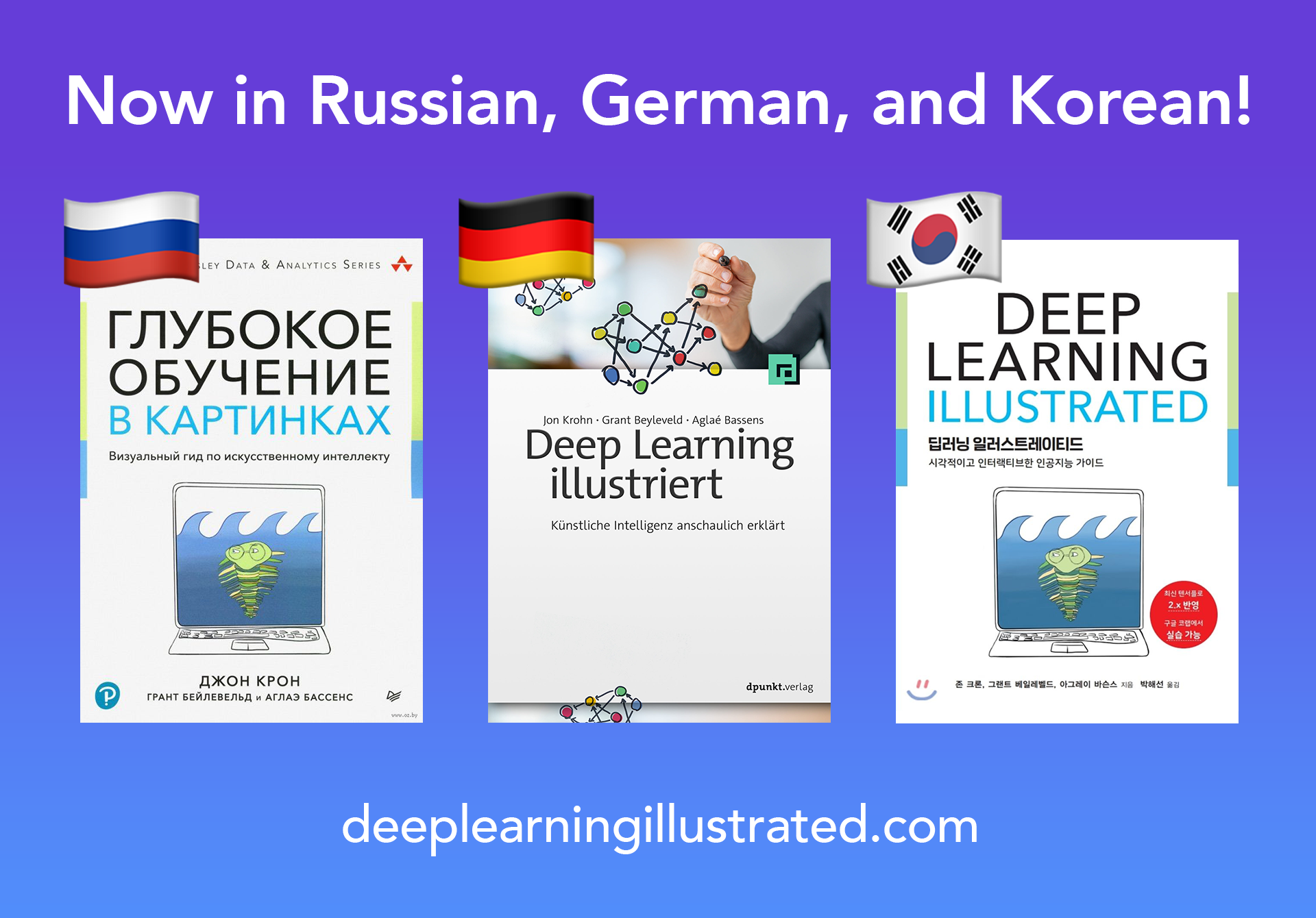
My book, Deep Learning Illustrated, is now available in 🇷🇺 Russian, 🇩🇪 German, and 🇰🇷 Korean.
Thanks to Kathrin Lichtenberg and Haesun Park for wonderfully detailed and thoughtful translations. Japanese, Traditional Chinese, and Simplified Chinese translations are also in the works.
The book is packed with lucid illustrations by the talented artist Aglae Bassens, full-color equations, and easy-to-follow code. This approach sweeps away the complexity of building deep learning models, making the subject approachable and fun to learn.
More detail and discounted purchasing options are available at deeplearningillustrated.com (links to translations are listed at the bottom).
Today, the wise Noah Gift weighs pros and cons of data science learning options (university degrees vs online certifications; full-time vs on-the-job) as well as how MLOps can quickly make you exponentially more impactful.
Noah has worked in countless technical leadership roles. He held the roles at companies ranging from tech start-ups he founded to prominent institutions like ABC, Caltech, and AT&T. Today, Noah’s founder of a consultancy called Pragmatic AI Labs — and he devises and teaches data science curricula at several of the most prestigious American universities, including Duke, Northwestern, and Berkeley. He has written eight books, including the bestselling Python for DevOps and the forthcoming Practical MLOps.
On top of all that incredible background, Noah has rich, well-formed life philosophies, which we dig into into detail. I learned a ton from him during this episode, and have been thinking about concepts we discussed time and again since filming. I highly recommend checking the episode out!
You can listen or watch here.
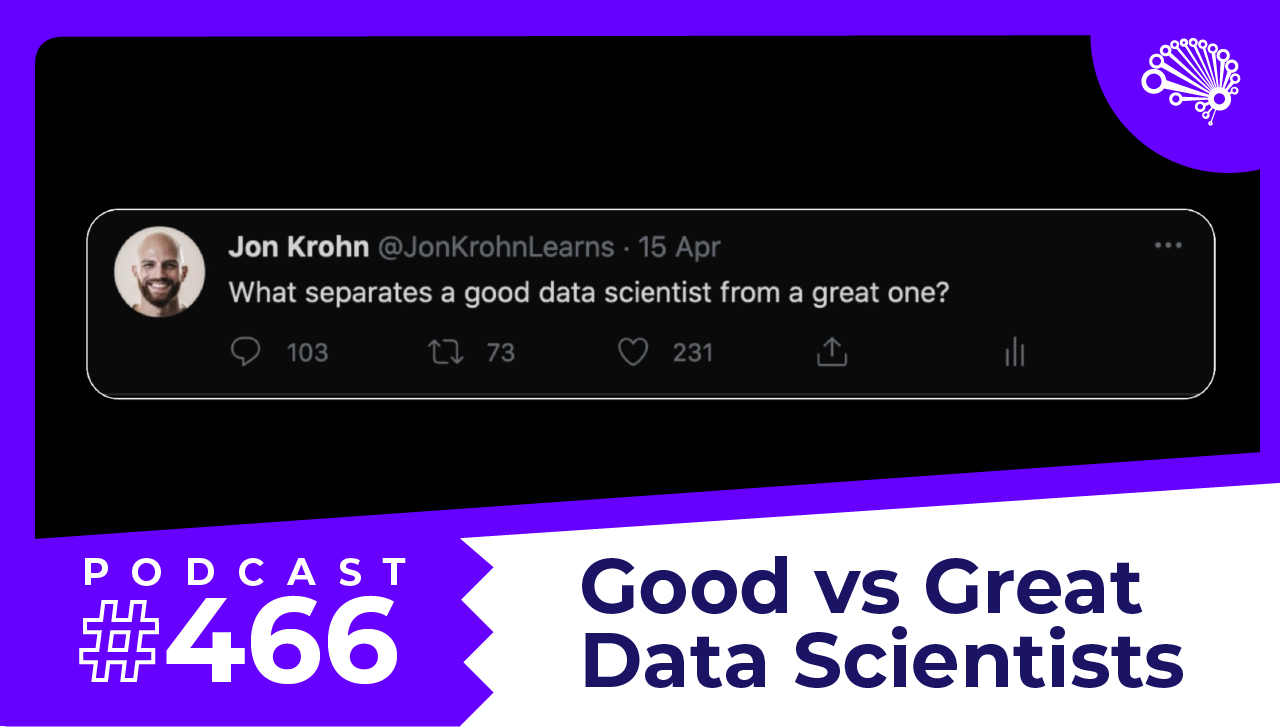
What separates a good data scientist from a great one? I asked this on Twitter recently and received hundreds of replies — some witty, others very thoughtful. For today's Five-Minute Friday episode, I review and summarize the thread.
The Tweet has had a crazy 7k engagements on 220k impressions so far — evidently it's a topic that lots of people have an opinion on. I highlighted some of my favorite individual replies in the video, including those from Martin Goodson, Chris Albon, Brandon Rohrer, Chelsea Parlett-Pelleriti, and Isabella Ghement.
What do you think? Let me know if I missed anything important!
You can listen to or watch my video summary here, or you can click through for the blog-post version.
The full Twitter thread is here if you'd like to dig through the entirety of the collective wisdom.
Read MoreI believe the easiest way to attain success — in personal or professional endeavors alike — is to rigorously track and analyze the right data. Konrad Kopczynski is a master on this topic and he joins me for this week's guest episode.
Whether you're developing machine learning models, maximizing your company's profitability, or tackling a full-length Ironman triathlon, if you're disciplined about data collection, tracking, and reflection, you can iterate, improve, and achieve your dream state. This is a central tenet of my life and much of my ideology on it has been influenced by my near-decade-long friendship with Konrad.
Konrad is the founder and managing partner of impakt Advisors, a consultancy that specializes in harnessing data for, well, impact. They structure the various data sources into thoughtfully constructed data warehouses and then layer on top analytics, data-science models, and visualizations to enable real-time reports, dashboards, and predictions across all the key areas of a business, including digital marketing, customer retention, behavioral segmentation, and profit margin.
Listen to or watch here.
"A.I.", "Machine Learning", and "Deep Learning" are terms that are often thrown around interchangeably. They shouldn't be! For Five-Minute-Friday this week, I define each of the three terms in straightforward language.
You can watch or listen to the episode here. Or you can expand below to read my blog post version.
Read MoreMatt Dancho joins me on this week's SuperDataScience guest episode, which is dedicated to time-series analysis. We cover what it is (modeling financial data and other quantities that vary over time) as well as the state-of-the-art techniques and tools.
Matt is the founder and CEO of Business Science, an educational platform dedicated to commercial applications of data science. He's a heavy contributor to open-source projects, particularly the Modeltime ecosystem of R packages he devised. Modeltime makes working with (and modeling!) time-series data both tidy and easy.
Listen or watch here!
Honored to be included in the matrix of Data Voices (populated with two nested "for" loops?) by Kate Strachnyi of DATAcated.
I personally know and admire several of these Voices, all of whom have played a role in my development as a data scientist: Matt Dancho, Kirill Eremenko, Ben Taylor, Kirk Borne, Ph.D., Harpreet Sahota, and Kate herself.
There are countless others whom I know by their stellar reputation only but am hopeful to become close with soon... perhaps even as a guest on an upcoming SuperDataScience podcast episode. Keep an eye out 😉