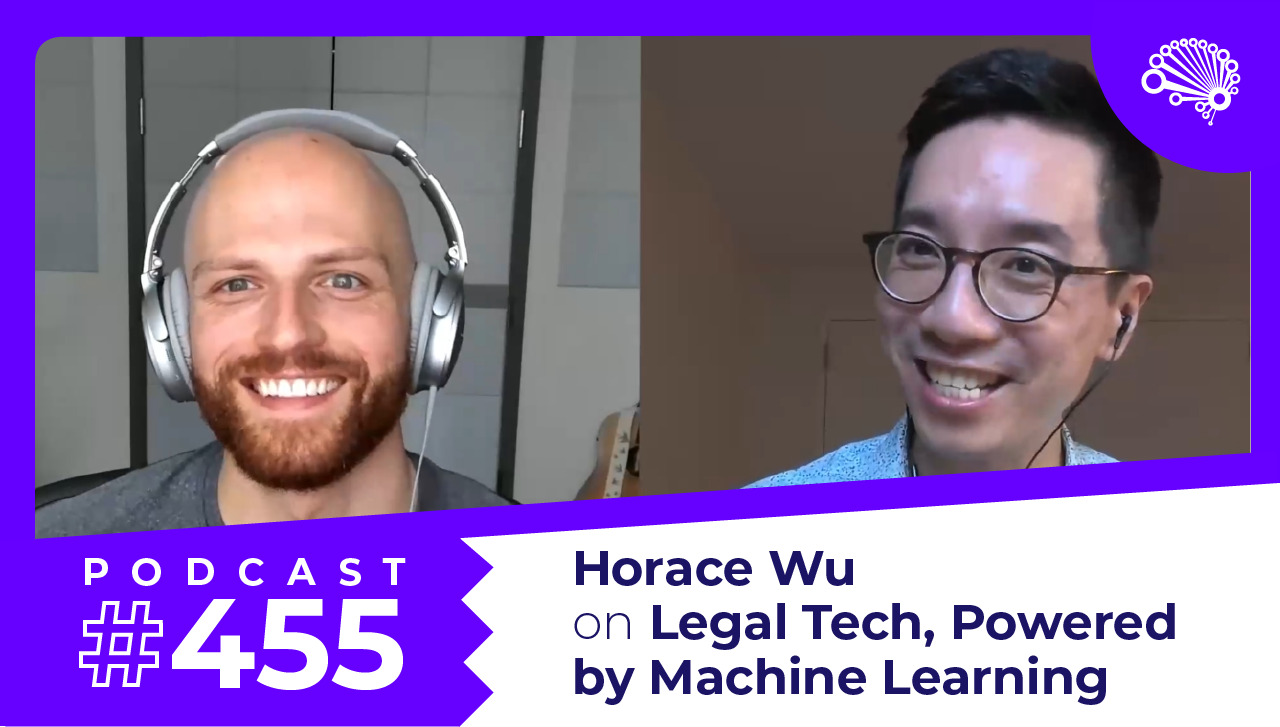
This week, Horace Wu fills us in on how to bootstrap an ML start-up — without outside capital while still earning an income! We also cover how AI can advance the legal sector and how to pivot your career from services to start-up founder.
Syntheia, the latest company Horace founded, augments human lawyers with the power of the (typically millions) of historical documents at their firm. Using a combination of NLP and machine vision (then surfaced in Microsoft Word using javascript), Syntheia provides lawyers with suggestions on tricky points in contracts and automates the generation of clauses.
Prior to founding Syntheia, Horace was an attorney at top firms in Australia and the US. At Syntheia, he works closely with his team of data scientists and developers to solve complex problems for the legal profession. Especially for a supposedly non-technical founder, he displays a stunning depth of knowledge of NLP models and full-stack model deployments.
You can listen and watch here: superdatascience.com/455

Filtering by Category: Podcast

The Staggering Pace of Progress (Part 2)
This episode was adapted from a post that I wrote for the GQR blog.
In today’s Five-Minute Friday episode, I continue last week’s theme. We overview exponentially accelerating technological progress and examine today’s augmentation of human intelligence: the first babysteps of the AI revolution.
In Part 3, coming next month, we'll speculate on how data and automation will dramatically change work and life over the coming decades.
Listen or watch here.
Big Global Problems Worth Solving with Machine Learning
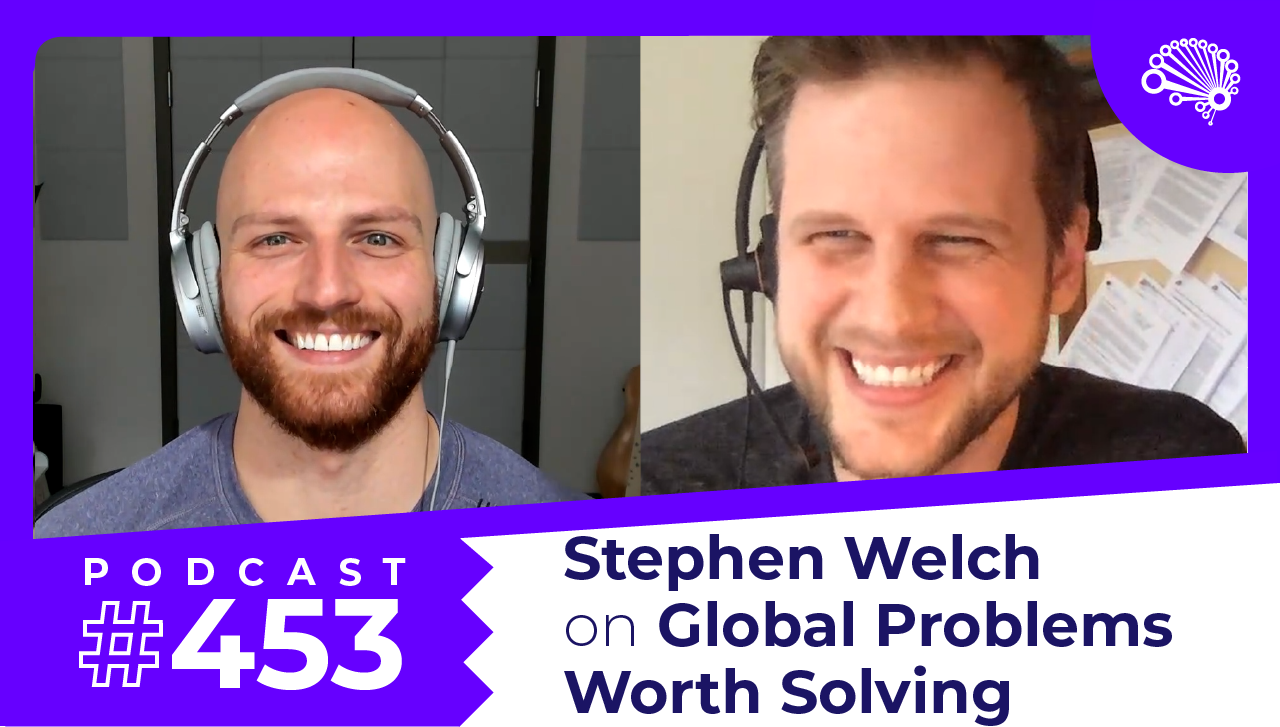
In this week's episode, Stephen Welch joined me to discuss 10 big global problems worth trying to solve with data science and machine learning. Perhaps you'll be inspired to tackle one or two yourself!
2020 presented a lot of challenges to a lot of folks around the world. For Stephen, the challenging year was compounded by intense delivery targets for him and his team on a machine vision-enabled system that automatically detects defective industrial products. After delivering this fascinating edge-deployed software into production, Stephen was able to finally come up for air and he reflected on what's most important in one's life — culminating in his list of 10 global problems worth solving.
Stephen is VP of Data Science at Mariner, where he leads a team developing deep learning-based solutions to manufacturing problems. Prior to working with Mariner, Stephen was VP of Machine Learning at Autonomous Fusion, a firm specialized in self-driving cars. He’s also an adjunct professor at University of North Carolina at Charlotte and the creator of the gorgeous math-focused YouTube channel WelchLabs, which has over 200k subscribers and 10M views.
You can listen or watch here.

The Staggering Pace of Progress
This podcast episode is based on a blog post I published for GQR. See here.
For millennia, you might not have witnessed a single innovation in your lifetime. In the 20th Century, any job changed dramatically. In the coming decades, automation will dramatically change all aspects of life many times over.
In this week's FiveMinuteFriday, I examine this acceleration — this staggering pace of progress — through the lens of the recruitment industry that is facilitating a lot of the change.
Listening and viewing options here.

Translating PhD Research into ML Applications
Dan Shiebler has a pretty unambitious hobby: a full-time University of Oxford PhD 😂! Dan researches Category Theory, a math branch that categorizes items by their behavior. By day, he's Staff Machine Learning Engineer at Twitter.
In this week's SuperDataScience episode, Dan explains to me how relatively pure mathematical research translates to improving real-world ML applications.
We also discuss:
• How Twitter labels huge datasets
• How Revenue Science can boost ad performance
• What the responsibilities of a staff software engineer at a big tech company are
• What skills are sought after in data science hires at Twitter
Listening and viewing options here.

Yoga Nidra
This episode features the world-renowned yogi Steve Fazzari. He gives me (and you!) a crash course on Yoga Nidra, a practice of deep relaxation that impacts brain structure, leading to better sleep and ability to respond to stress.
Steve lives up in the mountains of British Columbia as an explorer and instructor of yoga instructors. A ravenous reader and critical thinker, he has a rich understanding of science, the body, and the mind. I learned a ton from Steve during the filming of this episode.
If you like the sound of his explanation (and two-minute demo of) yoga nidra, please let me know because I'd love to bring him back on the SuperDataScience show to lead us through a full-length yoga nidra session.

Fairness in A.I.
Machines increasingly decide on critical aspects of your life, including medical treatment, mortgages, and job applications. Disturbingly, many such algorithms reinforce historical biases against particular gender and ethnic groups.
This week, Ayodele Odubela joins me on SuperDataScience to discuss the importance of equitability, introspection, and transparency when modeling data (and even in hardware development!), plus a bit about Ayodele’s own personal journey as a data scientist.
Ayodele works at Comet (a machine learning company), is the founder of FullyConnected (a brilliantly-named platform for black and brown data scientists), and the author of Getting Started in Data Science as well as the forthcoming book Uncovering Bias in Machine Learning. I learned a lot from Ayodele; she knows a ton and conveys her knowledge beautifully.
Listening/viewing options, as well as full transcript, available here.

How to Be a Data Science Leader
The more leadership responsibility you take on as a data scientist or engineer, the more you accept that can't stay on top of the cutting-edge innovations as much as you might like. Nor do you get to spend as much time as you'd like writing code.
...and that's for the best. It's what what your team and your company need from you.
Commercial ML Opportunities Lie Everywhere
In this week’s SuperDataScience guest episode, the staggeringly experienced Dr. Michael Segala fills us in on how commercial opportunities for applying machine learning to real-world problems are everywhere.
Michael is co-founder and CEO of SFL Scientific, a world-leading A.I.-consulting firm that brings state-of-the-art deep-learning possibilities into production across the public and private sectors alike. We survey opportunities for transformative ML applications in the coming decades across a broad range of industries before focusing on the medical industry and governments in particular.
As NVIDIA’s Partner of the Year for AI services, as well as a consultant to firms as diverse as the US Navy, the Smithsonian Institution, and Johnson & Johnson, Dr. Segala may be better-positioned than anyone to be optimistic about the huge positive social impact data and models will have in our lifetimes.
Listening/viewing options, as well as full transcript, available here.
Data Science as an Atomic Habit
In 2013, I sat on a crowded bus next to a guy with the same (bald) haircut as me. Luckily, we struck up a conversation because that talk was the catalyst for a drastic, ever-developing U-turn across my entire life, both personally and professionally.
Following what he today calls the Atomic Habits approach, that guy on the bus -- James Clear -- now has a million subscribers to his weekly email newsletter and a New York Times #1-bestseller that's been translated into over 40 languages.
Via analogy to specific data science and software development examples, in today’s FiveMinuteFriday on the SuperDataScience Podcast I describe how “atomic habits” have the capacity to dramatically transform your career and your very identity.
Read More
Getting Started in Machine Learning
On last Friday’s episode, I answered questions from podcast listeners on the “futureproof-ness” of a data science career. This week, I’m answering a few more listener-submitted questions about getting start in ML, particularly if you’re completely new to the field!
From MOOCs, to free videos, to graduate level textbooks, I cover a wide or materials that you can use to become an expert in machine learning.
Read MoreConversational A.I. with Sinan Ozdemir
Sinan Ozdemir may be the most articulate explainer of complex concepts I’ve ever met. In the latest SuperDataScience episode, he fills me in on how to design a Conversational A.I. (aka "chatbot") so it's effective for users and businesses alike.
In addition, we discussed AutoML, how a background in pure mathematics is a huge asset in applied data science, and the hard and soft skills you need for a career in natural language processing at a cutting-edge tech company.
Sinan co-founded Kylie.ai, a conversational-AI company, which was acquired by Directly, where Sinan now serves as Director of Data Science. He has a deep well of both technical knowledge and business savvy that I found wildly informative.
Listening/viewing options, as well as full transcript, available here.
Future-Proofing Your Career
At the beginning of 2021, I asked the following on Twitter: “What questions do you have about machine learning as a science or as a career?”
In response, I was asked some terrific questions about data science, many of which are popular ones that I’ve been asked time and again. In today’s FiveMinuteFriday, I’ll answer the ones I thought would be most valuable for everyone to hear the answer to.
Gabriel, who appears to be Brazillian, but indicates his location is “Lost + Found” asked me:
“Is a career in data science really future-proof? What are the odds of another AI winter and a crisis in this career?”
Read MoreThe End of Jobs
We’ve all heard the claim: “Robots will take our jobs.” But what actually happens when work is fundamentally changed by technology? Jeff Wald, author of The End of Jobs and co-founder of WorkMarket, joins me on this episode to discuss the future of our 9-to-5’s including how data science, automation, and other macroeconomic factors will reshape work around the globe in the coming decades.
Jeff’s work involves a careful examination of the data around the history of work, and builds on his own experience as co-founder of WorkMarket, a company focused on helping companies manage contractors. We discuss the pandemic, remote work, and the obligations of society towards the people caught up in the churn.
Listening/viewing options, as well as full transcript, available here.
Communicating Data Effectively
Things can get silly when Kate and I get together 🙃 BUT we also covered a lot in this week’s guest episode of the SuperDataScience, including:
The utter importance of communicating data effectively
Concrete tips for doing so
And how to build a giant social-media presence (like Kate's 150k following!)
Kate is the founder of Story by Data & DATAcated Academy, and author of four books including The Disruptors: Data Science Leaders and Journey to Data Scientist.
Listening/viewing options, as well as full transcript, available here.
MuZero: Learning Without Rules
This article was adapted from a podcast. Listening/viewing options, as well as a full transcript, available here.
On last week's Five-Minute-Friday episode, I introduced the concept of artificial general intelligence ( or AGI, for short), a theoretical algorithm that one day could have all of the intellectual capacities of a human being. I also introduced the company DeepMind and the landmark deep reinforcement learning algorithms they developed over the past decade, each one a stepping stone on the road to creating AGI. If any of AGI, DeepMind, or deep reinforcement learning are unfamiliar terms to you, you might want to check out last week's Five Minute Friday episode to brush up.
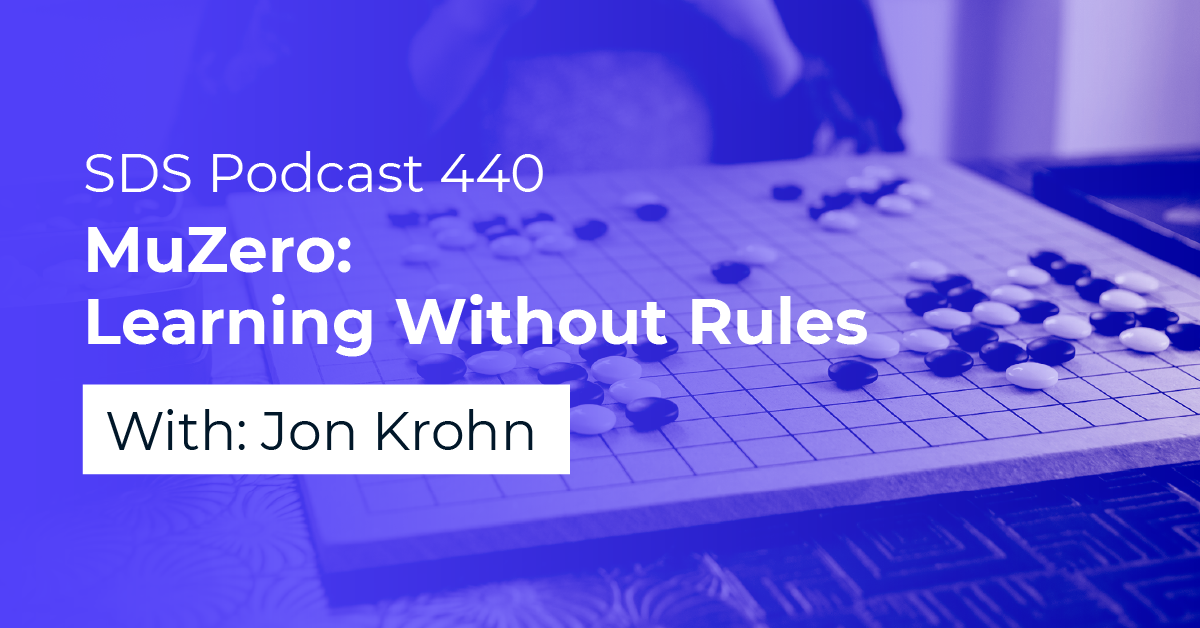
Last week's coverage of DeepMind's deep reinforcement learning advances bring me now to MuZero, an algorithm that David Silver and his DeepMind research team published on in the final days of 2020 in the journal Nature, arguably the most prestigious academic science journal.
Read MoreDeep Learning for Machine Vision
In the latest SuperDataScience episode, the brilliant A.I. researcher Deblina Bhattacharjee fills me in on the state of the art in machine vision. From predicting earthquakes to 3D VR experiences based on ordinary 2D art, she's seemingly in on it all!
We also covered:
Automatic detection of biological cells in medical images
The typical workday of, and software tools used by, A.I. researchers working at the cutting edge
The critical math subjects necessary to be an outstanding machine learning practitioner (to my delight, she reeled off the subjects covered in my ML Foundations curriculum)
The ever-increasing utility of unsupervised learning approaches
Her top productivity tips (Deblina is unbelievably productive so I greatly value her two cents on this!)
Prog rock music
The intelligence of plants (yep, plants!)
This is an outstanding episode. I learned a ton while filming and had a lot of laughs too, so I think you'll enjoy it too.
Listening/viewing options, as well as full transcript, available here.

DeepMind's quest for Artificial General Intelligence
This article is based off of a podcast episode. You can listen to or watch the full episode here.
DeepMind, a London-based subsidiary of Google’s parent company Alphabet, has done it again and pushed the boundaries of what can be achieved in the field of machine learning, thereby pushing the human race one step closer toward developing artificial general intelligence.
Read MoreData Science at a World-Leading Hedge Fund
This week's guest episode of SuperDataScience is wicked. Dr Claudia Perlich joined me to fill us in on data science at Two Sigma, how to win global data science competitions, and how to have an extraordinary career in any field.
We also talked about data science applied to financial markets in general and what the world's largest hedge funds (e.g., Two Sigma) look for in the data talent they hire.
The full episode is available here.

Tools for Sharpening Your Attention
This article is a combination of a two-part series from January 2021. You can listen to the first part here, and the second part here.
In any given workday, our goal is typically to get as much done as possible. Often, however, we spend the day feeling frazzled -- hopping reactively between multiple tasks, emails, texts, catch-ups with colleagues, and our physiological needs. By the end of the day, we feel worn out and we often didn’t accomplish all that we’d hoped to at the start of the day, even if we put in heroically long hours because we’re so committed to getting everything done.
Lying in bed after one of these long days, I often find myself thinking that it could have gone very differently…
Read More