Feel like the world is kinda poopy? Well, it is! BUT, covid pandemic not withstanding, it's also WAY better than ever before. I articulate this idea with data and charts for this week's Five-Minute Friday episode.
Thanks to Benjamin Todd for pointing me in the direction of a blog post by Max Roser (founder of Our World in Data) that formed the basis of this podcast episode.
Watch or listen here.

Filtering by Category: Five-Minute Friday
Say No to Pie Charts
Public Service Announcement for this week's Five-Minute Friday: Don't use pie charts! (Nor, in almost all circumstances, ANY circular chart!)
Listen or watch here.
The Price of Your Attention
Time is money. Every second of your life is yours to use and one of the options you have is to generate income. You can do this hourly, or, as a data scientist, invest time in a digitally-sharable product with a huge potential ROI.
Listen or watch here.
The History of Calculus
Y'all seem to love these "History of..." episodes, so for Five-Minute Friday this week, here's another one. It's on the History of Calculus! Enjoy 😄
(Leibniz and Newton, who independently devised modern calculus around the same time, are pictured.)
Listen or watch here.
Algorithm Aversion
Continuous Calendars
Extremely practical post for you today! It's on the Continuous Calendar, which in my opinion is vastly superior to the standard monthly calendar in every imaginable respect. Click through for more detail.
Top Resume Tips
In recent weeks, I've received several messages from folks struggling to get callbacks for Data Scientist interviews. In reviewing their résumés, I realized there are five specific tips that I highly recommend adhering to.
You can listen or watch here.
Five Keys to Success
I've recently been able to achieve markedly better results than ever before across my personal and professional lives. For Five-Minute Friday, I reflect on five keys to success that may allow achievement of many complex, long-term goals.
You can listen or watch here.
The Machine Learning House
In last week’s Five-Minute Friday, I discussed how, in the data science field, the learning never stops. But there’s one big counterpoint: The foundational subjects that underlie the field barely change at all, decade after decade.
These subjects — linear algebra, calculus, probability, statistics, data structures, and algorithms — build a strong foundation for your “Machine Learning House”. Today's Five-Minute Friday articulates my perspective that investing time in studying these foundational subjects will reap great dividends throughout your data science career.
You can listen or watch here.
The History of Data
Last month, I thought I was taking a risk by doing an episode on the History of Algebra, but it was an unusually popular episode! To follow up, today's Five-Minute Friday is on the four-billion-year History of Data — hope you enjoy it 😁
You can watch or listen here.
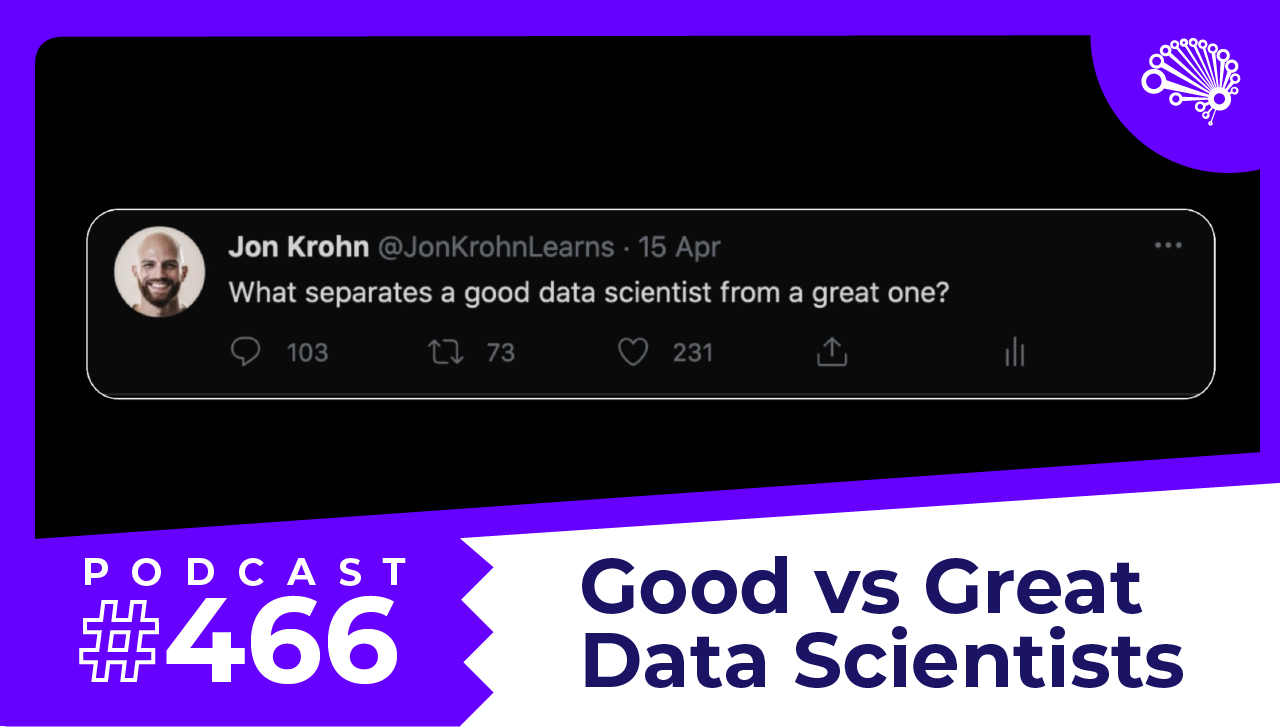
Good vs. Great Data Scientists
What separates a good data scientist from a great one? I asked this on Twitter recently and received hundreds of replies — some witty, others very thoughtful. For today's Five-Minute Friday episode, I review and summarize the thread.
The Tweet has had a crazy 7k engagements on 220k impressions so far — evidently it's a topic that lots of people have an opinion on. I highlighted some of my favorite individual replies in the video, including those from Martin Goodson, Chris Albon, Brandon Rohrer, Chelsea Parlett-Pelleriti, and Isabella Ghement.
What do you think? Let me know if I missed anything important!
You can listen to or watch my video summary here, or you can click through for the blog-post version.
The full Twitter thread is here if you'd like to dig through the entirety of the collective wisdom.
Read MoreA.I. vs Machine Learning vs Deep Learning
"A.I.", "Machine Learning", and "Deep Learning" are terms that are often thrown around interchangeably. They shouldn't be! For Five-Minute-Friday this week, I define each of the three terms in straightforward language.
You can watch or listen to the episode here. Or you can expand below to read my blog post version.
Read MoreIt Could Be Even Better
When something positive happens in my life, my mind tends to jump to the negative flipside right away. To fend this off, I now repeat to myself "It Could Be Even Better" when something good happens. The mental impact has been sublime.
For this week's Five-Minute Friday episode, I provide specific examples across my professional, fitness, and personal lives where repeating this "It Could Be Even Better" mantra has proved game-changing. If you too slip into negative thinking when something good happens, perhaps it's a simple trick that'll work for you too!
Watch the video above or click through for the full post.
Read MoreThe History of Algebra
Algebra lies at the core of all modern data science approaches. We've been working on it for a while though — it's at least 3900 years old! For Five-Minute Friday today, I cover the Babylonian genesis of the field through to today's ML applications.
Listen or watch here.

Behind the Scenes
Today’s Five-Minute-Friday episode is a behind-the-scenes tour of a professional studio configured for filming video tutorials. Specifically, we had just wrapped filming a ~10-hour series on Probability and Statistics for Machine Learning.
I’ve been fortunate to work with Erina Sanders and Guillaume Rousseau at Production Central Studios and Stages since 2017, including on my bestselling Deep Learning with TensorFlow videos. In this video you meet Erina and Guillaume — and hear about how they make the magic happen!
You can listen or watch here.
(And yes, I know! I learned my lesson and will now film in landscape mode not portrait on my phone!) 🤦♂️
The Pomodoro Technique
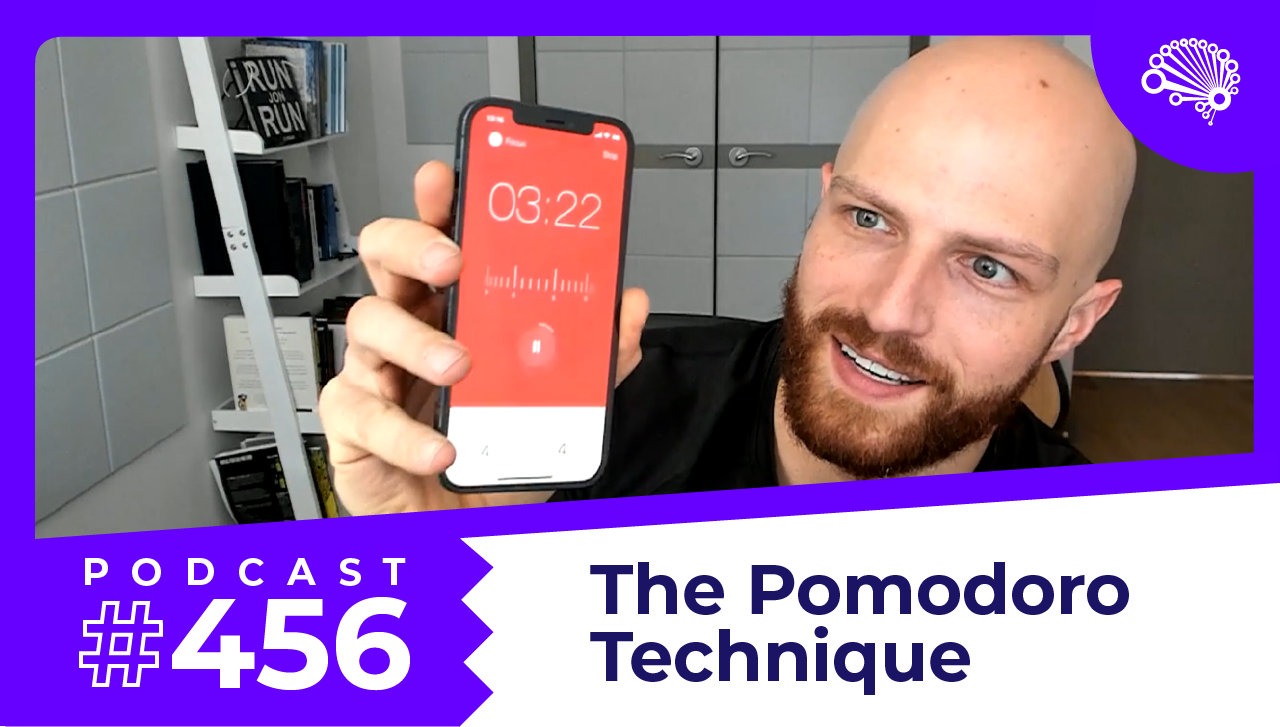
I’ve experimented with a lot of productivity techniques and quantitatively track their effectiveness every day. One of my long-standing favorites is the Pomodoro Technique to eke creative, highly focused work out of minimal effort 🍅
You can listen to or watch today's Five-Minute-Friday episode on the Pomodoro Technique here.
In addition to Pomodoros, some other techniques I've covered on the podcast are mindfulness (here and here) and a number popularized by James Clear over the years (see here).

The Staggering Pace of Progress (Part 2)
This episode was adapted from a post that I wrote for the GQR blog.
In today’s Five-Minute Friday episode, I continue last week’s theme. We overview exponentially accelerating technological progress and examine today’s augmentation of human intelligence: the first babysteps of the AI revolution.
In Part 3, coming next month, we'll speculate on how data and automation will dramatically change work and life over the coming decades.
Listen or watch here.

The Staggering Pace of Progress
This podcast episode is based on a blog post I published for GQR. See here.
For millennia, you might not have witnessed a single innovation in your lifetime. In the 20th Century, any job changed dramatically. In the coming decades, automation will dramatically change all aspects of life many times over.
In this week's FiveMinuteFriday, I examine this acceleration — this staggering pace of progress — through the lens of the recruitment industry that is facilitating a lot of the change.
Listening and viewing options here.

Yoga Nidra
This episode features the world-renowned yogi Steve Fazzari. He gives me (and you!) a crash course on Yoga Nidra, a practice of deep relaxation that impacts brain structure, leading to better sleep and ability to respond to stress.
Steve lives up in the mountains of British Columbia as an explorer and instructor of yoga instructors. A ravenous reader and critical thinker, he has a rich understanding of science, the body, and the mind. I learned a ton from Steve during the filming of this episode.
If you like the sound of his explanation (and two-minute demo of) yoga nidra, please let me know because I'd love to bring him back on the SuperDataScience show to lead us through a full-length yoga nidra session.

How to Be a Data Science Leader
The more leadership responsibility you take on as a data scientist or engineer, the more you accept that can't stay on top of the cutting-edge innovations as much as you might like. Nor do you get to spend as much time as you'd like writing code.
...and that's for the best. It's what what your team and your company need from you.