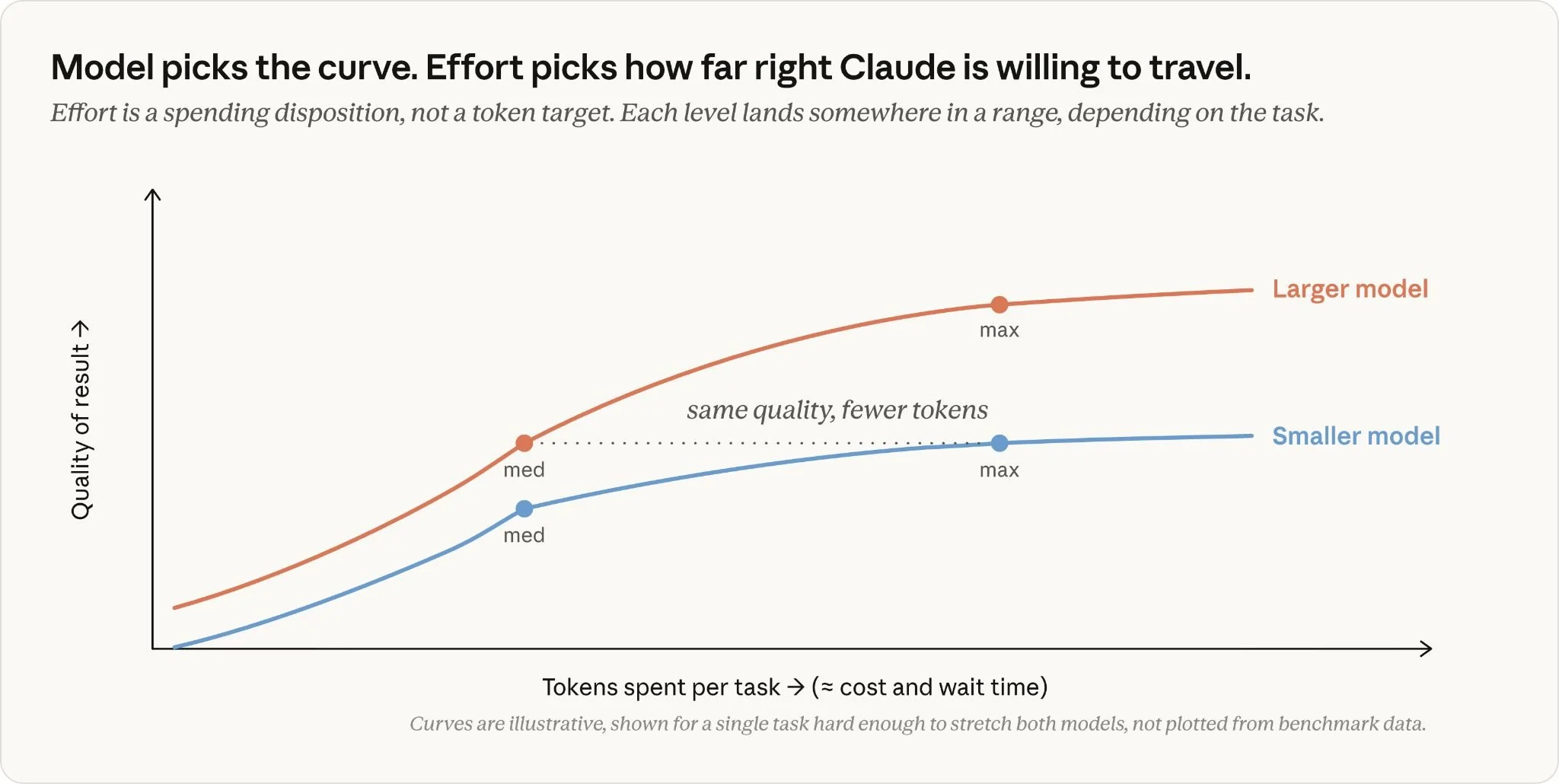
Every major A.I. platform now offers two dials that shape what you get back: how large of a model you pick and how much effort it can invest. Here's what each dial does and how to use them together:
THE "MODEL SIZE" DIAL
• Model selection swaps which set of frozen weights handles your request. Weights are fixed at training time; nothing in your prompt changes them.
• Larger models encode more knowledge and capability, and each output token costs more.
• Your prompt steers predictions but doesn't teach: Paste in docs for a library the model has never seen and it will use them for that request, then retain nothing.
THE "EFFORT" DIAL
• Effort shapes all output tokens: reasoning, tool calls and messages to you.
• At high effort, a model reads more files, verifies more of its own work and pushes further before checking in. In one Anthropic comparison, the high-effort path generated ~7x more tokens to reach a higher-confidence answer.
• Effort sets how far a model is willing to travel, not how far it *must* (thus a well-trained model stops when it finds the bug rather than padding the bill).
WHICH DIAL SHOULD YOU TURN?
• First off, when output disappoints, try fixing your prompt and context. A vague request is the most common culprit for a disappointing output and *no* knob will fix that.
• Skipped files, unrun tests, an abandoned refactor? Those are examples of DILIGENCE FAILURE: in these cases, RAISE THE EFFORT.
• Full context, visible attempt, still confidently wrong? Those are examples of CAPABILITY FAILURE: in these cases, upgrade to a BIGGER MODEL.
COST
• Cheaper *per token* isn't always cheaper *per task*. On hard multi-step work, a large model reaches the quality bar in fewer steps, so total cost can come out lower than a small model grinding at the ceiling of its ability (see chart).
• On routine work, the equation flips: Both models get it right, so the big model's extra verification is wasted money. Drop down to a smaller model.
WHAT CAN YOU DO?
• Start with defaults; providers tune them to what most users want to spend. Treat effort as a preference for your kind of work, generally NOT as a task-by-task fiddle.
• Route routine work to smaller, cheaper models and reserve the frontier for problems that stretch it.
• This applies everywhere: Anthropic, OpenAI, Google and open-source reasoning-model providers have all converged on separate capability and effort controls.
The SuperDataScience podcast is available on all major podcasting platforms, YouTube, and at SuperDataScience.com.

Filtering by Tag: #claude
Fable 5: The Full Story from Capabilities to Drama
The dust has settled, allowing me to provide you with all the key context you need to know on Fable 5, the most capable A.I. model ever offered to the public, and the US government forcing it off shelves three days later:
A NEW CLASS OF MODEL
• Anthropic stacks its models in tiers: Haiku (small and fast), Sonnet (the capable middle) and Opus (the powerful top). Sitting above all of them now is a "Mythos-class" tier.
• Fable 5 and its locked-down sibling Mythos 5 are the same underlying model... the only difference is the safeguards.
• Mythos 5 goes to trusted cyberdefenders with guardrails largely lifted; Fable 5 went to the public with them switched on.
WHAT IT COULD DO
• State-of-the-art on nearly every benchmark Anthropic tested... and the lead grows the longer and more complex the task (see chart).
• Stripe ran a codebase-wide migration on 50M lines of Ruby in a single day; work estimated at 2+ months for a full engineering team.
• Beat video "Pokémon FireRed" from raw screenshots alone, and got a 3x bigger memory boost than Opus on "Slay the Spire".
• Priced at $10/$50 per million input/output tokens: roughly 2x Opus 4.8, but under half the original Mythos Preview.
SAFETY BY DESIGN
• Classifiers watch three sensitive areas: cybersecurity, biology/chemistry and distillation (extracting a model to train a rival).
• Flagged requests quietly fall back to Opus 4.8 and the user is told.
• Triggers fire in under 5% of sessions. Anthropic admits it tuned conservatively, so some harmless prompts get bounced too.
THE THREE-DAY SHUTDOWN
• On Friday evening the federal government ordered Anthropic to switch off both Fable 5 and Mythos 5 worldwide, citing national security.
• The mechanism was an export-control action covering foreign nationals everywhere (including even, say, Canadian Anthropic employees living in the US!)... so broad that Anthropic pulled the model for absolutely everyone.
• The trigger was a reported jailbreak of the cyber safeguards by Amazon. Anthropic disputes its severity, calling it narrow and non-universal.
BOTTOM LINE
A premium-tier model, wrapped in deliberately cautious safeguards, pulled by its own government not long before Anthropic's reported IPO and the latest in a public battle between the firm and the federal government. Sessions now fall back to Opus 4.8. Whether Fable returns (and on what terms) depends on a fight that's far from over.
The SuperDataScience podcast is available on all major podcasting platforms, YouTube, and at SuperDataScience.com.