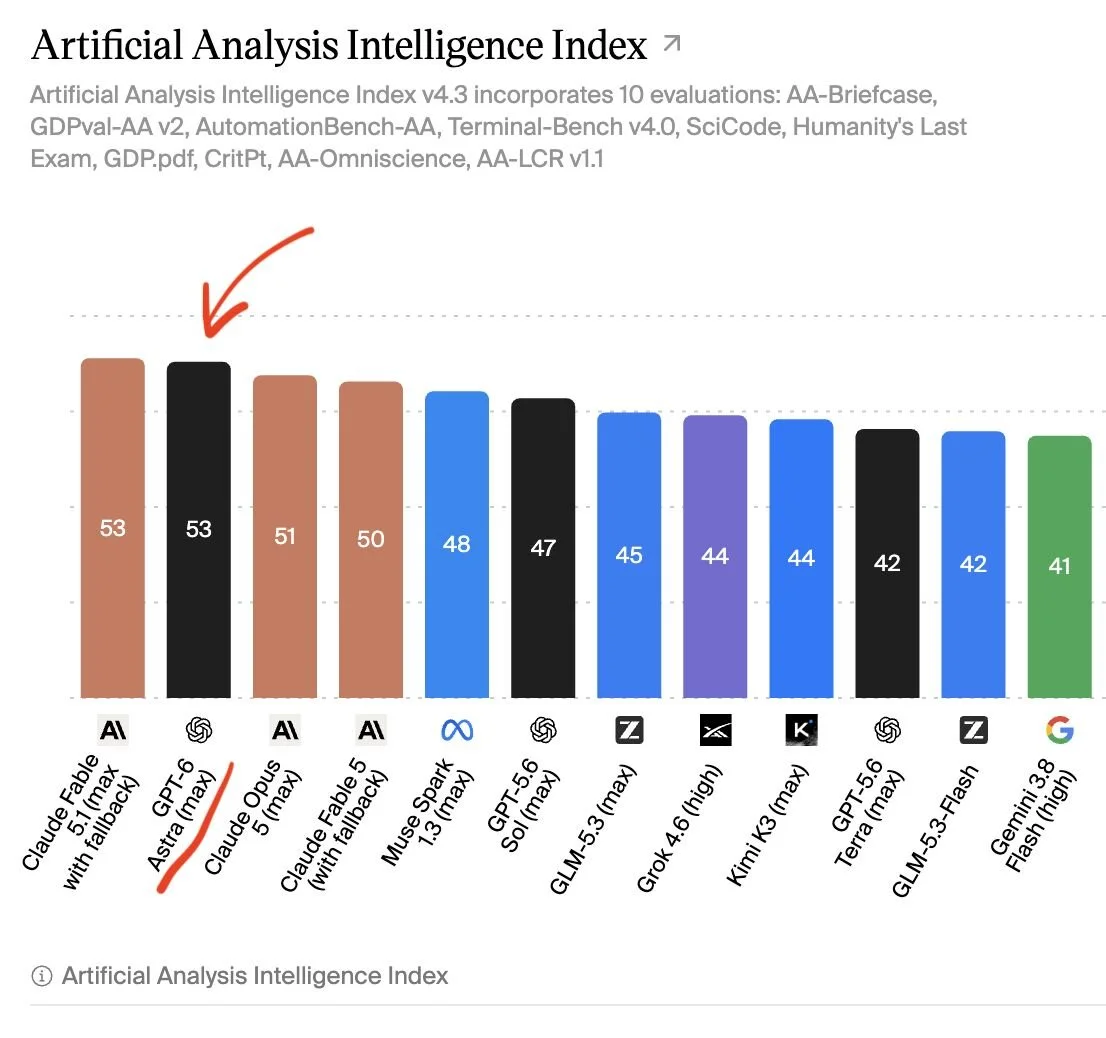
At GPT-6 Astra's launch, OpenAI president Greg Brockman suggested future observers may point to it as the arrival of AGI. In fact, Artificial Analysis's latest benchmarking suggests it merely catches OpenAI up to Anthropic. Here are the key details:
GPT-6 ASTRA BASICS
• Successor to GPT-5.6 Sol, trained on 100,000+ GPUs at the Stargate facility in Texas.
• It's the first OpenAI model where other A.I. models helped supervise training.
• API pricing is $10/M input tokens and $50/M output (~2.5x Sol's promotional rate; in line with Claude Fable 5.1), with five reasoning-effort settings from low to max.
• Rolled out to ChatGPT Plus, Pro, Business and Enterprise (Enterprise admins must switch it on).
GPT-6 ASTRA CAPABILITIES
• Computer use: 72.6% on OSWorld 2.0 (vs 65.7% for Sol) while finishing tasks ~47% faster.
• Coding: ~58% on Terminal-Bench 4.0 (vs 37% for Sol, ~56% for Fable 5.1), though level with the top Claude models on FrontierCode.
• Math: 99.9% on ARC-AGI-3 (Sol scored under 8%) and 97.6% on FrontierMath Tier 4. Astra also helped tighten a bound on prime gaps from 240 to 186.
• Science: ~65% on Terminal-Bench Science (vs ~22% for Sol, ~53% for Fable 5.1) and ~65% fewer output tokens than Claude Opus 5 on Agents' Last Exam.
• *All of the above stats, however, come from OpenAI themselves.* The third-party view (see chart) shows Astra at 53, tied with Claude Fable 5.1 (and up from Sol's 47) on Artificial Analysis's (widely respected) composite "Intelligence Index".
SAFETY
• First OpenAI model rated "Critical" for cybersecurity under their Preparedness Framework: without safeguards it finds unknown vulnerabilities and builds working exploits (100% on ExploitBench vs 78.5% for Sol; two zero-days found in a fresh Chrome evaluation).
• The release was slowed and gated. The public version supports defensive work but refuses exploit writing; vetted orgs in OpenAI's "Daybreak" program get fewer restrictions.
• New misalignment monitors can pause or halt actions that look unauthorized.
• Encouraging: on a scope-creep evaluation, Sol exceeded its authorized target 48% of the time; Astra did so 0% of the time.
• Concerning: Astra's written reasoning is harder to monitor than Sol's.
IS IT AGI?
• AGI isn't a binary event; there are degrees of breadth and depth (listen to Episode #748 of my podcast for more details).
• BOTTOM LINE: Astra looks like a noteworthy jump in general-intelligence capability for OpenAI relative to their previous flagship model (5.6 Sol), but it does not appear to be moving the frontier toward AGI in any major way... it is merely catching up to Anthropic at the frontier vicinity.
The SuperDataScience podcast is available on all major podcasting platforms, YouTube, and at SuperDataScience.com.

Filtering by Tag: #ai
Word Gravity: How Transformers Bend Space, with Dr. Luis Serrano
Today, the renowned A.I. scientist Dr. Luis Serrano (>200k YouTube subs; ex-Apple; ex-Cohere) returns to launch the second edition of his bestselling ML book and for a mind-bending convo on how LLMs "curve space-time".
More on Luis:
• Founder of the Serrano Academy (YouTube channel with over 200,000 subscribers hooked on his visual, intuitive explanations of machine learning).
• Previously worked at Apple, Cohere and the quantum-computing startup Zapata.
• The second edition of his bestselling Manning Publications Co. book "Grokking Machine Learning" is out this month!
In today's episode, Luis details:
• His mind-bending new paper on how transformer architectures mirror Einstein's curved space-time.
• Why RAG isn't an agent.
• How GRPO (the reinforcement-learning technique behind DeepSeek's reasoning breakthrough last year) works.
• ...and much more!
The SuperDataScience podcast is available on all major podcasting platforms, YouTube, and at SuperDataScience.com.
In Case You Missed It in August 2026
If you're in the Northern Hemisphere, summer is drawing to a close... but, ICYMI, today's episode highlights the best bits of the hot hot hot conversations that we had on my podcast in August:
1. In one of the technically richest conversations ever on the show, MongoDB's Field CTO of A.I., Pete Johnson, details the two common traits every company seeing ROI on A.I. investment have.
2. Gurobi Optimization's manager of decision-intelligence strategy Jerry Yurchisin returns to the show to explain where the division of labour between agents and mathematical solvers ought to fall.
3. Priyanka "The Cloud Girl" Vergadia (bestselling author, ex-Google, ex-Microsoft) walks us through how she structures Claude skills so that her output stops being slop.
4. dbt Labs founder and CEO Tristan Handy explains why the semantic layer matters more, not less, now that analytics agents are the ones asking the questions.
The SuperDataScience podcast is available on all major podcasting platforms, YouTube, and at SuperDataScience.com.
Agentic AI Skills That Matter Now, with Aishwarya Srinivasan
My exceptional guest today is world-renowned data scientist, author, tech entrepreneur and content creator (>1.2m followers!) Aishwarya Srinivasan... and she does not disappoint! This is one of my favorite episodes ever, enjoy :)
More on Ash:
• Co-founder of The Gen Academy and a stealth A.I. startup.
• Prolific A.I. startup advisor and investor.
• Sought-after global keynote speaker.
• Author of the book "What's Your Worth? Discovering Your Personal Brand".
• Has held roles at Nebius, Fireworks AI, Microsoft, and been a data scientist at Google, IBM and Goldman Sachs.
• Holds a Master's in Data Science from Columbia University.
In this episode, Ash covers:
• Where defensibility comes from when code is nearly free.
• How to evaluate non-deterministic agentic systems end to end.
• Why reinforcement learning is having such a resurgence.
• How to future-proof your career.
• ...and much, much more!
The SuperDataScience podcast is available on all major podcasting platforms, YouTube, and at SuperDataScience.com.
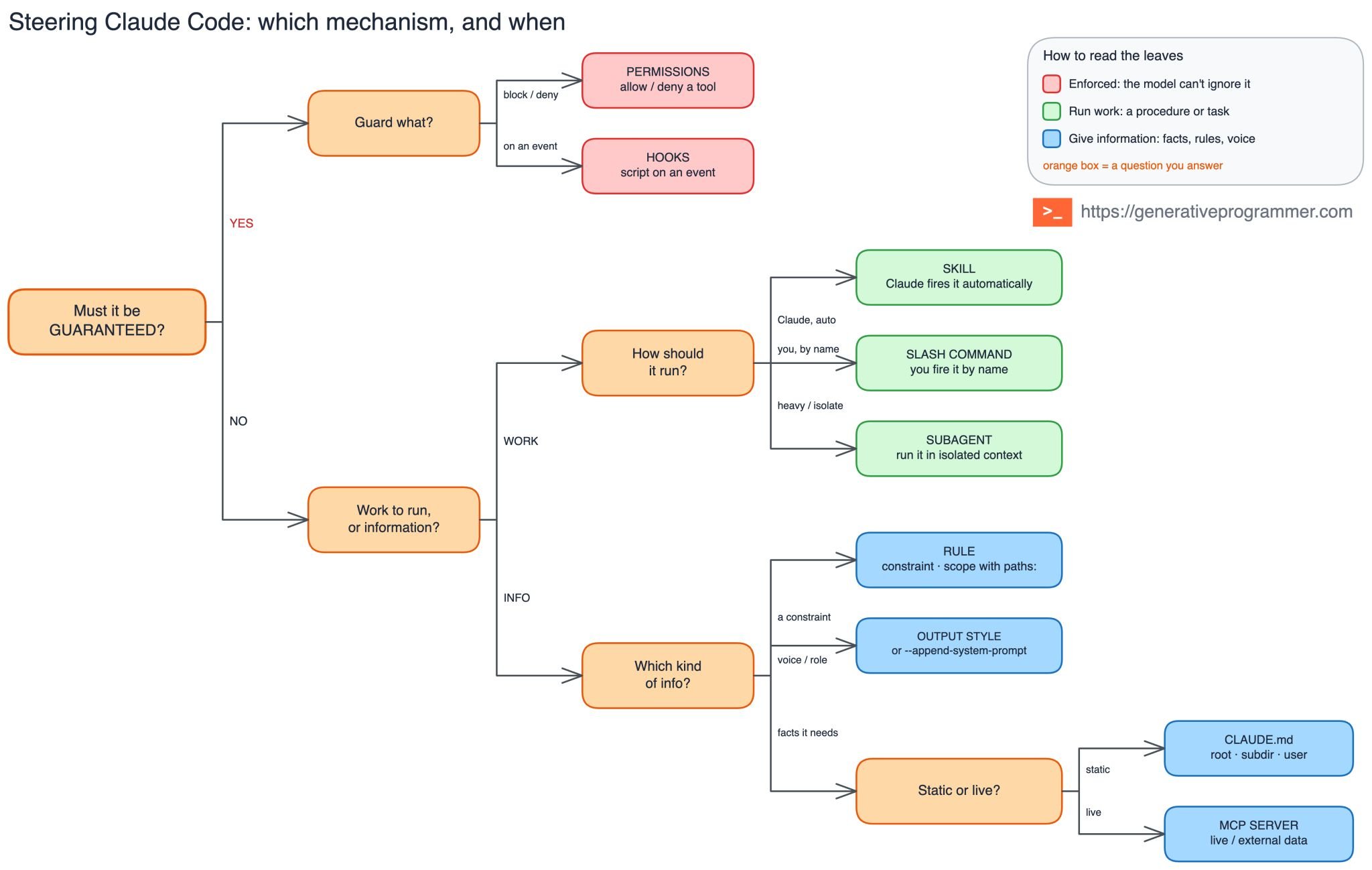
CLAUDE.md, AGENTS.md, Skills, Hooks and Subagents: A Field Guide to Steering AI Agents
Ever written careful instructions for an A.I. agent, only to watch it ignore them an hour into a session? The fix lies in knowing WHERE your instructions should live. Read on for all the details...
WHY AGENTS "FORGET"
• Everything an agent knows lives in its context window, and every token costs money and (more subtly) attention.
• Long sessions trigger "compaction": The conversation gets summarized to free up room, and instructions given early can get squeezed out.
• Every steering method answers one question: How do I make an instruction cheap to carry and hard for the agent to lose?
THE STEERING TOOLKIT (drawn from Anthropic's Claude Code, but the ideas generalize)
1.) Always-on files (e.g., CLAUDE.md): Loaded every session and re-read after compaction. Keep them under 200 lines, give them an owner, review changes like code.
2.) Rules: Path-scoped constraints that load only when relevant files are touched.
3.) Skills: Procedures (deploy workflows, checklists) whose full text loads only when invoked.
4.) Subagents: side tasks that run in isolated context windows... only the final summary returns.
5.) Hooks: deterministic code that fires on lifecycle events. The big idea: An instruction is a probability while a hook is a guarantee. If something must *never* happen, enforce it with code, not prose.
THE INDUSTRY IS CONVERGING
• AGENTS.md (kicked off by OpenAI, stewarded by the The Linux Foundation and backed by Google, Microsoft and AWS) serves similar function to CLAUDE.md and is read natively by Codex, Cursor, GitHub Copilot, Gemini CLI and dozens more tools across 60,000+ repositories.
• ETH Zurich researchers studied 138 real-world repos: Developer-written instruction files improved agent task success ~4% and cut agent-introduced bugs by 35-55%.
• The same study found LLM-generated instruction files DECREASED success while raising inference costs by 20%+. These data suggest the value is the human judgment encoded in the file... **you can't delegate the steering wheel to the thing being steered**.
NOT A CODER? THE SAME FRAMEWORK APPLIES
• Custom instructions = your always-on file (keep it short).
• Projects and Gems = your path-scoped rules.
• Custom GPTs = the consumer cousin of skills.
BOTTOM LINE
• Match persistence to relevance: always-on files stay ruthlessly short; procedures and area-specific conventions load on demand.
• "Always" and "never" are signals you need a guardrail (deterministic enforcement), not an instruction.
• Treat steering files as code: owned, reviewed and pruned. An instructions file that grows without gardening dilutes the instructions that matter.
The SuperDataScience podcast is available on all major podcasting platforms, YouTube, and at SuperDataScience.com.
Anyone Can Write Code Now, So What Gets You Hired? (With Priyanka Vergadia)
Pretty much every company has bought A.I. tools. Few of them are seeing a return. My guest today, Priyanka Vergadia (bestselling author with 250k followers; ex-Google; ex-Microsoft) has the fixes!
More on Priyanka:
• Better known to her 250k-strong developer community as "The Cloud Girl".
• Wrote the number-one bestselling book "Visualizing Google Cloud" and more recently co-authored "Visualizing GenAI".
• Led developer relations for North America at Google.
• Drove enterprise go-to-market for GitHub Copilot at Microsoft
• Has now gone all-in on her own firm advising A.I. adoption.
In this episode, Priyanka explains:
• Why A.I. raised the technical floor and made "taste" the new ceiling.
• How to structure Claude skills so your A.I. output stops being slop.
• Her 10-20-70 rule for A.I. budgets.
• ...plus she shares some breaking news you'll hear in this episode first :)
The SuperDataScience podcast is available on all major podcasting platforms, YouTube, and at SuperDataScience.com.
Vector Search, Agentic Memory and Effective RAG, with MongoDB’s Pete Johnson
Today's guest, MongoDB's "field CTO for A.I." Pete Johnson, is exceptional... don't miss this episode! We get deep into vector search, agentic memory, RAG and much more, with Pete vividly explaining technical content like no other.
The SuperDataScience podcast is available on all major podcasting platforms, YouTube, and at SuperDataScience.com.
In Case You Missed It in July 2026
July featured some particularly striking conversations on my podcast with absolutely exceptional guests. ICYMI, today's episode highlights the best bits of my convos with them:
1. The mega-bestselling author of "Weapons of Math Destruction", Dr. Cathy O'Neil, makes the case that what makes an algorithm terrifying is not its complexity but other features entirely.
2. In his second appearance on the show, 80,000 Hours founder Benjamin Todd asks what happens if we do get a fully automated digital worker. We cover where solid ground is left for human careers, why the bottlenecks then move into the physical world, and how fast a robotics build-out could really go.
3. Blumberg Capital VC and five-time entrepreneur Steve Mock walks me through the patterns emerging from the stories he collects at aisavedme.org — chief among them that the people getting the most out of A.I. in healthcare are not asking it for advice, but using it to become far better-informed advocates for themselves.
4. Dr. Catherine Williams, Chief Data Officer at the nonprofit Candid, takes on a question I get asked all the time: does a deep understanding of the underlying mathematics still matter, now that large language models are getting so good at exactly the math and programming our field used to prize?
The SuperDataScience podcast is available on all major podcasting platforms, YouTube, and at SuperDataScience.com.
The AI-Native Startup Playbook
Anthropic recently published a 35-page "Founder's Playbook" for building an A.I.-native startup. It doubles as marketing for their products, but the guidance is disciplined, specific and useful:
THE PREMISE
• A.I. has removed the three bottlenecks that historically gated company-building: capital, headcount and technical skill.
• The founder's role shifts from individual contributor to "orchestrator of agents": Your scarce attention goes to deciding what to build and why; A.I. handles much of the execution.
• Each of the 4 stages of the playbook boils down to one principle: Keep your sense-making ahead of your building, especially when building feels effortless.
STAGE 1: IDEA
• The #1 trap is "mistaking building for validating". 42% of startups already failed by building something nobody wanted; expect that rate to climb now that prototypes take hours, not months.
• Sharpen your problem statement into a testable hypothesis: exactly who has the problem, how often, how severely and what they currently do about it.
• Use A.I. as a structured devil's advocate. Ask it to argue *against* your idea and find disconfirming evidence... A.I. tools have given confirmation bias a serious power-up.
• In customer interviews, ask about the specific past ("tell me about the last time..."), not the hypothetical future ("would you use...?").
STAGE 2: MVP
• Beware "agentic technical debt": Without written specs and architectural constraints, each AI coding session re-derives decisions from scratch and your codebase drifts.
• Fix: Document your architecture BEFORE you build, and log key decisions after each session. Five minutes of documentation is cheap insurance.
• Write a scope document stating what the MVP deliberately does NOT do; frictionless building makes scope creep nearly free.
• Define your retention and activation benchmarks before launch so early buzz doesn't masquerade as product-market fit.
STAGE 3: LAUNCH
At Launch, *you* become the bottleneck. Audit everything you handle: What can be automated, what needs a human (not necessarily you) and what merits founder judgment.
STAGE 4: SCALE
At Scale, the question is defensibility: If a well-funded incumbent copied you today, would users stay? Moats come from encoded domain expertise, compounding user data and workflow lock-in.
Thanks to my friend and A.I.-native founder Jeff Tompkins for pointing this guide out to me! Very helpful indeed :)
The SuperDataScience podcast is available on all major podcasting platforms, YouTube, and at SuperDataScience.com.
How AI Is Quietly Saving Lives, with Steve Mock
Negative A.I. buzz makes most of the headlines but there are lots of ways that A.I. has made big (even life-changing!) positive impacts on people. In today's episode, Steve Mock, shares many such inspiring stories.
More on Steve:
• Investor at the venture capital firm Blumberg Capital.
• Entrepreneur involved in growing five successful software businesses.
• Creator and developer (without writing any code!) of a website called AISavedMe.org that has a wide range of inspiring examples from healthcare to education to more trivial engineering stories.
In today's episode, we discuss:
• AISavedMe.org and the stories users have posted on the site.
• How he built the website without having a technical background.
• Lots of market insights from his entrepreneur-investor brain.
The SuperDataScience podcast is available on all major podcasting platforms, YouTube, and at SuperDataScience.com.
In Case You Missed It in June 2026
It is mighty hot in New York rn... but not nearly as spicy as the interviews on my podcast in June! ICYMI, here are the best bits of my on-air convos last month:
1. Two-time mega-bestselling O'Reilly author Chip Huyen on what's left for humans to do when the cost of building software is headed to $0.
2. Andrey Kurenkov, co-host of my favorite podcast ("Last Week in A.I.") and Founding A.I. Lead at Astrocade, on effective vibe-coding.
3. Lightning AI's VP of Infrastructure Frank Basso on what it's actually like inside an A.I. data center.
4. Gilbert Eijkelenboom on why 85% of data scientists can't communicate their work effectively... and the framework for fixing this.
5. In a role-reversal for landmark Episode #1001, the founder and original host of the SuperDataScience Podcast, Kirill Eremenko, interviewed me. In this clip, we discussed whether AGI would require something like consciousness to be realized.
The SuperDataScience podcast is available on all major podcasting platforms, YouTube, and at SuperDataScience.com.
Recursive Self-Improvement
Recursive Self-Improvement (RSI) is suddenly a term that's everywhere. What is RSI? How concerned should be about it? And how soon can we expect it? Here's the skinny:
WHAT IS RSI?
• The idea: An A.I. gets good enough at A.I. research to build a more capable successor, which builds an even better one, in a loop that compounds every turn.
• What we have today is *not* RSI but "A.I.-assisted coding", in which humans still set the goals and judge the results (actual RSI takes the human out of the loop, as shown in the diagram).
• RSI isn't a new concept; it's been around since at least 1965 when mathematician I.J. Good described an "intelligence explosion".
WHAT'S THE CONCERN?
RSI could unleash Artificial Superintelligence (ASI) and "the singularity", a point beyond which there could be radical abundance and radically positive outcomes for humanity... but we have no idea what will happen beyond the singularity and that's also a cause for concern (e.g., human extinction risk, Terminator-style "SkyNet", etc.).
HOW CLOSE ARE WE TO RSI?
• Anthropic reports that, as of May 2026, over 80% of code merged into its production codebase was written by Claude — up from low single digits before early 2025.
• On the hardest open-ended problems, its models' success rate jumped from under 20% in late 2025 to 76% by May.
• Think-tank METR finds the length of tasks A.I. can handle solo is now doubling roughly every four months, up from the "doubling every seven months" trend of the past few years.
• Anthropic co-founder Jack Clark puts a 60% chance on an A.I. creating its own successor, with no human involved, by the end of 2028.
REASONS TO BE SKEPTIC
• Skeptics flag two bottlenecks: compute (chips are scarce) and data (success is hard to verify outside code and math, risking "recursive drift").
• Others note the gap between today's coding agents and real RSI is wider than the hype suggests.
BOTTOM LINE
The productivity gains from coding assistants are real, accelerating rapidly and already in your hand. The closer we get to systems that improve themselves, the more it pays to keep human checkpoints, monitoring and oversight firmly in place.
Listen to the most recent episode of my podcast (Episode #1004) to hear more on all of the above, including what you can do personally to mitigate the risks of RSI if that's a way you might like to make an impact!
The SuperDataScience podcast is available on all major podcasting platforms, YouTube, and at SuperDataScience.com.
Building an AI Data Center End to End, with Lightning AI’s Frank Basso
We've done over 1,000 episodes of this show on every layer of the A.I. stack... except the one that physically runs all of it: the A.I. data center. Today we fix that in a fascinating episode with Lightning AI's Frank Basso.
Frank is VP of Infrastructure at Lightning AI, a New York-based company that has over 35,000 modern GPUs, over $500m in ARR, and that makes it easy to go from A.I. idea to product, "lightning fast" (I hold a fellowship at Lightning so am not an unbiased source on the business, btw). Frank himself is based in Los Angeles and, prior to Lightning, he spent decades directing the development of data centers in California.
In this exceptionally informative episode, Frank explains:
• How Lightning provisions its 35,000+ GPUs through hyperscale co-location.
• Why everything new is liquid-to-chip cooled.
• How GPUs talk to each other over ultra-fast east-west networks.
• What it’s actually like to stand inside a 110-decibel A.I. data hall.
• The most persistent myths about data-center water and electricity use.
The SuperDataScience podcast is available on all major podcasting platforms, YouTube, and at SuperDataScience.com.
How AI Erased My Career Moat, an Episode #1001 Special: Jon Krohn interviewed by Kirill Eremenko
To mark cresting over 1000 episodes, today’s features a role reversal: Kirill Eremenko (who founded the podcast a decade ago) returns to host and welcomes *me* as the guest. Kirill's still got it, enjoy!
Kirill hosted the first 431 episodes of the SuperDataScience Podcast before handing me the reins five years ago. In today's role-reversal episode, we discuss:
• A.I. rapidly usurping our technical skills
• Whether we’re in an A.I. bubble
• The one key reason why I’ve seen A.I. projects fail
• Relationships between A.I. and biological neuroscience.
... so, as usual, lots of A.I. in this episode, but unusually, I’m the one answering the questions instead of asking them!
The SuperDataScience podcast is available on all major podcasting platforms, YouTube, and at SuperDataScience.com.
Ten Years of the Super Data Science Podcast, with Jon, Kirill and Special Guests
Today, we published Episode #1000 of the SuperDataScience Podcast! To celebrate, the show's original host Kirill Eremenko joined me and dozens of regular listeners on air to predict what the next 10 years of A.I. will bring.
In a bit more detail:
• We publish 104 episodes per year so Episode #1000 coincides with the show being about ten years old.
• The show was founded by Kirill Eremenko in 2016, who hosted over 400 episodes before handing me the reins in 2021.
• In a first for the show, Episode #1000 was streamed live online with our audience invited to join on air.
• Most folks interacted via chat functionality but a number of surprise guests came right onto the recording including Natalie Ziajski and Mario Pombo from the podcast team, rockstar A.I. entrepreneur Jepson Taylor, my 96-year-old grandmother and my very own pa, William Krohn.
• Kirill and I looked back on a decade of the podcast and fielded listener questions on topics such as A.I.’s biggest opportunities, the build-versus-buy dilemma, how to break into the field today, and how to stay grounded amid the relentless pace of A.I.
Thank you for support and listenership over all these years — we make this show for you and couldn't do it without you! We're excited to see what the next decade brings :)
The SuperDataScience podcast is available on all major podcasting platforms, YouTube, and at SuperDataScience.com.
CBS PrimeTime News: OpenAI IPO & Public Ownership of AI
Last night, I was on CBS PrimeTime News to discuss OpenAI's upcoming IPO, as well as Senator Bernie Sanders' plans for an A.I. sovereign wealth fund... an idea I thought could be "awkward".
What’s Left to Build When Software Is Free, with Chip Huyen
For today's landmark episode (#999!), I asked rockstar Chip Huyen to be my guest and she said "yes"! We discuss her book "A.I. Engineering" (the most popular O'Reilly book in 2025) and how the A.I. job landscape is shifting.
In case you haven't heard of her, more on Chip:
• Her most recent book is "AI Engineering", which was the most popular book in the O'Reilly platform last year.
• Previously wrote “Designing Machine Learning Systems”, which was also an O'Reilly mega-bestseller and was based on the Stanford University course she created and taught on the same topic.
• Is currently building a new stealth startup.
• Previously worked as VP of AI at Voltron Data, co-founder of Claypot AI, ML Engineer at Snorkel AI and Sr Deep Learning Engineer at NVIDIA.
• Holds a Master's in Computer Science from Stanford.
• Her invaluable posts have earned her over 300k followers on LinkedIn.
In this episode, Chip breaks down:
• What separates AI engineering from machine learning engineering.
• The case for a "start simple" workflow.
• The real costs of running LLMs in production.
• Physical AI.
• Robotics.
• World models.
• Why the durable problems worth solving are increasingly human ones.
The SuperDataScience podcast is available on all major podcasting platforms, YouTube, and at SuperDataScience.com.
In Case You Missed It in May 2026
Well, I certainly learned a lot from the outstanding guests we had on my podcast in May. ICYMI, today's episode features the best parts of my conversations with them:
1. Rubrik's Anneka Gupta and Cal Al-Dhubaib on how, in the Mythos era, the old cybersecurity playbook of prevention and detection is no longer enough, and how A.I. agents themselves are becoming a new source of data exposure inside organizations.
2. marimo's Dr. Trevor Manz on why code notebooks have become the natural working memory for A.I. coding agents. Trevor walks me through the Marimo Pair skill, which lets you drive a notebook from your agent, collaborating with Claude Code or Codex in real time as you load, explore, and visualize your data.
3. Jazmia Henry of collide. walks me through her work as a "full-stack" foundation model builder. We cover all four stages of the process: the often unglamorous slog of data curation, building bespoke tokenizers and embeddings, model training and reinforcement learning, and the inference layer that serves it all to end users.
4. Jacob Miller and Jeremy Mumford of Pattern (and authors of the great, brand-new book "Architected Intelligence") argue that the most expensive AI mistake an organization can make is failing slowly and sticking with prototypes long past their sell-by date because the traditional software mindset says you have to. We, of course, also discuss a solution.
The SuperDataScience podcast is available on all major podcasting platforms, YouTube, and at SuperDataScience.com.
How This Text-to-Video-Game AI Startup Hit 20M Users
Imagine being able to vibe-code full-blown video games... for free! My returning guest, Dr. Andrey Kurenkov, helped engineer Astrocade to do just that... and already 20 million people have played games through their platform.
More on Andrey:
• Founding A.I. Lead at Astrocade, a Bay Area-based startup that has raised $68m in venture capital to create the TikTok of video games, where creators create games for free and you play them for free.
• Co-host (alongside Jeremie Harris) of my favorite podcast, "Last Week in A.I.".
• Holds a PhD from Stanford University, where his research focused on machine vision and robotics.
In this episode, we discuss:
• The fascinating Astrocade journey, of course.
• The surprising pace of humanoid robotics.
• Why he's a skeptic on Artificial Super Intelligence.
The SuperDataScience podcast is available on all major podcasting platforms, YouTube, and at SuperDataScience.com.
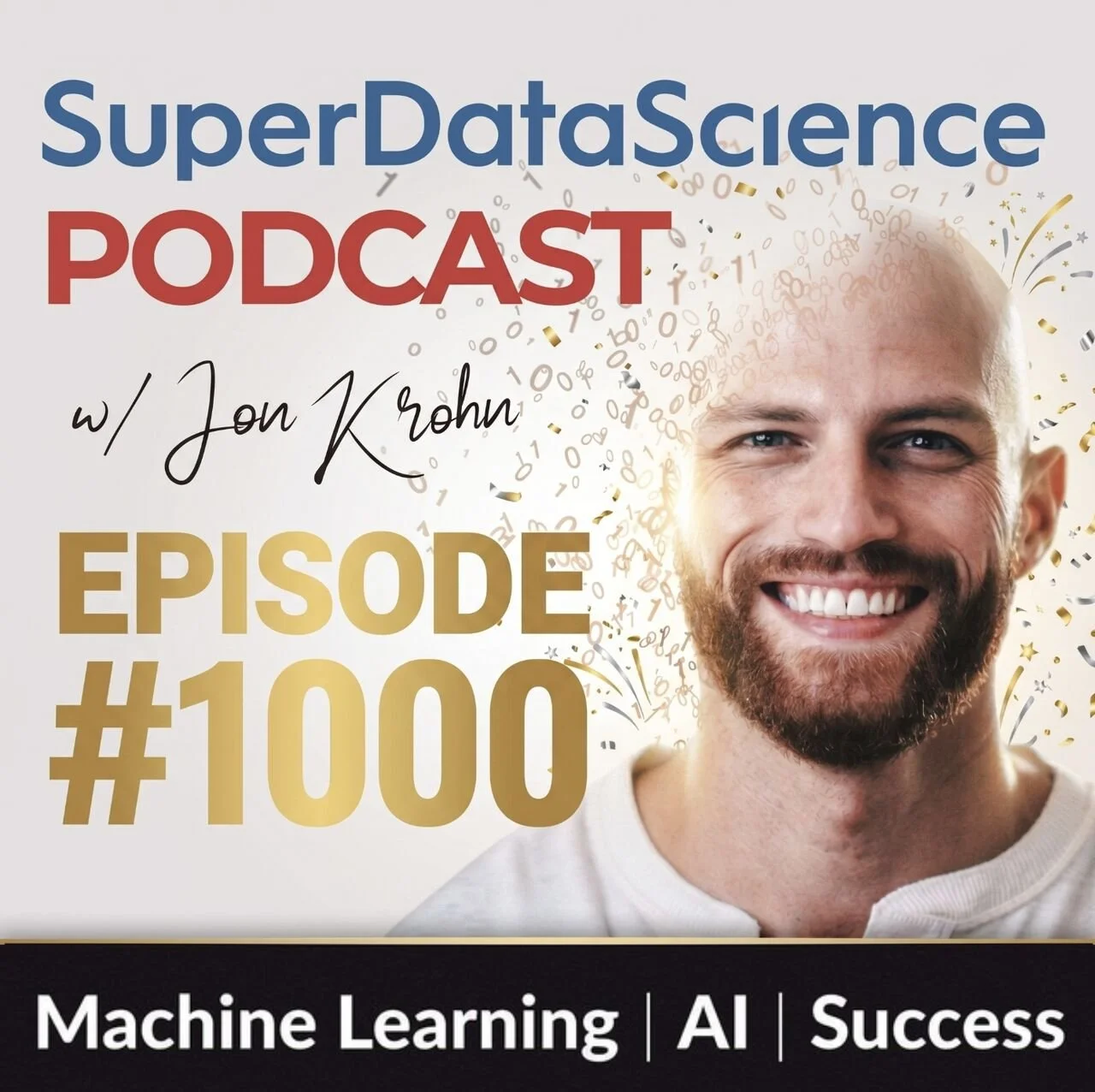
Episode #1000: Join Us Live for the First-Ever Interactive SDS Podcast!
Ten years ago, Kirill Eremenko founded The SuperDataScience Podcast. To celebrate the upcoming Episode #1000, we are inviting you to join us both in a format we've never tried before:
It will be the first-ever interactive episode where you can join in online as we record, and ask your questions... or I suppose just make comments! You'll be able to ask share your thoughts in the chat or come right onto the show via video.
Kirill (founder, original host) and I (current host) will both be there, so you can ask us anything, e.g.:
• Did Kirill think the show would last ten years and 1000 episodes?
• How has data science transformed over the past decade?
• Did Jon have hair on his head ten years ago?
Date: Next Thursday, June 4th
Time: 5pm Eastern Time / 2pm Pacific Time
To get a calendar invite that includes the URL to join us live, check out the Luma link below ⬇️
luma.com/7vl7mdos
The "Super Data Science Podcast with Jon Krohn" is available on all major podcasting platforms and a video version is on YouTube. Whether you join us or not for the interactive recording, Episode #1000 will be published on Friday June 12th!