Over a single weekend, Ishan S. burned through 2 billion tokens (building a video game for his wife)! He and Tyler Cox join me in today's episode to explain why agentic A.I. bills are exploding... and how a box under your desk can cut them by up to 93%.
Tyler and Ish are returning guests on my podcast... but they are on the show *together* for the first time today. They are both Distinguished Engineers in the Office of the CTO for the client group at Dell Technologies, where they work out how to run powerful A.I. models on the machines closest to you.
In this information-rich episode, Tyler and Ish:
• Dig into "tokenomics" (why agents and their sub-agents devour so many more tokens than chatbots ever did).
• How to pick the right LLM for the job.
• How moving agentic workloads off pay-per-token cloud APIs and onto your own hardware can pay for itself in as little as two months.
The SuperDataScience podcast is available on all major podcasting platforms, YouTube, and at SuperDataScience.com.

Filtering by Tag: #agenticAI
Garbage In, Gospel Out: Why Agents Need Better Data, with Salesforce’s Gaurav Pathak
When humans get bad data, we argue about it in meetings. When AI agents get bad data, they can turn it into an answer with total confidence.
My wise guest today, Gaurav Pathak, calls it “garbage in, gospel out.” The takeaway? Better data and context lead to better AI — and, of course, Gaurav has some thoughts on how to get there. #ad #SalesforcePartner
Gaurav Pathak:
• Senior Vice President Product Management AI and Metadata at Salesforce.
• Previously spent 13 years at Informatica building its metadata and AI products, including the CLAIRE AI engine, before Salesforce acquired the company last year.
• Holds a degree in computer science and engineering, as well as an MBA
In this episode, filmed live at Dreamforce in San Francisco last week, Gaurav explains:
• Why context is 95% of the battle for enterprise agents.
• Who the "sin eaters" are that pay for an agent's mistakes.
• The three skills that matter most for AI engineers today.
The SuperDataScience podcast is available on all major podcasting platforms, YouTube, and at SuperDataScience.com.
How AI Brought a Podcast Back From the Dead, with Linear Digressions’ Katie Malone
Dr. Caitlin Malone's extremely popular "Linear Digressions" podcast went silent for five years. Then A.I. made it possible to bring it back... and to manage it like a team. Hear all about effective agent teams in today's excellent episode.
More on Katie:
• Hosts and produces "Linear Digressions", one of the world's most popular data-science podcasts. (It's excellent — check it out!)
• Senior Researcher at Moonlite AI.
• Previously Sr Director of the A.I. Innovation Lab at the Health Care Service Corporation, Sr Director of Data Science at Tempus Labs, and Director of Data Science at Civis Analytics.
• Has taught machine learning via Udacity and at the University of Chicago.
• Holds a PhD in experimental particle physics from Stanford University focused on working with CERN data.
In this episode, Katie explains:
• Why managing people and managing A.I. agents are the same skill in different clothing.
• Why A.I. could hollow out the expertise we need to catch its mistakes.
• A fascinating range of data paradoxes from Simpson’s to Benford’s.
The SuperDataScience podcast is available on all major podcasting platforms, YouTube, and at SuperDataScience.com.
The Chip Built for Agentic AI Inference, with SambaNova’s Anton McGonnell
GPUs are the workhorse of A.I. inference… but they aren’t actually optimized for inference! SambaNova has raised over $2B to build a new chip that is, pushing the frontier of real-time A.I. speed and bandwidth. Hear about it from Anton in today's episode.
More on Anton McGonnell:
• VP of Product at SambaNova, a Bay Area A.I.-hardware business recently valued at $11 billion.
• Was previously Director of Product Management for Machine Learning at UiPath and responsible for A.I. research at Glasswing Ventures.
• Holds an MBA from Harvard Business School and a degree in computer science from Queen's University Belfast.
In today's episode, Anton explains:
• Why agentic A.I. has changed the shape of inference workloads.
• How SambaNova's chip sidesteps the memory bottleneck that slows GPUs when generating output tokens.
The SuperDataScience podcast is available on all major podcasting platforms, YouTube, and at SuperDataScience.com.
Agentic AI Skills That Matter Now, with Aishwarya Srinivasan
My exceptional guest today is world-renowned data scientist, author, tech entrepreneur and content creator (>1.2m followers!) Aishwarya Srinivasan... and she does not disappoint! This is one of my favorite episodes ever, enjoy :)
More on Ash:
• Co-founder of The Gen Academy and a stealth A.I. startup.
• Prolific A.I. startup advisor and investor.
• Sought-after global keynote speaker.
• Author of the book "What's Your Worth? Discovering Your Personal Brand".
• Has held roles at Nebius, Fireworks AI, Microsoft, and been a data scientist at Google, IBM and Goldman Sachs.
• Holds a Master's in Data Science from Columbia University.
In this episode, Ash covers:
• Where defensibility comes from when code is nearly free.
• How to evaluate non-deterministic agentic systems end to end.
• Why reinforcement learning is having such a resurgence.
• How to future-proof your career.
• ...and much, much more!
The SuperDataScience podcast is available on all major podcasting platforms, YouTube, and at SuperDataScience.com.
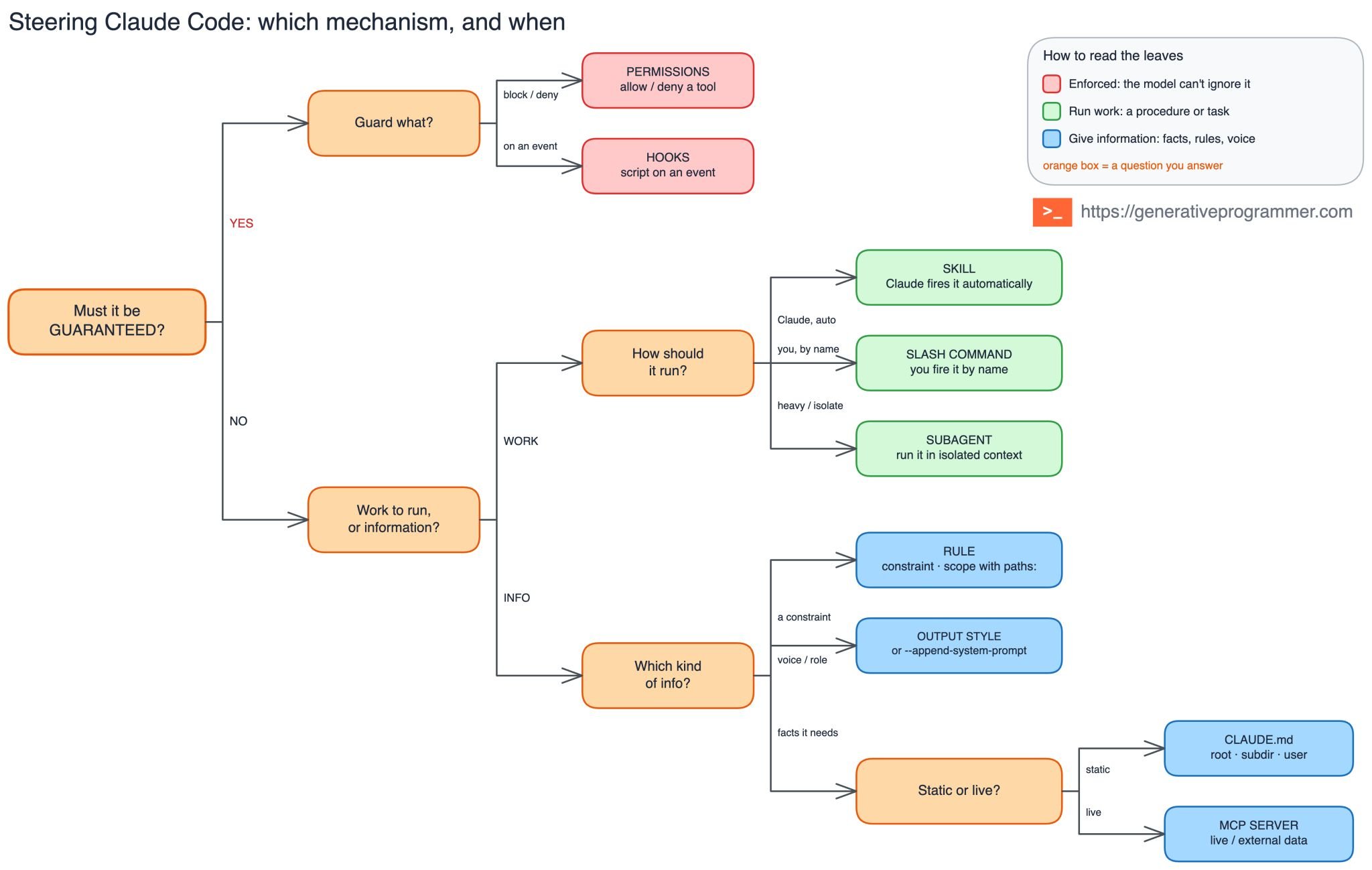
CLAUDE.md, AGENTS.md, Skills, Hooks and Subagents: A Field Guide to Steering AI Agents
Ever written careful instructions for an A.I. agent, only to watch it ignore them an hour into a session? The fix lies in knowing WHERE your instructions should live. Read on for all the details...
WHY AGENTS "FORGET"
• Everything an agent knows lives in its context window, and every token costs money and (more subtly) attention.
• Long sessions trigger "compaction": The conversation gets summarized to free up room, and instructions given early can get squeezed out.
• Every steering method answers one question: How do I make an instruction cheap to carry and hard for the agent to lose?
THE STEERING TOOLKIT (drawn from Anthropic's Claude Code, but the ideas generalize)
1.) Always-on files (e.g., CLAUDE.md): Loaded every session and re-read after compaction. Keep them under 200 lines, give them an owner, review changes like code.
2.) Rules: Path-scoped constraints that load only when relevant files are touched.
3.) Skills: Procedures (deploy workflows, checklists) whose full text loads only when invoked.
4.) Subagents: side tasks that run in isolated context windows... only the final summary returns.
5.) Hooks: deterministic code that fires on lifecycle events. The big idea: An instruction is a probability while a hook is a guarantee. If something must *never* happen, enforce it with code, not prose.
THE INDUSTRY IS CONVERGING
• AGENTS.md (kicked off by OpenAI, stewarded by the The Linux Foundation and backed by Google, Microsoft and AWS) serves similar function to CLAUDE.md and is read natively by Codex, Cursor, GitHub Copilot, Gemini CLI and dozens more tools across 60,000+ repositories.
• ETH Zurich researchers studied 138 real-world repos: Developer-written instruction files improved agent task success ~4% and cut agent-introduced bugs by 35-55%.
• The same study found LLM-generated instruction files DECREASED success while raising inference costs by 20%+. These data suggest the value is the human judgment encoded in the file... **you can't delegate the steering wheel to the thing being steered**.
NOT A CODER? THE SAME FRAMEWORK APPLIES
• Custom instructions = your always-on file (keep it short).
• Projects and Gems = your path-scoped rules.
• Custom GPTs = the consumer cousin of skills.
BOTTOM LINE
• Match persistence to relevance: always-on files stay ruthlessly short; procedures and area-specific conventions load on demand.
• "Always" and "never" are signals you need a guardrail (deterministic enforcement), not an instruction.
• Treat steering files as code: owned, reviewed and pruned. An instructions file that grows without gardening dilutes the instructions that matter.
The SuperDataScience podcast is available on all major podcasting platforms, YouTube, and at SuperDataScience.com.
Vector Search, Agentic Memory and Effective RAG, with MongoDB’s Pete Johnson
Today's guest, MongoDB's "field CTO for A.I." Pete Johnson, is exceptional... don't miss this episode! We get deep into vector search, agentic memory, RAG and much more, with Pete vividly explaining technical content like no other.
The SuperDataScience podcast is available on all major podcasting platforms, YouTube, and at SuperDataScience.com.
TrueFoundry’s Nikunj Bajaj on How to Get $100M Returns on AI Agent Deployments
Imagine being able to deploy an AI agent and getting a return of over $100m from that single deployment. My guest today, Nikunj Bajaj, has facilitated that multiple times! Lots to learn from him, enjoy!
Nikunj:
• CEO and co-founder of TrueFoundry, a Bay Area-based startup that has raised over $20m to solve the thorniest problems that enterprises face when deploying agents.
• His clients include demanding organizations like NVIDIA and Siemens.
• Was previously ML tech lead at Facebook.
• Holds a master's in computer science from University of California, Berkeley.
The SuperDataScience podcast is available on all major podcasting platforms, YouTube, and at SuperDataScience.com.
How to Build AI-First Organizations, with Jacob Miller and Jeremy Mumford
After today's fun episode with Jacob and Jeremy — authors of the brand-new book "Architected Intelligence" — you’ll have all the key info to build successful AI features, AI products and AI-first companies. Enjoy!
Jeremy Mumford and Jacob Miller serve as Lead AI Engineer and Vice President of Platform Intelligence, respectively, at Pattern, a giant Utah-based tech company that IPO’ed on the Nasdaq exchange about six months ago.
Jacob and Jeremy's brand-new "Architected Intelligence" book was published by Wiley and this episode focuses almost exclusively on this invaluable book.
Episode highlights include:
• The "User Agnosticism Tenet", which means designing products and processes so they can be executed equally well by a human, an AI agent, or any hybrid combo.
• The shift in the "define-build-feedback" loop today where "building" is no longer the bottleneck, which means "definition" and "feedback" are where teams win or lose.
• Why workflows are deterministic, predictable, and cheaper than agents, and why the natural progression is skills first, then workflows, and only then agents.
• Why data engineering is the bedrock of AI engineering.
• Why velocity is the only durable moat in a world where everyone has access to the same frontier models.
Thanks to podcast superfan Jonathan Bown for recommending Jeremy and Jacob as guests!
The SuperDataScience podcast is available on all major podcasting platforms, YouTube, and at SuperDataScience.com.
Pair Programming with AI in Your Python Notebook, with Dr. Trevor Manz
Exceptional technical episode today with Dr. Trevor Manz on "marimo Pair", an actually!) game-changing pair-programming A.I.-agent companion that lifts heavy loads within your Python data-science notebook.
More on Trevor:
• 27-time NCAA Swimming All-American & National Champion.
• Master's in Computational Biology from University of Cambridge.
• PhD in Bioinformatics from Harvard University.
• Creator of the popular open-source "anywidget" project (amongst many others, particularly in visualizing bioinformatics data, e.g., genomics data).
• Now a founding engineer at marimo.io, where he is leading the charge on marimo Pair.
Seriously, marimo Pair is unreal. A complete reimagining of what's possible in a Jupyter notebook-style environment in the agentic A.I. era. You will hear (and see) my mind explode in this episode!
We also discuss:
• Agent skills.
• Recursive language models.
• A number of other open-source projects, largely in data viz/analysis.
The SuperDataScience podcast is available on all major podcasting platforms, YouTube, and at SuperDataScience.com.
Web Summit Vancouver 2026
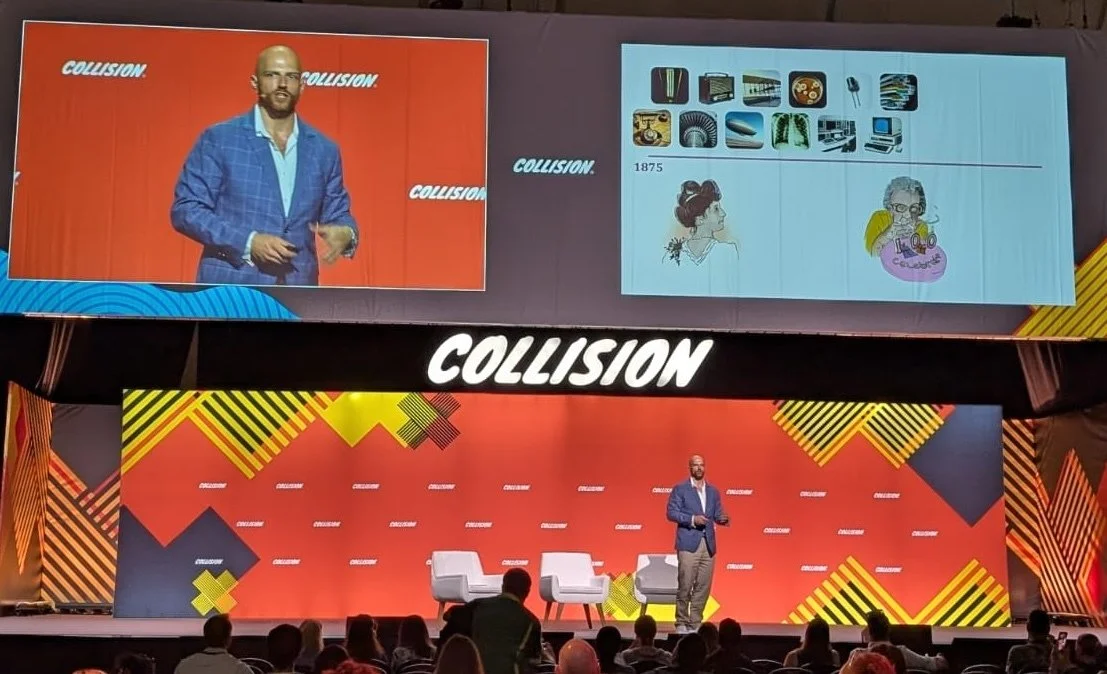
"Collision" has grown and re-branded as "Web Summit Vancouver". I'm looking forward to experiencing the new brand for the first time next week! See you there? Here's where you can catch me:
• Tue May 12 at 11am: Mentor Hours on "scaling your startup"
• Wed May 13 at 1:30pm: Delivering my agentic A.I. talk ("Something Big is Happening") on the "A.I. Summit" stage.
• Wed May 13 at 1:50pm: Emceeing the "A.I. Summit" stage all afternoon.
More on Web Summit Vancouver:
• Taking place May 11–14 at the Vancouver Convention Centre.
• It's the second year in a row the conference, under this new brand, has taken place (the previous "Collision"-branded event was held annually in Toronto and the photo in this post is from a talk I gave there in 2024).
• Connects over 35,000 startup founders, investors and industry leaders to discuss A.I., entrepreneurship and tech trends.
Security for Mythos-Era Agentic Risks, with Rubrik’s Anneka Gupta and Cal Al-Dhubaib
Mythos finds security vulnerabilities at ~100X the rate of publicly available models, and comparable open-weight models are ~6 months away. Scary? Thankfully my guests today, Anneka and Cal, have solutions!
Anneka:
• Chief Product Officer at Rubrik.
• Lecturer in Product Management at Stanford University.
• Climbed the ladder from software engineer to President (!!) during an 11-year tenure at LiveRamp.
• Holds a degree in math and computational sciences from Stanford.
Cal:
• Principal Technologist at Rubrik.
• Formerly founder and CEO of Pandata, which was acquired by Further.
• Highly sought-after keynote speaker.
• Holds a degree in data science from Case Western Reserve University.
This is an exceptional episode with two brilliant, entertaining and highly knowledgeable guests. It can be enjoyed by anyone! In it, they cover:
• How Anthropic's Mythos model can be pointed at a code repository and autonomously surface every vulnerability inside it, and how Anthropic itself estimates Mythos-class capabilities will reach other labs within six to eighteen months, with open-weight versions likely to follow.
• How code-gen models make it easy for attackers by scaling up their capabilities... and by vibe-coders not being aware of vulnerabilities they have!
• How Rubrik's Agent Cloud delivers three pillars of resilience: visibility into every agent in your environment, governance and runtime control through the SAGE small language model, and remediation through Agent Rewind.
• Why the next wave of knowledge work is inherently cross-functional, with A.I. attorneys, security pros, and data scientists all needing shared literacy in A.I. risk.
The SuperDataScience podcast is available on all major podcasting platforms, YouTube, and at SuperDataScience.com.
Building Hardware is Hard but AI Agents Help, with Kishore Subramanian
In software, when something goes wrong, you push a patch. In hardware? Oooph. You're dealing with big headaches and huge costs. Thankfully, my guest today — Kishore Subramanian — is using AI to transform the way physical products get built for the better.
Kishore:
• Is CTO of Propel Software, a Bay Area company that combines product data with agentic AI to make the production of physical hardware (including high tech and medtech devices) as seamless as possible.
• Prior to Propel, held senior engineering roles at Google, where he worked on Google Assistant, so he has particularly rich experience with agent development.
• Holds a degree in electronics, computers and process control… as well as a 200-hour yoga-teaching certificate!
In this episode, Kishore covers:
• How product lifecycle management (PLM) is the system that takes a physical product from concept all the way to the customer and beyond.
• How AI agents can review engineering change orders — the hardware equivalent of pull requests — to flag risks, compliance gaps, and downstream impacts before they become expensive problems.
• How Propel built their AI platform, Propel One, on top of Salesforce's Agentforce 360 Platform, which gave them security, governance, data infrastructure, and a reasoning engine out of the box, allowing them to ship in about six months.
The SuperDataScience podcast is available on all major podcasting platforms, YouTube, and at SuperDataScience.com.
The Four Types of Memory Every AI Agent Needs, with Richmond Alake
To build an effective A.I. agent, getting its memory right is essential. In today's episode, our agent-memory guide is brilliant (and very funny!) machine-learning architect and engineer, Richmond Alake.
More on Richmond:
• Director of A.I. developer experience at Oracle.
• Previously roles include: staff developer advocate for AI/ML at MongoDB, ML architect at Slalom, writer for NVIDIA and computer-vision engineer at Loveshark.
• Holds a master's in ML and robotics from the University of Surrey.
In this episode, Richmond magnificently covers:
• How agent memory is the encapsulation of systems (embedding models, rerankers, databases, and LLMs) that allow AI agents to learn and adapt with new information over time, rather than starting from scratch every session.
• The four types of agent memory (all drawn from human cognition).
• Memory-first agent harnesses.
• Predictions for a flattening of AI engineering roles, where the future developer will need end-to-end understanding of the full agent stack.
The SuperDataScience podcast is available on all major podcasting platforms, YouTube, and at SuperDataScience.com.
Building AI Agents Where 99.9% Accuracy Isn't Good Enough, with Raju Malhotra
The headlines shout “SaaSpocalypse,” but I don’t buy it. Neither does my guest today, Raju Malhotra, who argues that, thanks to humans collaborating with agents on optimized workflows, the SaaS opportunity is now far bigger than ever before.
More on Raju:
Chief Product & Technology Officer (CPTO) at Certinia, an Austin, Texas-based company whose Professional Services Automation software is used by over 1400 organizations around the world.
Was previously CPTO at PAR Technology and Khoros.
Earlier, spent 12 years at Microsoft working on cornerstone products like Visual Studio .NET.
Holds an MBA from The Wharton School and an undergrad in computer engineering.
In this episode, we cover:
Traditional SaaS isn't dead… instead, it's evolving into a hybrid of SaaS plus agentic capabilities, where humans and agents work together in optimized workflows.
By removing the human-skills constraint from professional services delivery, the agentic revolution could expand the addressable market by 7-8X.
The Agentforce 360 platform (by combining probabilistic AI with deterministic logic and guardrails) empowers innovators to turn their ideas into scalable software businesses, allowing businesses like Certinia to bring AI agents securely and reliably to their customers, even in sensitive industries where 0.1% error rates are unacceptable.
The SuperDataScience podcast is available on all major podcasting platforms, YouTube, and at SuperDataScience.com.