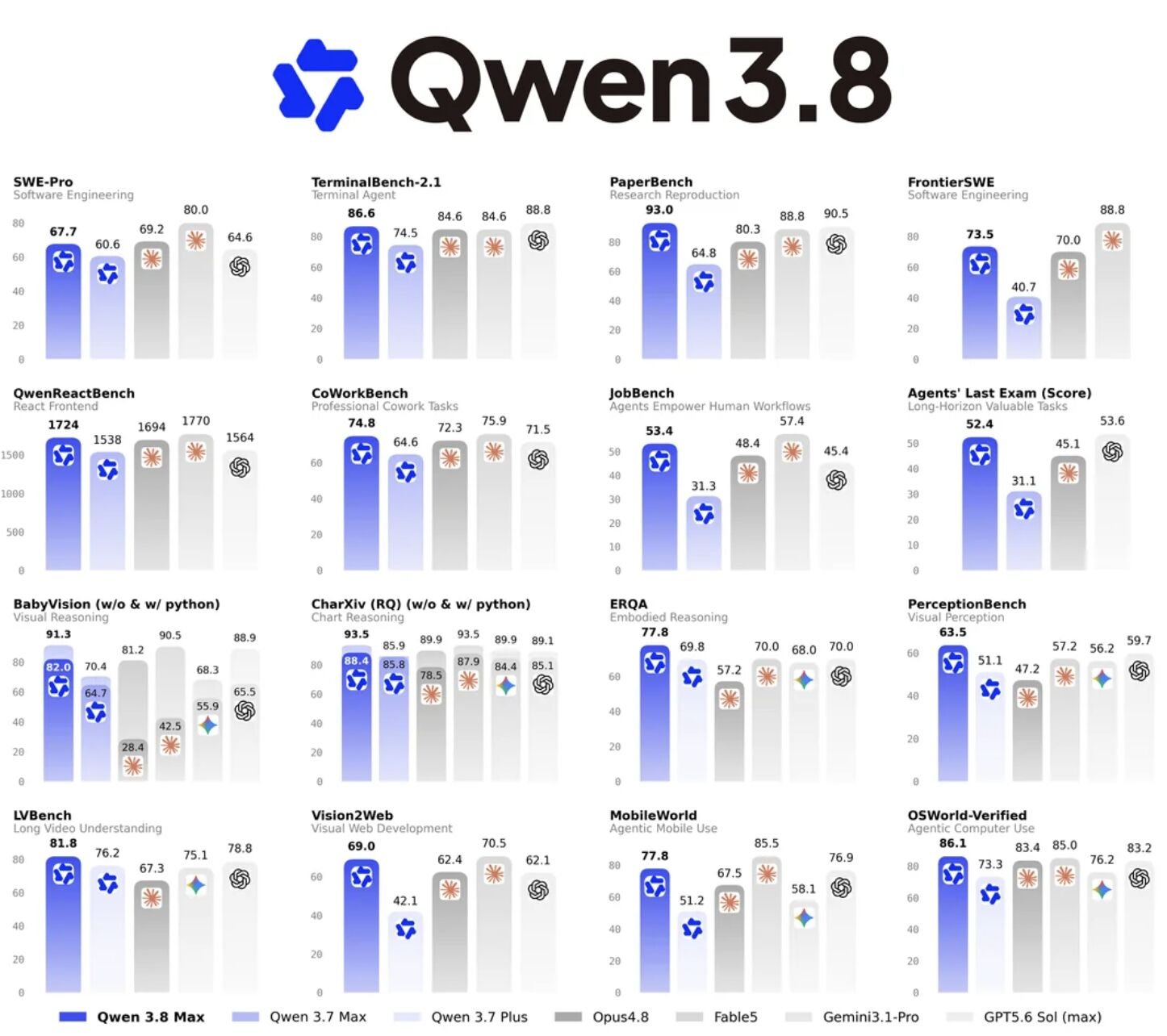
Chinese tech giant Alibaba is shipping Qwen3.8-Max: It'll be the largest open-weight A.I. model ever released and (as shown in chart) it's competing at the frontier alongside closed-source models from Anthropic and OpenAI. Here's what you need to know:
THE MODEL
• 2.4 trillion parameters in a mixture-of-experts architecture; only ~95B are active per token, so the headline number reflects capacity, not per-request compute.
• Accepts text, images and video, with a one-million-token context window (~750K words).
• Selectable low, medium or extra-high reasoning effort, so no paying for lengthy thinking traces when you need a quick lookup.
• All part of Alibaba's ~$53B, three-year bet on cloud and A.I. infrastructure.
THE BENCHMARKS
• Alibaba frames it as second only to Anthropic's Claude Fable 5; independent signals so far land in a similar neighborhood.
• Immediately became the highest-ranking Chinese model for text on the Arena leaderboard and ranked second globally on vision.
• Scored 86.6 on Terminal-Bench (agentic command-line tasks), ahead of both Claude Opus 4.8 and Fable 5.
• Vendor demos showcase multi-day autonomy: 10+ days coding unattended, plus reproducing an ML research paper from scratch and then beating 87% of 526 human teams in a live contest.
THE PRICE WAR
• $2 per million input tokens, $6 output and 25¢ cached input.
• Undercuts domestic rival Kimi K3 by more than half on output.
• Combined rate is less than a third of Claude Opus and under a quarter of GPT-5.6 Sol's... and cached-input pricing lets agentic workloads collapse toward the 25¢ floor.
IS IT SAFE TO USE A CHINESE MODEL?
• The risk depends less on the model and more on how your data reach it.
• Consumer apps and the hosted API route data through infrastructure governed by Chinese law, so keep anything sensitive or proprietary out of that.
• Safer: open weights hosted by a Western A.I. cloud (like Lightning AI) in your own jurisdiction.
• Safest: run the model on your own hardware: weights are inert files that can't phone home.
• Caveats: outputs reflect training under Chinese content regulations, so evaluate before trusting; practice supply-chain hygiene (official repos, checksums) and check whether your industry restricts Chinese-origin models.
BOTTOM LINE: Whatever your view on the geopolitics, the cost of experimenting at/near the frontier keeps falling and the control builders retain over their own stacks keeps rising. In my view, that's great news :)
The SuperDataScience podcast is available on all major podcasting platforms, YouTube, and at SuperDataScience.com.